History of CalFresh in Timeline


CalFresh is California's version of the federal SNAP program, previously known as Food Stamps. It offers financial aid to eligible low-income residents of California, specifically to help them afford food.
1939: Food Stamp Program Established
In 1939, the Food Stamp Program was established by Henry Wallace, the Secretary of Agriculture, under the Roosevelt administration. The first food stamps were introduced in Rochester, New York.


1961: Food Stamp Pilot Programs
In 1961, food stamp pilot programs were introduced under the Kennedy administration, readdressing the original Food Stamp Program.
January 1964: Johnson Proposes Permanent Food Stamp Legislation
On 31 January 1964, President Johnson proposed to Congress the passage of legislation to make the food stamp programs permanent.
April 1965: Program Participation Reaches Half a Million
In April 1965, participation in the Food Stamp Program reached half a million people.
1974: Program Participation Reaches 15 Million
In October 1974, the number of participants in the Food Stamp Program reached 15 million.
1977: CalFresh Established
In 1977, CalFresh was formally established by the Food Stamp Reform Act to act as a "safety net" against hunger for low income Americans in the state of California.
1980: Program Expansion
Around the 1980's, the CalFresh program was greatly expanded due to widespread and severe domestic hunger.
1990: Electronic Benefit Transfer Cards Introduced
Beginning in 1990, electronic benefit transfer cards replaced paper food stamps, leading to the program's renaming to the Supplemental Nutrition Assistance Program.
1996: Immigrants Lose Food Stamp Eligibility
As part of federal welfare reform in 1996, many documented non-citizen immigrants in California lost their eligibility for food stamps through the CalFresh program.
2003: California Food Stamp Access Improvement Plan Developed
In 2003, the CDSS and CDPH cooperated with the California Association of Food Banks to develop the first California Food Stamp Access Improvement Plan.
2011: Food Stamp Act
The Federal law mostly consists of the Food Stamp Act (7 U.S.C. § 2011 et seq.) in 2011.
January 2013: Annual Update of Access Improvement Plan
As of 1 January 2013, the California Food Stamp Access Improvement Plan has been overseen by the CDSS and updated annually.
2015: CalFresh Student Eligibility Amendment
In 2015, the CalFresh Student Eligibility Amendment established exemptions to the rule in Section 273.5(a) of Title 7 of the Code of Federal Regulations which excluded college students enrolled at least half-time from SNAP benefits, in response to the changing student population.
2019: College Student Hunger Act Proposed
In 2019, the College Student Hunger Act of 2019 was proposed, focusing on improving student eligibility, increasing outreach and education for SNAP, and introducing a student hunger pilot program.
2020: COVID-19 Pandemic Impact
During the COVID-19 pandemic in 2020, it was estimated that 2.6 million people received $166 per month.
2022: Funding Supports Millions
Funding supported 5.1 million people from 2022-2023.
2023: Household Support
It is estimated to support 3,054,600 households in the year 2023-2024.
2024: Household Support Estimated
It is estimated to support 3,054,600 households in the year 2023-2024.
Mentioned in this timeline
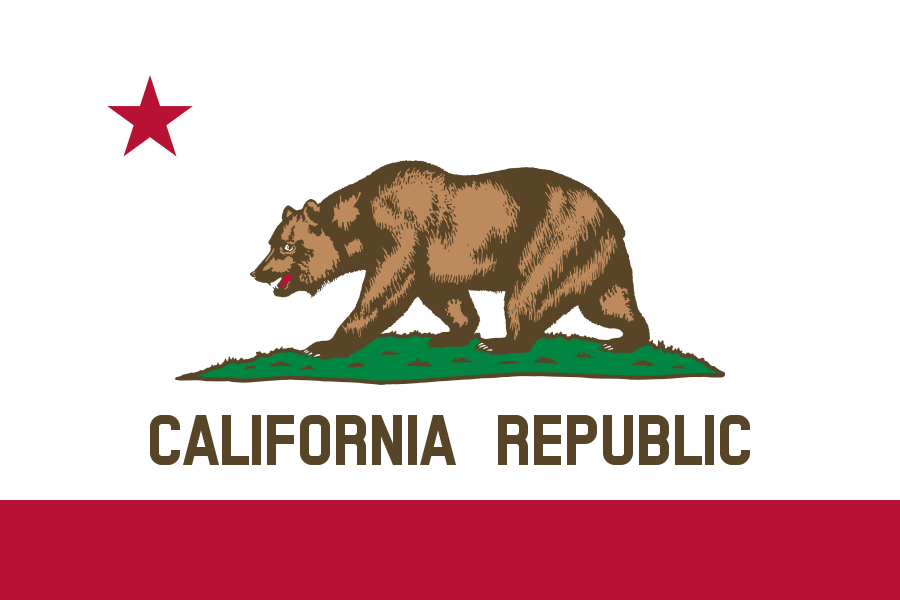
California is a U S state on the Pacific Coast...
Time is the continuous irreversible progression of existence from past...
The letter S or s is the th letter in...
Trending

2 months ago Kara Swisher's CNN docuseries explores longevity trends, tech, and living longer.

1 year ago Will Forte reflects on SNL, Alan Alda & Tina Fey reunite for Four Seasons.

1 month ago Rybakina Closes In on Sabalenka's No. 1 Ranking; Roddick Comments on Rybakina

8 months ago Mike Vrabel on Patriots' Defense and Primetime Matchup Against Bills

3 months ago Val Kilmer Returns to Film via AI in 'As Deep as the Grave'.

6 days ago Anna Kalinskaya faces Alina Korneeva in Roland Garros second round match.
Popular

Ken Paxton is an American politician and lawyer serving as...
Graham Cunningham Platner is an American oyster farmer and Marine...

Michael Joseph Jackson the King of Pop was a highly...

E Jean Carroll is an American journalist author and advice...
William Franklin Graham III known as Franklin Graham is an...

Blackpink is a South Korean girl group formed by YG...