History of Elephant bird in Timeline


The elephant bird (Aepyornis) was a group of massive, flightless birds that inhabited Madagascar until their extinction around 1,000 to 1,200 years ago. As members of the order Aepyornithiformes, they were among the largest birds to ever exist, with some species reaching heights of up to three meters and weighing over 500 kilograms. They were characterized by heavy, sturdy legs and small wings, making them incapable of flight. Their eggs were exceptionally large, significantly exceeding the size of ostrich eggs and remaining the largest eggs ever laid by any vertebrate. Genetic research suggests they were most closely related to the modern kiwi, despite the massive disparity in size. The extinction of the elephant bird is widely attributed to a combination of habitat loss and human activity, specifically overhunting by early settlers on the island. Their historical presence remains a significant subject of study in paleontology and evolutionary biology, offering insights into island gigantism and prehistoric ecosystem dynamics.
4 hours ago : Elephant Fire in California Grows to 6,436 Acres With 5% Containment
The Elephant Fire near Loyalton, California, has grown to 6,436 acres, forcing mandatory evacuation orders across Sierra, Lassen, and Plumas counties. Firefighters have achieved 5% containment as they battle the rapidly spreading blaze.


1934: Proposal of Mullerornithidae family
In 1934, Lamberton suggested that Mullerornis should be classified into a separate family known as Mullerornithidae, diverging from the traditional placement of all elephant birds within the single family Aepyornithidae.
1992: Discovery of the Cervantes Egg
In 1992, a complete Aepyornis maximus egg, known as the Cervantes egg, was discovered within dune deposits in southern Western Australia. This finding, alongside a similar egg found in the 1930s, supports scientific interest regarding the potential transoceanic transport of these specimens via the Antarctic Circumpolar Current.
2018: Systematic Review of Elephant Bird Taxonomy
In 2018, researchers Hansford and Turvey conducted a major systematic review using morphological analysis. This study proposed a reclassification of elephant birds, recognizing only four valid species: Aepyornis maximus, Aepyornis hildebrandti, Mullerornis modestus, and a newly established genus and species, Vorombe titan, which was categorized to account for the largest known remains of these birds.
2021: Radiocarbon dating study on Elephant bird extinction
In 2021, a scientific study indicated that elephant birds and Malagasy hippopotamuses likely went extinct between 800 and 1050 AD. The research suggests that human-induced environmental shifts, specifically the conversion of forests into grasslands through fire for cattle pastoralism, played a significant role in their decline. While theories regarding human hunting, egg consumption, and introduced hyperdiseases were discussed, the study highlighted the correlation between habitat loss and the disappearance of the species by 2021 analytical standards.
2022: Isotope Analysis of Elephant Bird Diet
In 2022, an isotope analysis study provided new insights into the dietary habits of elephant birds, suggesting that Aepyornis hildebrandti were likely mixed feeders with a significant grazing component, while other species such as A. maximus and Mullerornis modestus were likely browsers in forested environments.
2023: Takezaki et al. Phylogenetic Study
In 2023, Takezaki et al. conducted a study regarding the phylogenetic placement of elephant birds within the Palaeognathae group, providing significant genetic insights.
2026: Kück and Suh Phylogenetic Study
In 2026, researchers Kück and Suh published a study further refining the understanding of the evolutionary placement of elephant birds within the Palaeognathae lineage.
Mentioned in this timeline

Australia officially the Commonwealth of Australia is a country encompassing...
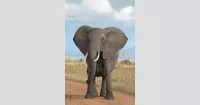
Elephants are the largest land animals on Earth with three...

Fire is a rapid oxidation process specifically combustion that releases...
Family is a fundamental social unit based on kinship or...
Trending

3 hours ago NASCAR O'Reilly Series Atlanta Qualifying and Race Schedule Details
4 hours ago Elephant Fire in California Grows to 6,436 Acres With 5% Containment
4 months ago Jay-Z's Yankee Stadium Anniversary Concert Sparks Ticket Frenzy with Sky-High Prices.

6 hours ago Aliyah Boston and Indiana Fever Teammates Showcase Stylish Pregame Outfits
6 hours ago James Norton Discusses His Role as Ormund Hightower in House of the Dragon

2 months ago Connecticut Sun Sold, Relocating to Houston in 2027 After NBA, WNBA Approval.
Popular

Lindsey Graham is a prominent American politician serving as the...

Cristiano Ronaldo widely considered one of the greatest footballers captains...

Mitch McConnell is a prominent American politician and the longest-serving...

Neymar J nior is a Brazilian professional footballer renowned for...

Candace Owens is an American conservative political commentator author and...

Bernie Sanders is a prominent American politician and the senior...