


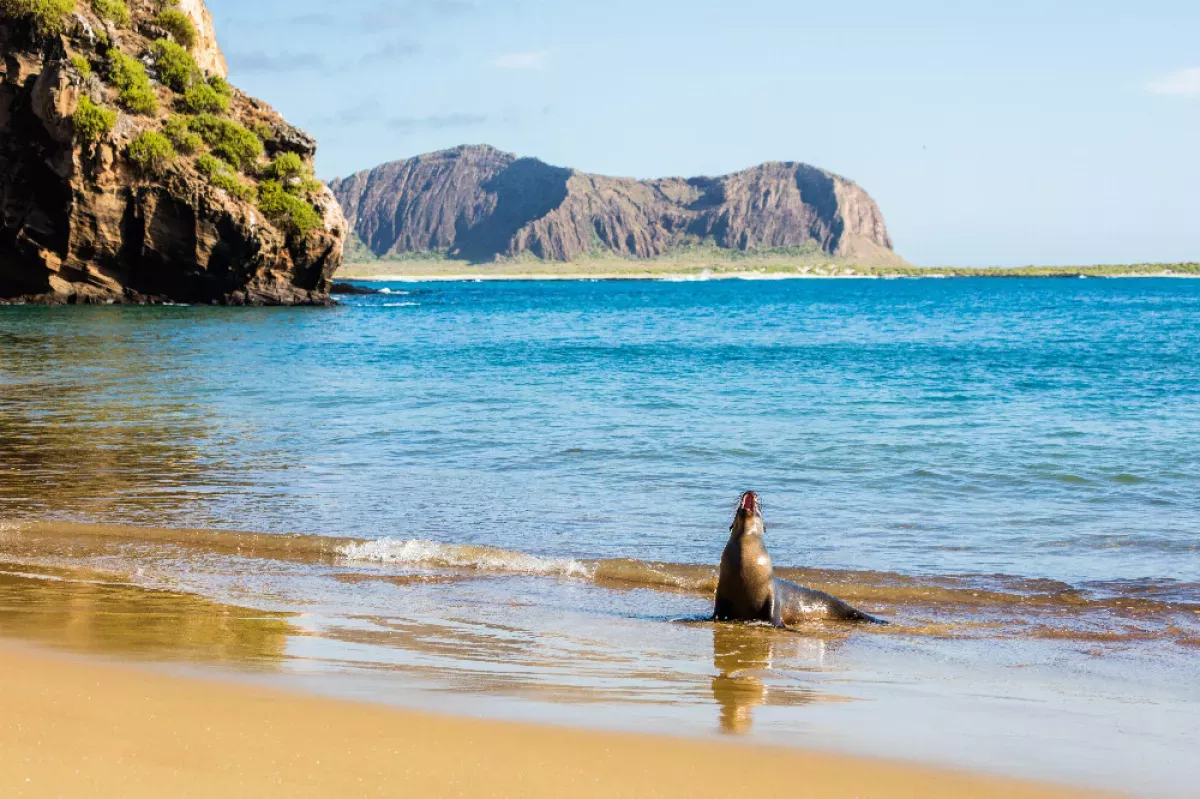
The Galápagos Islands are a volcanic archipelago in the Eastern Pacific, belonging to Ecuador. Located 900 km west of South America, they are renowned for their high number of endemic species. Famously, Charles Darwin studied the islands' unique wildlife in the 1830s, which significantly influenced his development of the theory of evolution by natural selection. With a population of over 33,000, the islands are divided into the cantons of San Cristóbal, Santa Cruz, and Isabela. The entire area is protected as Ecuador's Galápagos National Park and Marine Reserve, highlighting its ecological importance.
1903: Chilean Lieutenant Argues for Possessing Equatorial Islands
In 1903, Chilean lieutenant Gregorio Santa Cruz argued that possessing an island in equatorial waters, like the Galápagos, would be of great benefit to Chile.


September 1904: Academy of Sciences Expedition
From September 1904, an expedition of the Academy of Sciences of California, led by Rollo Beck, stayed in the Galápagos collecting scientific material.
1904: Assassination of Manuel Julián Cobos
In 1904, Manuel Julián Cobos was assassinated on San Cristóbal Island after exploiting lichen and attempting sugar cane plantation.
1906: Last eruption on Santiago Island
In 1906, Santiago Island experienced its last eruption.
1929: Ecuador seeks buyers for the islands
At least through 1929, cash-strapped Ecuador had reached out for potential buyers of the islands to alleviate financial troubles at home.
1930: First Protective Legislation
In 1930, the first protective legislation for the Galápagos Islands was enacted to safeguard the native flora and fauna.
1932: Templeton Crocker Expedition
In 1932, the Templeton Crocker Expedition from the Academy of Sciences collected insects, fish, shells, fossils, birds, and plants.
1936: Protective Legislation Supplemented
In 1936, the initial protective legislation for the Galápagos Islands was supplemented, aiming to further protect the flora and fauna.
1946: Penal Colony Established
In 1946, a penal colony was established on Isabela Island.
1952: Archaeological Survey by Heyerdahl and Skjølsvold
In 1952, Thor Heyerdahl and Arne Skjølsvold conducted an archaeological survey and found potsherds and other artifacts suggesting visitation by South Americans during the pre-Columbian era.
1955: Fact-Finding Mission Organized
In 1955, the International Union for the Conservation of Nature organized a fact-finding mission to the Galápagos Islands to assess the state of the flora and fauna.
1957: UNESCO Expedition Sent
In 1957, UNESCO, in cooperation with the government of Ecuador, sent an expedition to the Galápagos to study the conservation situation and select a site for a research station.
1959: Island Population
In 1959, approximately 1,000 to 2,000 people lived on the islands.
1959: Goats Introduced to Pinta Island
In 1959, fishermen introduced one male and two female goats to Pinta Island, leading to a significant population increase.
1959: National Park Declared
In 1959, the Ecuadorian government declared 97.5% of the Galápagos archipelago's land area a national park and the Charles Darwin Foundation (CDF) was founded to conduct research for effective management.
1959: Galápagos National Park Established
In 1959, the Galápagos National Park was established, marking the beginning of tourism expansion in the 1960s.
1959: Penal Colony Suspended
In 1959, the penal colony on Isabela Island was suspended.
1961: Volcanic Eruptions Begin
Between 1961 and 2011, the nine active volcanoes in the archipelago erupted 24 times.
1964: Charles Darwin Research Station Established
In 1964, the Charles Darwin Research Station was established on Santa Cruz Island to carry out conservation programs, such as eradication of introduced species and protection of native species.
1967: Goats Introduced to Marchena Island
In 1967, goats were introduced to Marchena Island, contributing to the problem of invasive species.
1968: Fernandina Caldera Collapse
In 1968, the caldera on Fernandina experienced the largest basaltic volcano collapse in history, due to a phreatomagmatic eruption.
March 1969: Variation of Rainfall in Santa Cruz
During March 1969, the precipitation over Charles Darwin Station on the southern coast of Santa Cruz was 249.0 mm (9.80 in), while on nearby Baltra Island the precipitation during the same month was only 137.6 mm (5.42 in).
April 1969: First Organized Tours Started
In April 1969, Forrest Nelson's Hotel Galápagos began the first organized tours in the Galápagos Islands, marking the start of regular air service and organized tourism.
1969: High Precipitation at Charles Darwin Station
In March 1969, precipitation at Charles Darwin Station was 249.0 mm, a particularly wet year.
1969: Variation of Precipitation in Santa Cruz Island
In the wet year of 1969, precipitation varied in different places on Santa Cruz Island.
March 1970: Low Precipitation at Charles Darwin Station
In March 1970, precipitation at Charles Darwin Station was only 1.2 mm, following a particularly wet March in 1969.
1971: Goats Introduced to Rabida Island
In 1971, goats were introduced to Rabida Island, further expanding the problem of invasive species in the Galápagos.
1972: Island Population
In 1972, a census in the archipelago recorded a population of 3,488.
February 1973: Galápagos Province Established
On February 18, 1973, the islands were administered as Ecuador's Galápagos Province by presidential decree during the administration of Guillermo Rodríguez Lara.
1973: Goat Population Estimated on Pinta Island
By 1973, the National Park service estimated the population of goats on Pinta Island to be over 30,000 individuals.
1978: UNESCO Recognizes Islands as World Heritage Site
In 1978, UNESCO recognized the Galápagos Islands as a World Heritage Site.
1982: Devastating El Niño
The devastating El Niño of 1982–83 saw almost six times as much rain as normal in the Galapagos and created a wildlife catastrophe.
1985: UNESCO Recognizes Islands as Biosphere Reserve
In 1985, UNESCO recognized the Galápagos Islands as a biosphere reserve.
1986: Marine Reserve Declared
In 1986, 70,000 square kilometers of ocean surrounding the Galápagos Islands was declared a marine reserve.
1990: Archipelago Becomes Whale Sanctuary
In 1990, the Galápagos archipelago was declared a whale sanctuary.
1991: Eruption on Fernandina Island
In 1991, Fernandina experienced eruptions, with recent eruptions in 1995, 2005, and 2009.
1992: Uplift at Sierra Negra Volcano
In 1992, Sierra Negra on Isabela Island began experiencing uplift, with a total of 240 cm of uplift recorded by 1998.
1993: Uplift at Alcedo Volcano
In 1993, Alcedo on Isabela Island had its most recent eruption and an uplift of greater than 90 cm.
1995: Eruption on Fernandina Island
In 1995, Fernandina experienced eruptions, with recent eruptions in 2005, and 2009.
1995: High Population Growth Rate
In 1995, the human population in the Galápagos Islands was growing at a rate of 8% per year, threatening the islands' biodiversity.
1996: Eradication Plan Commenced
In 1996, a US$5 million, five-year eradication plan commenced in an attempt to rid the Galápagos Islands of introduced species such as goats, rats, deer, and donkeys.
1997: El Niño Adversely Affected Wildlife
The 1997–98 El Niño adversely affected wildlife in the waters surrounding the Galápagos Islands, as the waters were 5 °C warmer than normal.
1998: Uplift at Sierra Negra Volcano
By 1998, Sierra Negra on Isabela Island had experienced a 240 cm (94 in) uplift since 1992 due to volcanic activity.
January 2001: Oil Slick Threatens Islands
In January 2001, an oil slick from a stranded tanker threatened the Galápagos Islands, but winds and shifting ocean currents helped disperse the oil before much damage was done.
December 2001: Marine Reserve Included as World Heritage Site
In December 2001, the UNESCO World Heritage Site designation for the Galápagos Islands was extended to include the marine reserve.
2001: Poachers Killed Sea Lions
In 2001, poachers killed 35 male sea lions in the Galápagos Islands.
2001: Oil Tanker Jessica Grounding
In 2001, the grounding of the oil tanker Jessica and the subsequent oil spill brought the threat of development to the world's attention.
2005: Eruption on Fernandina Island
In 2005, Fernandina experienced eruptions, with a recent eruption in 2009.
2005: Eruption at Sierra Negra Volcano
In 2005, Sierra Negra on Isabela Island had its most recent eruption.
2005: Last Sierra Negra Eruption
In June 2018, Sierra Negra erupted for the first time since 2005.
2006: Feral Animals Eliminated from Santiago and Isabela
By 2006, all feral pigs, donkeys, and non-sterile goats had been eliminated from Santiago and Isabela, the largest islands with the worst problems due to non-native mammals.
2006: Baltra Island Opens to Limited Camping
In 2006, the military governed Baltra Island was opened up to limited overnight camping, requiring permits from the military government for beach stays.
2006: Eradication Plan Completed
In 2006, the species eradication project was essentially completed in the Galápagos Islands, except for the rats. Rats have only been eliminated from the smaller Galápagos Islands of Rábida and Pinzón.
2007: Galápagos Islands Added to List of World Heritage in Danger
In 2007, UNESCO put the Galápagos Islands on their List of World Heritage in Danger because of threats posed by invasive species, unbridled tourism and overfishing.
January 2008: Sea Lions Killed
On 28 January 2008, 53 sea lions were found killed at the Galápagos Islands nature reserve on Pinta.
2008: Asia-Pacific Taxa Report
In 2008, a report by archeologists from the Australian National University stated that certain Asia–Pacific taxa may have been growing in the Galápagos prior to 1535.
2008: Most recent eruption of a volcano on Isabela Island
In 2008, a volcano on Isabela Island experienced its most recent eruption.
February 2009: Galápagos Islands Ranked First in New7Wonders of Nature
As of February 2009, the Galápagos Islands were ranked first in Group B, the category for islands, in the New7Wonders of Nature competition.
April 2009: Lava Flows on Fernandina Island
In April 2009, lava from the volcanic island of Fernandina started flowing towards the island's shoreline and into the center caldera.
2009: Eruption on Fernandina Island
In 2009, Fernandina experienced eruptions.
July 2010: Galápagos Islands Removed From List of Endangered Sites
In July 2010, the World Heritage Committee removed the Galápagos Islands from its list of precious sites endangered by environmental threats or overuse due to significant progress made by Ecuador.
July 2010: Galápagos Islands Removed From List of World Heritage in Danger
On 29 July 2010, the World Heritage Committee decided to remove the Galápagos Islands from the list because the Committee found significant progress had been made by Ecuador in addressing these problems.
2010: Galápagos Islands Population
In 2010, the population of the Galápagos Islands was recorded to be 25,124 people.
2011: Volcanic Eruptions End
Between 1961 and 2011, the nine active volcanoes in the archipelago erupted 24 times.
2012: Shift to Land-Based Tourism
By 2012, more than half of the visitors to the Galápagos Islands were using day boats and small hotels on the inhabited islands, making it a more accessible and economical travel option.
2012: Seymour Airport Renovation
Seymour Airport on Baltra underwent renovation in 2012-2013 to accommodate larger planes.
2013: Seymour Airport Renovation Complete
Seymour Airport on Baltra underwent renovation in 2012-2013 to accommodate larger planes.
2016: Reanalysis of Archaeological Sites
In 2016, a reanalysis of Heyerdahl and Skjølsvold's archaeological sites rejected their conclusions, suggesting artifacts were brought as souvenirs during Spanish occupation.
June 2018: Sierra Negra Eruption
In late June 2018, Sierra Negra, one of five volcanoes on Isabela, began erupting for the first time since 2005. Lava flows reached the coastline, leading to resident evacuations and tourist access restrictions.
2020: Galápagos Islands Population
In 2020, the Galápagos Islands had a population of slightly over 33,000 people. These islands form the Galápagos Province of Ecuador.
2021: Projected Population of Galapagos Islands
In 2021, the projected population of Galapagos Islands was 40,685.
May 2023: Debt-for-Nature Swap
In May 2023, Credit Suisse announced it would buy Ecuador's debt of $1.6 billion in a "Debt-for-nature swap" for Galapagos conservation.
2035: Bonds for Galapagos Conservation
In May 2023, Credit Suisse said it would sell 2035 bonds for Galapagos conservation at a reduced issue price as part of a "Debt-for-nature swap".
2040: Bonds for Galapagos Conservation
In May 2023, Credit Suisse said it would sell 2040 bonds for Galapagos conservation at a reduced issue price as part of a "Debt-for-nature swap".
Mentioned in this timeline
California is a U S state on the Pacific Coast...
The lion Panthera leo is a large cat species native...
Australia officially the Commonwealth of Australia is a country encompassing...
The Panama Canal is an -kilometer artificial waterway connecting the...

A hotel is a commercial establishment that provides short-term lodging...
Panama officially the Republic of Panama is situated at the...
Trending

4 hours ago Deebo Samuel Fantasy Football Value and Start Sit Advice for NFL Week 5
4 hours ago Denver Women's Tennis Teams Compete in ITA Mountain Regional Championships

5 hours ago Jameson Williams Critiques His Early Season Performance With Detroit Lions
5 hours ago Seattle Seahawks Sign Cornerback Trevon Diggs From Practice Squad
5 hours ago Elon Musk Promises Affordable Starlink Service in India Amid Feud with Mukesh Ambani
5 hours ago US Military Targets Cargo Vessels Amid Rising Tensions in Hormuz and Gulf of Oman
Popular

Ken Paxton is an American politician and lawyer serving as...

Jameis Winston is an American football quarterback currently playing for...

Cristiano Ronaldo widely considered one of the greatest footballers captains...

Michael Joseph Jackson the King of Pop was a highly...

Elon Musk is a visionary entrepreneur and engineer known for...

Shakira Isabel Mebarak Ripoll the Queen of Latin Music is...