


In basketball, the 'key' is a designated area on the court surrounding the basket. Officially known as the 'free throw lane' by organizations like the NBA, EuroLeague, NCAA, NAIA, and NFHS, it's also referred to as the 'restricted area' by FIBA. The key, also known as the lane, is a crucial space where significant gameplay unfolds.
1951: NBA widens the key
At the start of the 1951-52 NBA season, the key was widened from 6 feet to 12 feet to counter dominant centers.


1956: FIBA sanctioned tournaments use trapezoidal key
From 1956 until 2010, FIBA-sanctioned tournaments used a trapezoidal key, with the narrower end measuring 3.6 meters at the free-throw line and the wider end measuring 6 meters at the end line.
1964: NBA widens key further
In the 1964-65 NBA season, the key was widened to 16 feet to reduce the effectiveness of dominant centers like Wilt Chamberlain.
1997: Restricted area arc appears in the NBA
The restricted area arc rule first appeared at any level of competition in the NBA for the 1997-98 season.
April 25, 2008: FIBA Central Board approves key shape rule changes
On April 25, 2008, the FIBA Central Board approved changes to the shape of the key, making it rectangular with similar dimensions to the NBA key, and created the restricted area arc.
2008: FIBA rule amendments approved
In 2008, FIBA approved rule amendments to change the shape of the key to a rectangle and created the no-charge semicircle.
2010: FIBA tournaments use rectangular key
After the 2010 FIBA World Championship, all FIBA-administered tournaments began using a rectangular key 4.9 meters wide.
2010: FIBA rule amendments
Following the 2010 FIBA World Championship, FIBA rule amendments were implemented, changing the key to a rectangular shape of 16 feet wide for NBA and FIBA games.
2010: FIBA rule changes take effect
In 2010, the FIBA rule changes approved in 2008, including the rectangular key and the restricted area arc, took effect.
2010: Restricted area arc applied in NCAA men's basketball
In 2010, the restricted area arc rule was applied in NCAA men's basketball for the 2010-2011 season.
2011: NCAA adds visible restricted-area arc
For the 2011-2012 season, the NCAA approved adding a visible restricted-area arc three feet from the center of the basket in Division I men’s and women’s games.
2012: NCAA panel delays restricted area arc implementation for Divisions II and III
In 2012, the NCAA panel delayed the implementation of the restricted area arc until the 2012-2013 season for Divisions II and III to allow schools more time to plan and place the arc.
2013: NCAA Divisions II and III implement restricted area arc
In 2013, the NCAA Divisions II and III implemented the restricted area arc in their games, following a delay for planning and placement in home arenas.
2015: NCAA moves restricted area arc out to four feet
Starting with the 2015-2016 season, the NCAA moved the Restricted Area arc out to four feet from the center of the basket; the NAIA followed suit.
2016: NCAA moves restricted area arc out to four feet
Starting with the 2015-2016 season, the NCAA moved the Restricted Area arc out to four feet from the center of the basket; the NAIA followed suit in 2016.
Mentioned in this timeline
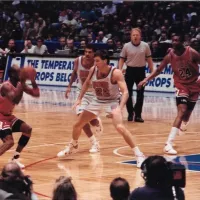
Basketball is a team sport played on a rectangular court...
Time is a fundamental dimension used to sequence events measure...
The letter S or s is the th letter in...
Trending

3 hours ago Troy Aikman Faces Uncertainty Amid Tense ESPN Contract Negotiations

3 hours ago Joe Montana's Historical NFL Impact and Collectible Market Trends

3 hours ago Bradley Cooper and Gigi Hadid Spark Marriage Rumors Amidst Matching Ring Sightings
3 hours ago Trade Rumors Circulate Regarding Indianapolis Colts Running Back Jonathan Taylor

3 hours ago Treylon Burks Returns to Action for Week 6 Matchup

3 hours ago Brock Purdy Masters Passing Techniques and Credits Defensive Scheme for Growth
Popular

Ilhan Omar is a prominent American politician currently serving as...

Ken Paxton is an American politician and lawyer serving as...

Elon Musk is a visionary entrepreneur and engineer known for...

Michael Joseph Jackson the King of Pop was a highly...

Cristiano Ronaldo widely considered one of the greatest footballers captains...

MrBeast the professional name of Jimmy Donaldson is the most-subscribed...