


Manaus is the capital and largest city of Amazonas, a state in Brazil. With an estimated 2024 population of over 2.2 million, it's Brazil's seventh-largest city. Located in the east centre of the state, near the confluence of the Negro and Amazon rivers, Manaus is the center of its metropolitan area and the largest in Brazil's North Region by urban landmass. It's one of only two Amazon rainforest cities with a population exceeding 1 million.
January 17, 1909: Foundation of the Federal University of Amazonas
On January 17, 1909, the Federal University of Amazonas, the oldest federal university in Brazil, was founded.


January 1913: Foundation of Nacional Futebol Clube
In January 1913, Nacional Futebol Clube, the most successful club in Manaus, was founded.
1913: Atlético Rio Negro Clube Founded
In 1913, Atlético Rio Negro Clube was founded. They have won the state championship 17 times.
November 18, 1918: São Raimundo EC Founded
On November 18, 1918, São Raimundo EC was founded. They have since won the state championship six times and the North Cup 3 times.
1932: Sul América Esporte Clube Founded
On 1 of May, 1932, Sul América Esporte Clube was founded.
October 23, 1951: National Congress approval of Free Trade Port project
On October 23, 1951, the Free Trade Port project was approved by the National Congress under No. 1.310.
August 1955: Temperature drop due to polar air masses
In August 1955, Manaus experienced a rare drop in temperature to 18 °C (64.4 °F) or below due to the influence of intense polar air masses.
June 6, 1957: Formalization of Free Trade Port idea
On June 6, 1957, the initial idea of a Free Trade Port in Manaus was formalized by Law No. 3.173.
February 2, 1960: Regulation of Free Trade Port project
On February 2, 1960, the Free Trade Port project was regulated by Decree No. 47.757.
1960: City population in 1960
In 1960, the population of Manaus was 343,038 inhabitants.
February 28, 1967: Redefinition of Manaus Free Trade Zone
On February 28, 1967, President Castelo Branco signed Decree-Law No. 288, redefining the Manaus Free Trade Zone and stipulating its radius and economic means for regional development.
August 28, 1967: Creation of Manaus Free Trade Zone Authority
On August 28, 1967, the Manaus Free Trade Zone Authority (SUBFRAME) was created as an independent body with legal status, assets, and financial autonomy.
1967: Manaus Free Trade Zone introduction
In 1967, the Manaus Free Trade Zone was introduced, leading to a period of financial and economic investments and significant demographic growth for Manaus.
1970: City population in 1970
By 1970, the population of Manaus had grown to 622,733 inhabitants.
1970: Northeastern Championship Runners-up
In 1970, National Fast Club were Northeastern Championship runners-up.
1970: Inauguration of the Vivaldão
In 1970, the Vivaldão was inaugurated by the Brazilian national team before their victorious 1970 World Cup in Mexico.
1970: Participant of highest division
Nacional Futebol Clube was a participant of the highest division several times starting in 1970.
1982: Fitzcarraldo film scenes
In 1982, the Teatro Amazonas was used in scenes of the Werner Herzog film Fitzcarraldo.
September 9, 1986: José Aldo Born
José Aldo, a black belt in Brazilian jiu-jitsu and notable UFC fighter, was born on September 9, 1986.
1989: Illegally cleared areas
In 1989, some areas were illegally cleared.
1989: Lowest temperature registered
In 1989, the lowest temperature registered in Manaus was 12 °C (53.6 °F), according to the National Institute of Meteorology (INMET).
1990: City population in 1990
By 1990, the population of Manaus had reached 1,025,979 inhabitants, with a density of 90 inhabitants per square kilometre.
1990: Participant of highest division
Nacional Futebol Clube was a participant of the highest division several times ending in 1990.
1992: State Championship Won
In 1992, Sul América Esporte Clube won the state championship.
1992: Creation of ecological area
In 1992, an urban area in the November 10 Park district was created to be an area of ecological interest.
1993: State Championship Won
In 1993, Sul América Esporte Clube won the state championship.
1996: Atlético Clipper Clube Runners-up
In 1996, Atlético Clipper Clube finished as runners-up in the state championship.
1997: Reopening of the Teatro Amazonas
After being closed for almost 90 years, the Teatro Amazonas reopened in 1997 to produce live opera, attracting performers from around the world.
2002: Atlético Clipper Clube Runners-up
In 2002, Atlético Clipper Clube finished as runners-up in the state championship.
December 14, 2004: Opening of third cargo terminal at Eduardo Gomes International Airport
On December 14, 2004, Infraero opened the third cargo terminal at Eduardo Gomes International Airport, Brazil's third largest in freight movement.
2007: Eastern region population
In 2007, the eastern region of Manaus was the most populated, with approximately 600,000 inhabitants.
2008: Inauguration of cargo terminal by TAM Airlines
In 2008, TAM Airlines inaugurated its own cargo terminal near the airport, claiming it to be the largest in Brazil.
November 26, 2009: Case of acid rain
On November 26, 2009, a case of acid rain was recorded in Manaus, caused by air pollution from smoke and sulfur dioxide emitted by cars, exacerbated by drought and forest fires.
2009: Chosen as Host City for 2014 FIFA World Cup
In 2009, Manaus was chosen to be a host city for the 2014 FIFA World Cup, representing the North Region of Brazil.
2013: Genetic ancestry study
According to a 2013 genetic study, the ancestry of Manaus inhabitants is 45.9% European, 37.8% Native American, and 16.3% African.
2013: Manaus Futebol Clube Founded
In 2013, Manaus Futebol Clube was founded and competes in the Campeonato Brasileiro Série C.
2014: GDP statistics
According to IBGE in 2014, Manaus' GDP was R$67,5 billion, with a per capita income of R$33,446.
2014: 2014 FIFA World Cup Matches Held in Manaus
In 2014, Manaus hosted World Cup matches including England vs Italy on June 14, Cameroon vs Croatia on June 18, USA vs Portugal on June 22, and Honduras vs Switzerland on June 25. Manaus also hosted the first-ever official water break during the USA vs Portugal match on June 22.
2014: Host City for 2014 FIFA World Cup
In 2014, Manaus served as a host city for the FIFA World Cup.
2014: Arena Amazônia for the 2014 World Cup
In 2014, the 44,000-seater Arena Amazônia replaced the Vivaldão for the World Cup.
2014: 2014 World Cup Host City
Manaus was one of the twelve Brazilian host cities of the 2014 World Cup.
2014: Plans to restore the city centre
Plans were prompted by the 2014 World Cup to restore the Manaus city centre to its former glory, by removing beggars and irregular sellers from sidewalks and providing more safety for tourists and locals in the historical areas.
2015: Highest temperature registered
In 2015, the highest temperature registered in Manaus was 39 °C (102.2 °F), according to the National Institute of Meteorology (INMET).
2016: 2016 Summer Olympics Host City
In 2016, Manaus was one of the six host cities for football matches at the Summer Olympics.
January 2017: Massive prison riot
In January 2017, a massive prison riot began in Manaus and spread to two other cities in Brazil, creating security problems within the country.
2019: Population statistics
According to the IBGE in 2019, Manaus had 2,182,763 residents, with 2,676,936 people in the Metropolitan Region. The population density was 191.45 inhabitants per square kilometre.
2019: Petrification Event in Dr. Stone
In 2019, the anime and manga Dr. Stone depicts an explosion near Manaus causing the petrification of all humans on earth.
January 2021: Second COVID-19 outbreak with new variant
In early January 2021, Manaus experienced a second outbreak of COVID-19, this time with the Lineage B.1.1.248 variant.
2024: Estimated Population
In 2024, Manaus had an estimated population of 2,279,686, making it the seventh-largest city in Brazil.
Mentioned in this timeline
England a constituent country of the United Kingdom occupies roughly...
FIFA or the F d ration Internationale de Football Association...
Football commonly known as soccer in many regions is the...
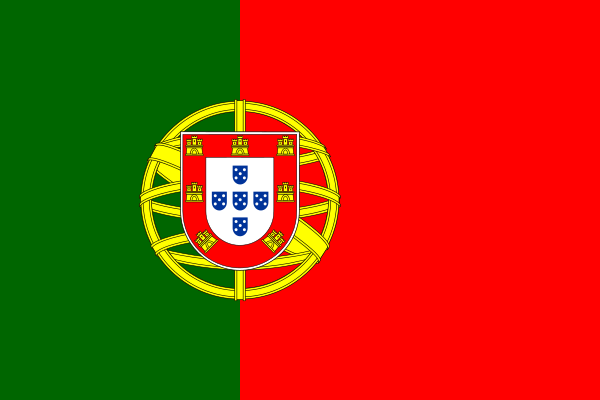
Portugal is a unitary republic located on the Iberian Peninsula...
Mexico officially the United Mexican States is a North American...
Italy officially the Italian Republic is a country in Southern...
Trending

3 hours ago 2026 MLB Wild-Card Series Day 2 Updates and Game Highlights
3 hours ago Miguel Vargas Featured in MLB Wild Card Home Run Prop Predictions and Betting Analysis
3 hours ago Munetaka Murakami Leads Chicago White Sox to First MLB Postseason Appearance

4 hours ago Sonny Gray Takes the Mound for Critical Game 2 Against the Yankees

4 hours ago Max Fried Prepares for Crucial Yankees Game 2 Start During Postseason Run

1 day ago 4-Star Defensive Back Jordan Hicks Enjoys First Recruiting Visit to Alabama
Popular

Jameis Winston is an American football quarterback currently playing for...

Ken Paxton is an American politician and lawyer serving as...

Shakira Isabel Mebarak Ripoll the Queen of Latin Music is...

Sylvester Stallone is an iconic American actor screenwriter and filmmaker...

Michael Joseph Jackson the King of Pop was a highly...

Peter Thiel is a prominent American entrepreneur venture capitalist and...