History of NCAA basketball championships (Philippines) in Timeline


The NCAA basketball championships in the Philippines comprise two main tournaments: the seniors' division for male college students and the juniors' division for male senior high school students. These tournaments typically run concurrently. A notable achievement is winning both championships in the same season, referred to as achieving the 'double championship.' The NCAA basketball championships are a significant part of the Philippine collegiate sports scene, fostering competition and showcasing young basketball talents.
1924: NCAA Foundation
In 1924, the NCAA championship was founded and has been continually contested since then, with exceptions.


1925: Double Championship Definition
In 1925, when a school wins both the Juniors (or Midgets pre-1925) and Seniors tournament at the same season, the school is said to have won the double championship.
1970: Marlon Bola Bola's Single-Game Record
In 1970, Marlon Bola Bola of the Letran Squires held the single-game record of 71 points.
1974: Lim Eng Beng's Record-Breaking Performance
In the 1974 season, Lim Eng Beng of the De La Salle Green Archers scored 55 points in an NCAA seniors' game, leading his team to the championship. He averaged 32 points that season, setting an all-time record in average points per game in Philippine Men's NCAA.
1976: National Inter-Secondary Champion Team
In 1976, some of the Letran team players, who were products of their Varsity High School Team, were part of the National Inter-Secondary Champion Team held in Baguio City, where they beat San Beda College with a score of 52-51.
1979: Double Championship and General Champions
During the 1979 NCAA season, Colegio de San Juan de Letran achieved a double championship by winning both the Juniors and Seniors divisions of the NCAA Basketball Championship. The Knights were also declared General Champions after accumulating the highest overall points.
1980: Tournament Aborted
In 1980, the NCAA tournament was aborted by the Basketball Association of the Philippines.
1997: Double Round Elimination
From 1997 to 2024, all member schools have been participating in a double round elimination tournament, leading to the Final Four.
1997: Stable Tournament Format
From the end of World War II until 1997, the tournament format has been stable. Since 1997, the tournament format has remained stable, with occasional one-game playoffs for tied teams.
1997: Split Season Format Before 1997
Prior to 1997, with six teams for most of its history, the NCAA employed a split season format where the first-round winner secured a Final berth, and the second-round winner secured the other.
September 5, 2008: Keith Agovida's Record
On September 5, 2008, Keith Agovida scored 82 points against the Malayan Red Robins.
2008: Best-of-Three Finals Series
Until 2008, the finals was in a best-of-three series even if a team swept the elimination round. Previously, the first seed holds a twice to beat advantage in the finals.
2009: Joshua Saret Breaks Scoring Record
In 2009, Joshua Saret of the JRU Light Bombers scored 89 points against the AUF Baby Danes, breaking the all-time high mark set by Keith Agovida on September 5, 2008.
2010: Thrice-to-beat Advantage
Since 2010 the team who sweeps the elimination round will automatically go to the finals with a thrice-to-beat advantage and a 1-0 edge over their opponent.
2019: Separate Category for Foreigners
Until NCAA Season 95 (2019), players of all nationalities were eligible for all awards. In 2019, a separate category was created for foreign players.
2020: Rosters Restricted to Filipinos
From NCAA Season 96 (2020) onwards, rosters were restricted to Filipinos.
2020: COVID-19 Pandemic Impact
In 2020, the NCAA championship was interrupted due to the COVID-19 pandemic.
2021: Postponement of NCAA Season 97
In 2021, NCAA Season 97 was postponed to early 2022 due to the effects of the COVID-19 pandemic, and the juniors' tournament was cancelled.
2021: COVID-19 Pandemic Interruption
In 2021, the NCAA championship was still interrupted due to the COVID-19 pandemic.
2021: Special Tournament Format
The 2021 NCAA tournament, which was held in early 2022, featured a special format with one round of eliminations and a play-in tournament for teams finishing third to sixth, followed by the regular Final Four format.
2022: NCAA Season 98 and Schedule Changes
In 2022, NCAA Season 97's men's tournament, postponed from 2021, was played early in the year, while the juniors' tournament was cancelled. The men's tournament of NCAA Season 98 was then played from September to December, and the juniors' tournament from January to March.
2022: 2021 Tournament Held in Early 2022
In early 2022, the 2021 NCAA tournament was held using a special format that included a single round of eliminations, a play-in tournament, and the regular Final Four format.
2023: Schools with Double Championship
As of 2023, only seven schools were able to win the double championship.
2024: Double Round Elimination
From 1997 to 2024, all member schools have been participating in a double round elimination tournament, leading to the Final Four.
2025: Reversion to Concurrent Tournaments
In 2025, NCAA Season 101 reverted back to holding both the men's and juniors' tournaments concurrently.
2025: Modification of Tournament Format
In 2025, the NCAA announced a modification of the overall format of both the men's and juniors' tournaments in response of Metro Manila hosting the 2025 FIVB Men's Volleyball World Championship.
2027: Evaluation of Current Format
The current format is in a three-year trial period that will be used until Season 103 (2027–28) to evaluate its long-term viability.
Mentioned in this timeline
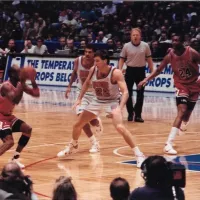
Basketball is a team sport played on a rectangular court...

World War II - was a global conflict between the...

The Philippines is an archipelagic nation in Southeast Asia situated...

War is defined as an armed conflict involving the armed...

September is the ninth month of the year in the...
Time is a fundamental dimension used to sequence events measure...
Trending

3 hours ago Billy Crystal Reflects on Tragedy and New Broadway Show

4 hours ago Brian Austin Green Explains Absence From Sharna Burgess Dancing with the Stars Performances
4 hours ago Knicks Likely to Release Former Champion James Wiseman Amid Roster Adjustments

4 hours ago Adam Levine Selects Alex Warren as Advisor for The Voice
4 hours ago Jalen Smith Sentenced to Six Years Over NCAA Point Shaving Scheme
4 hours ago Travis Bazzana Faces Elimination in High-Stakes American League Championship Series Action
Popular

Ken Paxton is an American politician and lawyer serving as...

Ilhan Omar is a prominent American politician currently serving as...

Jameis Winston is an American football quarterback currently playing for...

Cristiano Ronaldo widely considered one of the greatest footballers captains...

Elon Musk is a visionary entrepreneur and engineer known for...

Michael Joseph Jackson the King of Pop was a highly...