


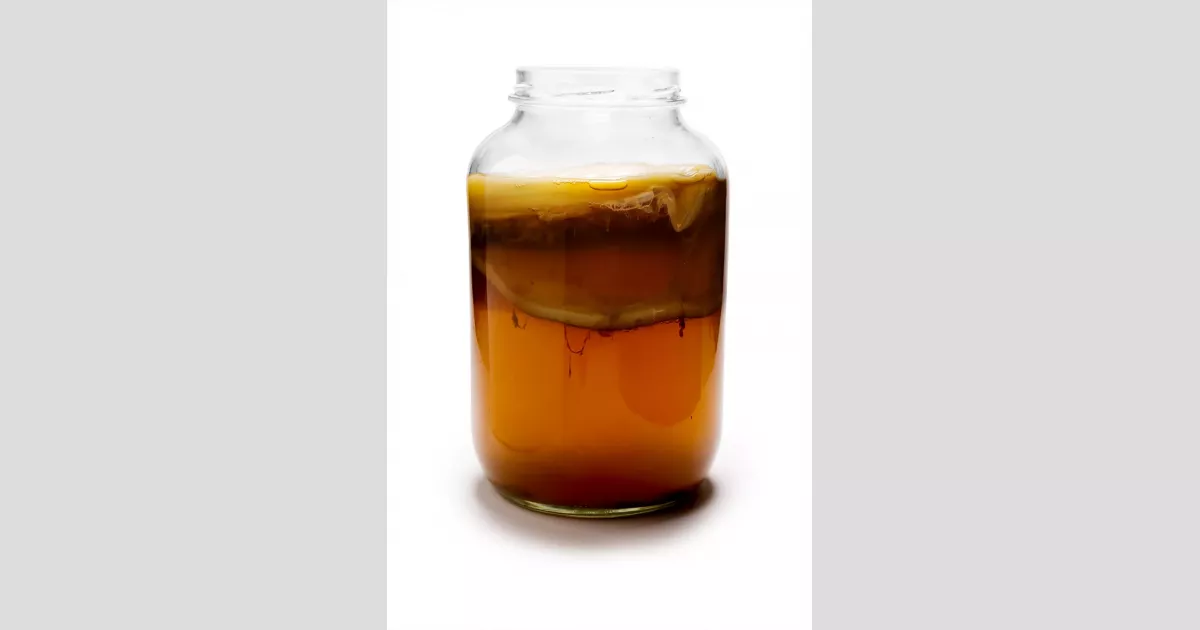
Kombucha is a fermented, slightly fizzy, sweetened black tea beverage. It may be called kombucha tea to differentiate it from the symbiotic culture of bacteria and yeast (SCOBY) used in its production. Flavorings such as juice, spices, or fruit are commonly added to enhance its taste.
1944: First Known English Use
In 1944, the word kombucha was first used in the English language to describe "a gelatinous mass of symbiotic bacteria (as Acetobacter xylinum) and yeasts (as of the genera Brettanomyces and Saccharomyces) grown to produce a fermented beverage held to confer health benefits".


1975: Popularization of Kōcha Kinoko
Around 1975, kōcha kinoko (紅茶キノコ, 'black tea mushroom') was popularized, potentially leading to confusion in the etymology of kombucha.
2003: Review of Adverse Effects
According to a 2003 review, reports of adverse effects related to kombucha consumption are rare, but may be underreported.
2003: Review of Health Claims
In a 2003 review, physician Edzard Ernst characterized kombucha as an "extreme example" of an unconventional remedy due to the disparity between implausible health claims and potential risks, concluding that the proposed therapeutic claims did not outweigh known risks.
2009: American Cancer Society Statement
The American Cancer Society said in 2009 that "serious side effects and occasional deaths have been associated with drinking Kombucha tea."
2010: Elevated Alcohol Levels in Bottled Kombucha
In 2010, elevated alcohol levels were found in many bottled kombucha products, leading retailers to temporarily remove the drinks from store shelves. Suppliers responded by reformulating their products to have lower alcohol levels. This event took place in 2010.
2014: US Bottled Kombucha Sales
By 2014, US sales of bottled kombucha reached $400 million. In 2014, Kombucha Brewers International was formed.
2015: Description of Kombucha Culture
As of 2015, the mixed culture in Kombucha has been further described as being lichenous, in accord with the reported presence of the known lichenous natural product usnic acid.
2015: Alcohol Content Issues in Kombucha
Prior to 2015, some commercially available kombucha brands were found to contain alcohol content exceeding legal thresholds, leading to the development of new testing methods. This event took place in 2015.
2016: PepsiCo Acquires KeVita
In 2016, PepsiCo purchased kombucha maker KeVita for approximately $200 million.
2017: Rise in Sales of Fermented Drinks
In 2017, sales of kombucha and other fermented drinks in the US rose by 37 percent.
2019: Review of Potential Health Risks
A 2019 review enumerated numerous potential health risks but stated that "kombucha is not considered harmful if about 4 oz [120 mL] per day is consumed by healthy individuals."
2019: Global Market Size of Kombucha
In 2019, kombucha had a global market size of US$1.67 billion, according to Grand View Research.
2019: Global Kombucha Market Value
In 2019, the global kombucha market was valued at approximately US$1.7 billion.
2021: Kombucha Popularity in India
As of 2021, kombucha had some popularity in India's National Capital Region, partly due to its success in the west.
2030: Projected Global Market Size of Kombucha
The global market size of Kombucha is expected to grow to US$9.7 billion by 2030.
Mentioned in this timeline

India officially the Republic of India is a South Asian...
Trending

3 hours ago Tyson Fury Versus Anthony Joshua Showdown Tickets Sell Out Rapidly

4 hours ago OpenAI and AI Leaders Develop Crisis Response Strategies for Potential Catastrophic Events
4 hours ago Debating the Influence of Digital Culture on Modern Societal Intelligence and Reading Habits

5 hours ago SpaceX Disrupts Telecommunications Industry with Major Low-Band Spectrum Acquisition Plans

5 hours ago Mirra Andreeva Advances to China Open Semifinals After Victory Over Alexandrova

5 hours ago ATP Shanghai Tennis Tournament Schedule and Round Two Match Predictions
Popular

Ken Paxton is an American politician and lawyer serving as...

Cristiano Ronaldo widely considered one of the greatest footballers captains...
Michael Joseph Jackson the King of Pop was a highly...

Elon Musk is a visionary entrepreneur and engineer known for...

Jameis Winston is an American football quarterback currently playing for...

Shakira Isabel Mebarak Ripoll the Queen of Latin Music is...