


A truck, also known as a lorry, is a motor vehicle primarily designed for transporting freight, carrying specialized payloads, or performing utilitarian tasks. Trucks come in diverse sizes, power levels, and configurations, typically featuring a body-on-frame construction with a distinct cabin and payload area. Smaller trucks share mechanical similarities with cars. Commercial trucks can be large and powerful, equipped with specialized equipment like concrete mixers or fire-fighting apparatuses. In American English, a commercial vehicle without a trailer is a 'straight truck,' while a vehicle designed to pull a trailer is a 'tractor'.


1903: Eldridge builds early American truck
In 1903, George Eldridge of Des Moines, Iowa, built an early American truck powered by an engine with two opposed cylinders and a chain drive. A 1903 Eldridge truck is displayed at the Iowa 80 Trucking Museum in Walcott, Iowa.
1911: Usage of lorry for self-propelled vehicles
Since 1911, the expanded meaning of lorry, "self-propelled vehicle for carrying goods", has been in usage.
1923: Benz introduces diesel engine in trucks
In 1923, Benz introduced the diesel engine in production trucks, despite the diesel engine having been invented in 1897.
1930: Expanded usage of "truck"
Since 1930, the expanded application of "truck" to mean "motor-powered load carrier" has been in usage, shortened from "motor truck", which dates back to 1901.
1935: End of steam-powered wagons in the UK
In 1935, a change in road tax rules in the United Kingdom made steam-powered wagons uneconomical compared to the new diesel lorries, leading to the end of their use.
1939: Autocar launches the "DC" model
In 1939, Autocar launched the "DC" model (diesel conventional) due to the high demand for diesel engines in heavy applications in the United States.
1997: Driving license weight reduction
For licenses first acquired after 1997, the weight limit for driving vehicles for commercial purposes without a specialist license was reduced to 3.5 t (3.4 long tons; 3.9 short tons), not including trailers.
2002: Fatalities related to trucking accidents
In 2002, there were over 5,000 fatalities related to trucking accidents in the United States.
2004: Fatalities related to trucking accidents
In 2004, there were over 5,000 fatalities related to trucking accidents in the United States.
2006: US trucking industry employment
In 2006, the US trucking industry employed 1.8 million drivers of heavy trucks.
2008: Trucking industry lowers fatality rate
In 2008, the trucking industry had successfully lowered the fatality rate to just over 4,000 deaths, but trucking accidents are still an issue that causes thousands of deaths and injuries each year.
March 2012: Launch of InTANDEM road safety competition
Following pressure from The Times "Cities Fit For Cycling" campaign, in March 2012, the InTANDEM road safety competition was launched to advocate extra care when passing a large vehicle on the nearside, leading to warning signs being displayed on heavy goods vehicles (HGV) to prevent accidents with cyclists.
2013: C1 license category allows driving vehicles over 3.5 and up to 7.5 tonnes
Since 2013, the C1 license category allows driving vehicles over 3.5 and up to 7.5 tonnes. The C license category allows driving vehicles over 3.5 tonnes with a trailer up to 750 kg, and the CE category allows driving category C vehicles with a trailer over 750 kg.
2018: Fatal crashes involving large trucks and buses in the US
In 2018, in the US, 5,096 large trucks and buses were involved in fatal crashes.
2019: Alternative technologies compete with diesel engines
As of 2019, several alternative technologies are competing to displace the use of diesel engines in heavy trucks, with CNG engines widely used in specific industries but limited in broader freight hauling applications due to range limitations.
2021: Heavy electric and hydrogen-powered trucks enter the market
In 2021, heavy electric trucks and hydrogen-powered trucks are new to the market, attracting interest from major freight haulers as part of the broader phase-out of fossil fuel vehicles.
2021: CO2 emissions from medium and heavy trucks
In 2021, over 1700 million tonnes of global transport CO2 emissions were from medium and heavy trucks. Many countries are further restricting truck CO2 emissions to help limit climate change.
2022: Trucks contribute to pollution
As of 2022, trucks contribute to air, noise, and water pollution. Most trucks run on diesel, and diesel exhaust is especially dangerous for health. Some countries outside the EU have different vehicle emission standards for trucks and cars.
2030: Pledge for zero emission trucks and buses
Several countries have pledged that 30% of sales of trucks and buses will be zero emission by 2030.
Mentioned in this timeline
The United States of America is a federal republic primarily...

Michigan is a state in the Great Lakes region of...
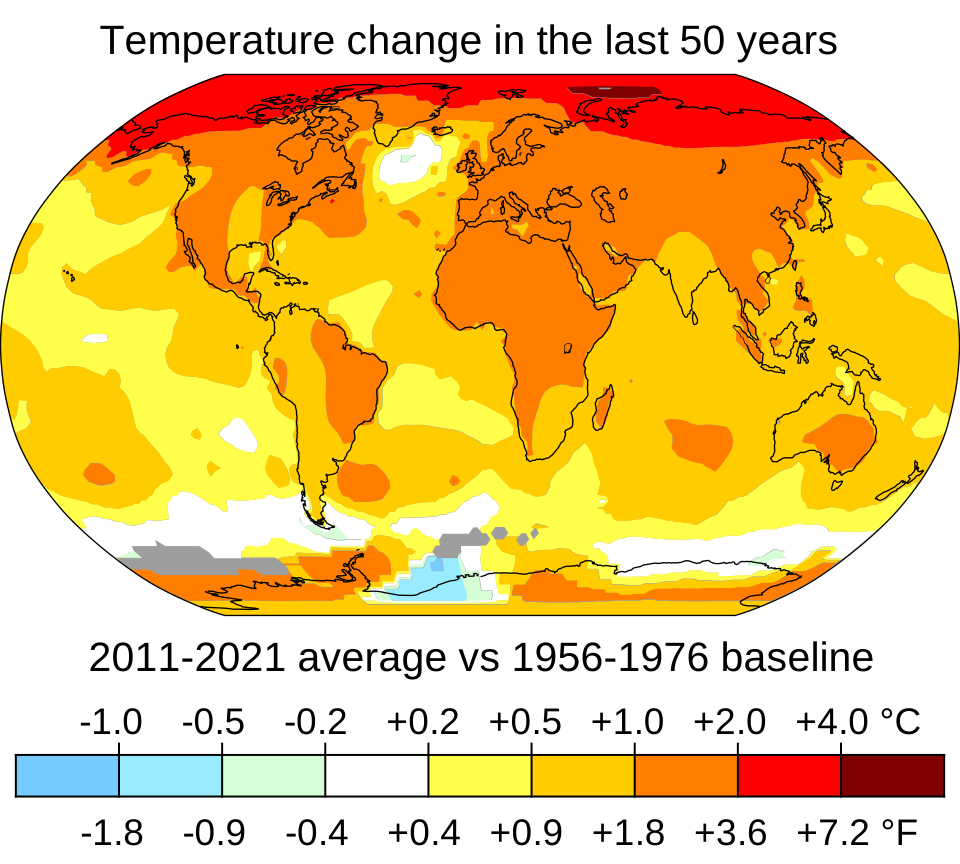
Climate change refers to long-term shifts in global temperatures and...

Iowa is a state in the U S Midwest bordered...
Twice is a highly successful South Korean girl group formed...
The letter S or s is the th letter in...
Trending
4 hours ago Eight Injured in South Korea Supermarket Stabbing Attack

4 hours ago Zeynep Sönmez Competes at Wuhan Open Against Yulia Putintseva

4 hours ago Alexander Bublik Smashes Racket Five Times During Wild Shanghai Masters Outburst
5 hours ago Sorana Cîrstea Returns to WTA Circuit at Wuhan Open

5 hours ago WTA Wuhan Open Tennis Match Predictions and Analysis

5 hours ago Maja Chwali?ska Competes Against Mayar Sherif at the WTA Tournament in Wuhan
Popular

Ken Paxton is an American politician and lawyer serving as...

Cristiano Ronaldo widely considered one of the greatest footballers captains...

Jameis Winston is an American football quarterback currently playing for...

Michael Joseph Jackson the King of Pop was a highly...

Elon Musk is a visionary entrepreneur and engineer known for...

Ilhan Omar is a prominent American politician currently serving as...