


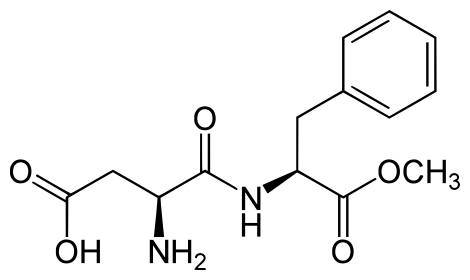
Aspartame is an artificial sweetener, roughly 200 times sweeter than sucrose, widely used in food and beverages as a sugar substitute. Chemically, it is the methyl ester of aspartic acid/phenylalanine dipeptide and is marketed under brand names like NutraSweet and Equal. Discovered in 1965, it gained approval from the FDA in 1974, although this was briefly revoked before being re-approved in 1981.
1965: Accidental Discovery of Aspartame
In 1965, James M. Schlatter, a chemist, accidentally discovered aspartame's sweet taste while working for G.D. Searle & Company.


1965: Aspartame Discovered
In 1965, aspartame was discovered as an artificial sweetener, being 200 times sweeter than sucrose.
1974: FDA Approved Aspartame
In 1974, aspartame was initially approved by the US Food and Drug Administration (FDA).
1975: FDA Task Force Review of Aspartame Studies
In 1975, an FDA task force team reviewed 25 studies submitted by the manufacturer, including 11 on aspartame and reported "serious deficiencies in Searle's operations and practices".
1979: CFSAN Concluded Aspartame Studies Could Be Used
In 1979, the Center for Food Safety and Applied Nutrition (CFSAN) concluded that many problems with the aspartame studies were minor and did not affect the conclusions and the studies could be used to assess aspartame's safety.
1980: Public Board of Inquiry recommended against approving aspartame
In 1980, the FDA convened a Public Board of Inquiry (PBOI) and it concluded aspartame does not cause brain damage, but it recommended against approving aspartame at that time, citing unanswered questions about cancer in laboratory rats.
1981: Aspartame Re-approved
In 1981, aspartame was re-approved by the FDA after its initial approval was briefly revoked.
1983: FDA Approved Aspartame in Carbonated Beverages
In 1983, the FDA approved aspartame for use in carbonated beverages.
1985: Monsanto Bought G.D. Searle
In 1985, Monsanto bought G.D. Searle, and the aspartame business became a separate Monsanto subsidiary, NutraSweet.
1987: European Use Patents Expired
In 1987, European use patents on aspartame expired.
1993: FDA Approved Aspartame for Baked Goods and Confections
In 1993, the FDA approved aspartame for use in other beverages, baked goods, and confections.
1994: EU-Wide Approval of Aspartame
In 1994, aspartame received EU-wide approval.
1996: FDA Removed All Restrictions from Aspartame
In 1996, the FDA removed all restrictions from aspartame, allowing it to be used in all foods.
March 2000: Monsanto Sold NutraSweet
In March 2000, Monsanto sold NutraSweet to J.W. Childs Associates Equity Partners II L.P.
2000: Ajinomoto acquired Aspartame business
In 2000, Ajinomoto acquired its aspartame business from Monsanto for $67 million.
2002: SCF Reaffirmed Aspartame Approval
In 2002, the Scientific Committee on Food (SCF) reviewed subsequent safety studies and reaffirmed the approval of aspartame.
2004: Aspartame and Sucralose Prices
In 2004, aspartame traded at about $30 per kilogram and sucralose traded at around $300 per kilogram.
2004: Aspartame Market Size
In 2004, the market for aspartame, in which Ajinomoto had a 40% share, was 14,000 metric tons a year.
2006: EFSA Reaffirmed Acceptable Daily Intake
In 2006, The European Food Safety Authority (EFSA) reported that the previously established Acceptable daily intake (ADI) was appropriate, after reviewing yet another set of studies.
2006: Holland Sweetener Company Left Industry
In 2006, the Holland Sweetener Company left the sweetener industry due to oversupply and price erosion.
2007: Asda Removed Artificial Additives
In 2007, Asda was the first British supermarket chain to remove all artificial flavourings and colours in its store brand foods.
2008: Ajinomoto Sued Asda
In 2008, Ajinomoto sued Asda for a malicious falsehood action concerning its aspartame product when the substance was listed as excluded from the chain's product line.
July 2009: British Court Ruled in Favor of Asda
In July 2009, a British court ruled in favor of Asda in the lawsuit with Ajinomoto.
November 2009: Ajinomoto Announced AminoSweet
In November 2009, Ajinomoto announced a new brand name for its aspartame sweetener — AminoSweet.
June 2010: Appeals Court Reversed Decision
In June 2010, an appeals court reversed the decision, allowing Ajinomoto to pursue a case against Asda to protect aspartame's reputation.
2011: Lawsuit Settled
In 2011, the lawsuit was settled with Asda choosing to remove references to aspartame from its packaging.
December 2013: EFSA Ruled out Cancer Risk
In December 2013, the EFSA released a report stating that after examining the evidence, it ruled out the "potential risk of aspartame causing damage to genes and inducing cancer" and deemed the amount found in diet sodas safe to consume.
2017: Clinical Trials Review on Aspartame
As of 2017, reviews of clinical trials showed that using aspartame reduces calorie intake and body weight in adults and children.
2019: American Academy of Pediatrics Policy Statement
In 2019, a policy statement by the American Academy of Pediatrics concluded that there were no safety concerns about aspartame in fetal or childhood development or as a factor in attention deficit hyperactivity disorder.
2021: FDA Disagreed with IARC Classification
In 2021, the FDA reviewed the scientific information included in IARC's review and identified significant shortcomings in the studies on which IARC relied, disagreeing with IARC's conclusion that these studies support classifying aspartame as a possible carcinogen to humans.
May 2023: FDA Stated Aspartame Safe
As of May 2023, the FDA stated that it regards aspartame as a safe food ingredient when consumed within the acceptable daily intake level of 50 mg per kg of body weight per day.
July 2023: IARC Classified Aspartame as Possibly Carcinogenic
In July 2023, scientists for the International Agency for Research on Cancer (IARC) concluded that there was "limited evidence" for aspartame causing cancer in humans, classifying the sweetener as Group 2B (possibly carcinogenic).
2023: Regulatory Agencies Concluded Aspartame Safe
As of 2023, regulatory agencies, including the FDA and EFSA, and the US National Cancer Institute, have concluded that consuming aspartame is safe within acceptable daily intake levels and does not cause cancer.
2023: Equivalent Value of Acquisition
In 2023, the $67 million acquisition from 2000 was equivalent to $113 million.
2023: WHO Recommended Against Aspartame
In 2023, the World Health Organization recommended against the use of common non-sugar sweeteners (NSS), including aspartame, to control body weight or lower the risk of non-communicable diseases.
Mentioned in this timeline

The World Health Organization WHO is a specialized agency of...
Trending

3 hours ago Casper Ruud Faces Rafael Jodar in ATP Shanghai Quarterfinals Match

3 hours ago Rafael Jódar Faces Casper Ruud at the Shanghai Masters 1000 Tournament

3 hours ago Maria Sakkari Advances to Wuhan Open Quarterfinals After Defeating Mia Pohankova

4 hours ago Katie Price Testifies in Kieran Hayler Child Rape Allegations Trial

4 hours ago Alexander Bublik Destroys Racket During Intense On-Court Outburst At Shanghai Masters

4 hours ago Meagan Good Opens Up About Her Happiness and Relationship With Jonathan Majors
Popular

Ilhan Omar is a prominent American politician currently serving as...

Ken Paxton is an American politician and lawyer serving as...

Elon Musk is a visionary entrepreneur and engineer known for...

Jameis Winston is an American football quarterback currently playing for...

Michael Joseph Jackson the King of Pop was a highly...

Cristiano Ronaldo widely considered one of the greatest footballers captains...