


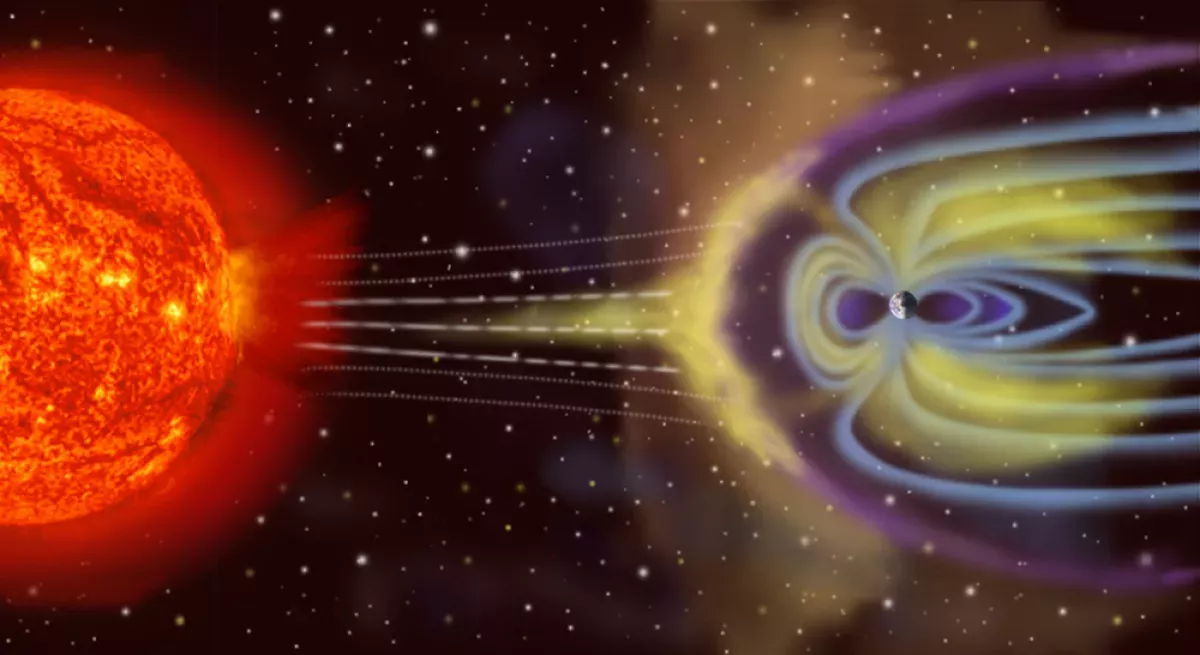
A geomagnetic storm is a temporary disturbance of Earth's magnetosphere caused by interactions with solar phenomena. These storms arise from large-scale plasma and magnetic field structures originating on or near the Sun that interact with Earth's magnetosphere. They can disrupt satellite operations, communication systems, and power grids. Geomagnetic storms vary in intensity, with stronger storms causing more significant disruptions. Understanding and predicting these storms is crucial for mitigating their impact on technological infrastructure.
May 1921: Geomagnetic storm disrupts telegraph service and causes fires
In May 1921, a geomagnetic storm occurred, disrupting telegraph service and causing fires.


1930: Chapman and Ferraro propose new theory of magnetic storms
In 1930, Sydney Chapman and Vincenzo C. A. Ferraro proposed a new theory of magnetic storms in their article, explaining that solar flares emit plasma clouds (coronal mass ejections) that compress Earth's magnetic field, increasing it at the surface. Their work built on Kristian Birkeland's experiments with cathode-ray tubes showing deflection towards magnetic poles.
1960: Widespread radio disruption reported
In 1960, widespread radio disruption was reported due to a geomagnetic storm.
August 1972: Flares and solar storms disrupt terrestrial networks and satellites
In August 1972, a series of solar flares and storms peaked, including a flare estimated around X20, producing a fast CME transit and severe geomagnetic and proton storm. This disrupted terrestrial electrical and communications networks, damaged satellites, and detonated U.S. Navy sea mines in North Vietnam.
1979: Skylab's destruction
In 1979, Skylab's destruction is an example of a spacecraft reentering Earth's atmosphere prematurely as a result of higher-than-expected solar activity.
March 9, 1989: Coronal mass ejection from the Sun
On March 9, 1989, a coronal mass was ejected from the Sun.
March 1989: Geomagnetic storm affects satellites
During the great geomagnetic storm of March 1989, four of the U.S. Navy's navigational satellites had to be taken out of service for up to a week, the U.S. Space Command had to post new orbital elements for over 1000 objects affected.
March 1989: Geomagnetic storm causes collapse of Hydro-Québec power grid
In March 1989, a geomagnetic storm led to the collapse of the Hydro-Québec power grid in seconds, leaving six million people without power for nine hours and causing auroras as far south as Texas and Florida. The minimum Dst was −589 nT.
1989: Geomagnetic storm disrupts power in Quebec
In 1989, a geomagnetic storm caused ground induced currents that disrupted electric power distribution throughout most of Quebec and caused aurorae as far south as Texas.
July 14, 2000: X5 class flare erupts (Bastille Day event)
On July 14, 2000, an X5 class flare erupted which is known as the Bastille Day event and a coronal mass was launched directly at the Earth.
November 2003: Halloween Solar Storm
In November 2003, seventeen major flares erupted on the Sun, including a huge X28 flare on November 4, resulting in extreme radio blackout. These flares caused three geomagnetic storms between October 29 and November 2. Another storm occurred on November 4-5. This sequence became known as the Halloween Solar Storm. The Wide Area Augmentation System (WAAS) was offline for 30 hours, and the Japanese ADEOS-2 satellite was severely damaged.
2008: Metatech Corporation study on geomagnetic storm impact
In 2008, a study by Metatech corporation concluded that a storm with a strength comparable to that of 1921 would destroy more than 300 transformers and leave over 130 million people without power in the United States, costing several trillion dollars.
2008: National Academy of Sciences report on widespread disruption
In 2008, the National Academy of Sciences reported on possible scenarios of widespread disruption in the 2012–2013 solar peak.
2012: Potential for large-scale global Internet outages
In 2012, a study described the potential for a solar superstorm to cause large-scale global months-long Internet outages and analyzes the robustness of the current Internet infrastructure.
2013: Potential for large-scale global Internet outages
In 2013, a study described the potential for a solar superstorm to cause large-scale global months-long Internet outages and analyzes the robustness of the current Internet infrastructure.
2016: United States Federal Energy Regulatory Commission adopts NEARC rules
In 2016, the United States Federal Energy Regulatory Commission adopted NEARC rules for equipment testing for electric utilities. Implementation of any upgrades needed to protect against the effects of geomagnetic storms was required within four years, and the regulations also directed further research.
Mentioned in this timeline
Texas is the second-largest U S state by area and...
Florida the southernmost state in the contiguous United States is...

Bastille Day or le juillet is France's national day celebrated...
Solar flares are intense bursts of electromagnetic radiation emanating from...

Halloween is an annual celebration on October st preceding All...
Satellites often spacecraft are objects intentionally placed into orbit around...
Trending

4 hours ago Food Critic Moves From Las Vegas to Italian Blue Zone for Longevity
4 hours ago Seth McGowan Increases Workload Amidst Jonathan Taylor Concerns for Colts
4 hours ago Sonny Styles Named NFC Defensive Player of the Week After Outstanding Performance
4 hours ago Eight Titles Depart Xbox Game Pass Service in Early October 2026
4 hours ago Kurt Warner Shares Professional NFL Quarterback Analysis and Advice
5 hours ago Buffalo Bills Face New England Patriots in Highly Anticipated NFL Week 4 Matchup
Popular

Jameis Winston is an American football quarterback currently playing for...

Ken Paxton is an American politician and lawyer serving as...

Shakira Isabel Mebarak Ripoll the Queen of Latin Music is...

Elon Musk is a visionary entrepreneur and engineer known for...

Bernie Sanders is a prominent American politician and the senior...

Michael Joseph Jackson the King of Pop was a highly...