


A klystron is a specialized vacuum tube used as an amplifier or oscillator for high-frequency radio waves, particularly in the microwave range. Invented in 1937 by Russell and Sigurd Varian, it functions by modulating the velocity of an electron beam. The device works by passing an electron beam through a series of resonant cavities, which bunch the electrons together, allowing them to transfer energy efficiently into electromagnetic fields. Because of its ability to produce high-power, coherent microwave radiation, the klystron is essential in modern technology. It is a critical component in particle accelerators, radar systems, satellite communications, and television transmitters, serving as a foundational piece of hardware for high-power radio frequency applications.
5 hours ago : Severe Teacher Shortages Impact Schools Nationwide Before New Academic Year Begins
School districts across America face a critical teacher shortage as the academic year approaches. Experts call for reduced credentialing barriers to fill essential roles and address systemic staffing challenges plaguing the education sector.


1935: Description of velocity modulation
In 1935, A. Arsenjewa-Heil and Oskar Heil published a description of velocity modulation, a foundational concept that preceded the Varian brothers' work on the klystron.
August 30, 1937: Demonstration of the first Klystron prototype
On August 30, 1937, brothers Russell and Sigurd Varian successfully completed and demonstrated the first functioning prototype of the klystron at Stanford University, providing a powerful source of microwave radio waves.
1937: Invention of the Klystron
In 1937, American electrical engineers Russell and Sigurd Varian invented the klystron, a specialized linear-beam vacuum tube designed to function as an amplifier for high radio frequencies, ranging from UHF to microwave levels.
1939: Citation of W. W. Hansen's resonator work
In 1939, the Varian brothers published a paper on the klystron, in which they formally cited the work of physicist W. W. Hansen, whose research on resonator analysis provided the theoretical foundation for energy transfer between electrons and radio frequency fields.
1939: Publication and Impact of the Klystron
In 1939, the publication of the klystron technology occurred, which immediately served as a significant catalyst for research and development of radar equipment within the United States and the United Kingdom.
1949: Death of W. W. Hansen
In 1949, physicist W. W. Hansen passed away due to beryllium disease, which was caused by his professional exposure to beryllium oxide while conducting his scientific research.
2007: Global Resource Corporation Klystron Innovation
In 2007, Popular Science recognized Global Resource Corporation in its 'Best of What's New' list for developing a technology that utilized a klystron to transform hydrocarbons found in diverse sources—such as automotive waste, coal, oil shale, and oil sands—into usable natural gas and diesel fuel.
Mentioned in this timeline
The United States of America is a federal republic primarily...

Radar Radio Detection and Ranging is a detection system that...
Stanford University officially Leland Stanford Junior University is a private...

Diesel fuel is a liquid fuel designed for diesel engines...

Gas is a state of matter characterized by the absence...
Energy is a fundamental quantitative property transferred to a body...
Trending
3 hours ago MLB Suspends Mariners Reliever Gabe Speier After Hitting Tigers Batter

3 hours ago Alex Bregman Leads Offense With Crucial RBI Double and Defensive Excellence
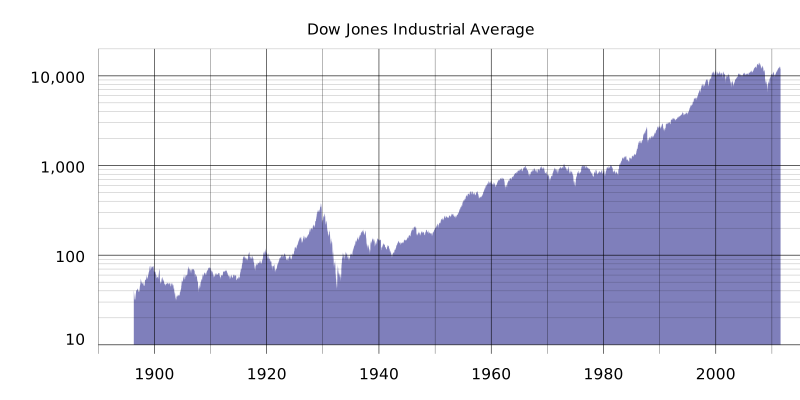
3 hours ago Dow Jones Falls as Oil Rally and Hormuz Deal Doubts Impact Markets

3 hours ago Madison Keys Faces Marta Kostyuk in WTA Toronto Canadian Open Third Round Match

3 hours ago Marta Kostyuk Competes in the 2026 Canadian Open Tournament
4 hours ago MLB Suspends Mariners Manager Dan Wilson and Gabe Speier After On-Field Altercation with Tigers
Popular

Mario Armando Lavandeira Jr better known as Perez Hilton is...

Rand Paul is an American politician and the junior United...

Anthony Stephen Fauci is a prominent American physician-scientist and immunologist...

Buc-ee's is an American chain of large country stores gas...

Jeanine Pirro is an American television host lawyer and author...

Johnny Depp is a highly successful American actor musician and...