


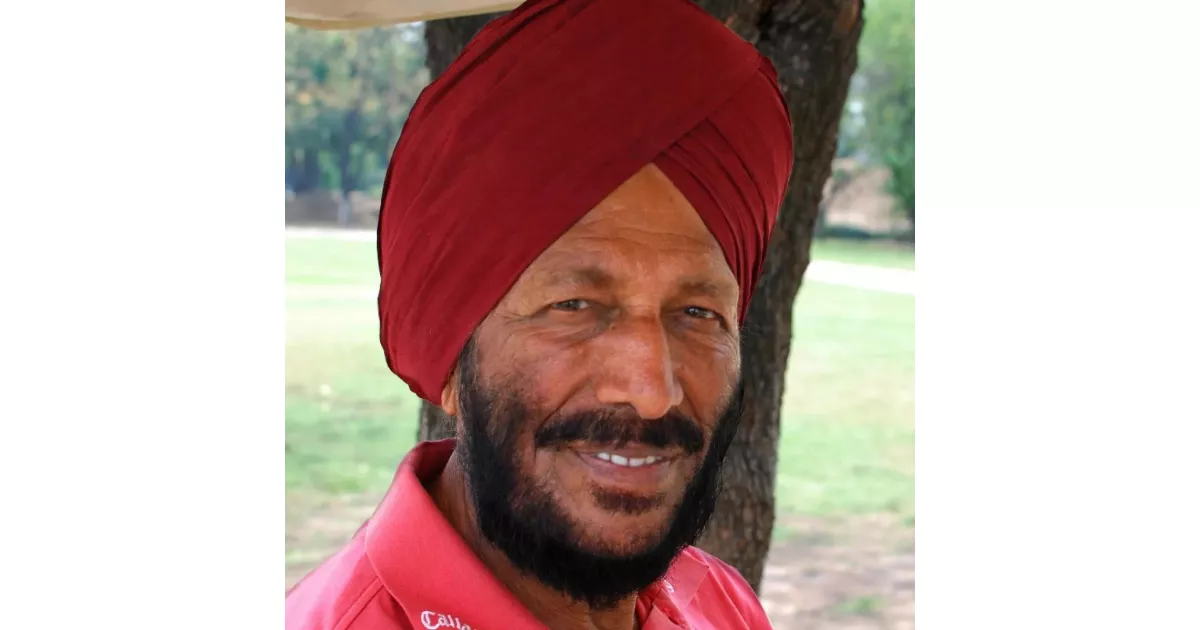
"The Flying Sikh", Milkha Singh, was an acclaimed Indian track and field sprinter renowned for his exceptional speed and achievements. His career peaked with a gold medal in the 400 meters at both the Asian and Commonwealth Games, a feat unmatched by any other athlete. Representing India in three consecutive Olympic Games, he consistently demonstrated his athletic prowess on the global stage. His remarkable contributions to sports earned him the Padma Shri, one of India's highest civilian honors."
November 1929: Birth and Early Life
Milkha Singh was born on November 20, 1929, in Govindpura, British India. He was one of fifteen children in a Sikh Rathore Rajput family. Tragically, he lost his parents, a brother, and two sisters during the violence of the Partition of India.


1947: Displacement and Imprisonment
Following the turmoil of the Partition, Milkha Singh relocated to Delhi, India, in 1947 to escape the violence in Punjab. During this time, he faced hardship and even spent a short period imprisoned in Tihar Jail for traveling on a train without a ticket. His sister, Ishvar, made sacrifices to secure his release.
1951: Joining the Indian Army and Introduction to Athletics
In 1951, Milkha Singh successfully enlisted in the Indian Army on his fourth attempt. It was during his time stationed at the Electrical Mechanical Engineering Centre in Secunderabad that he discovered his passion for athletics. His natural running ability, honed from running long distances to school as a child, was noticed during a cross-country run, leading to his selection for specialized training.
1952: Previous Olympic Record in the 400m
Before the 1960 Rome Olympics, the Olympic record for the 400m was held by George Rhoden and Herb McKenley, both clocking in at 45.9 seconds in 1952.
1955: Meeting Future Wife
Milkha Singh first encountered Nirmal Saini, the former captain of the Indian women's volleyball team in Ceylon, in 1955.
1956: Melbourne Olympics Qualification Rounds
During the 1956 Melbourne Olympics, Milkha Singh competed in the qualification rounds of the 400m event. Similar to his performance in Rome, he did not achieve a first-place finish in any of those races.
1956: Olympic Debut in Melbourne
Milkha Singh made his Olympic debut at the 1956 Melbourne Games, competing in the 200m and 400m races. Despite not progressing past the heats, he gained valuable experience and insights from his encounter with the eventual 400m champion, Charles Jenkins.
1956: Melbourne Olympics and Inspiration
Milkha Singh represented India at the 1956 Melbourne Olympics in the 200m and 400m events. Although his lack of experience prevented him from advancing beyond the heats, a significant encounter with the eventual 400m champion, Charles Jenkins, left a lasting impact. This meeting ignited within Singh a burning desire to excel and provided him with invaluable knowledge about advanced training techniques.
1956: Lou Jones' 400m World Record
The official report of the 1960 Rome Olympics recognizes Lou Jones as the 400m world record holder at the time. He achieved this record in 1956 in Los Angeles with a time of 45.2 seconds.
1958: Asian Games and Commonwealth Games Gold Medals
Milkha Singh achieved remarkable success in 1958 by securing gold medals in the 200m and 400m events at both the National Games of India and the Asian Games. He also clinched a gold medal in the 400m at the British Empire and Commonwealth Games, becoming the first gold medalist from independent India in the process.
1958: National and International Triumphs
Milkha Singh had an exceptional year in 1958. He set new records in the 200m and 400m at the National Games of India and won gold medals in the same events at the Asian Games. Notably, he earned a historic gold medal in the 400m at the British Empire and Commonwealth Games, marking the first time an athlete from independent India achieved this feat.
1958: Recognition and Padma Shri Award
Milkha Singh's exceptional performance at the 1958 Asian Games earned him a promotion to Junior Commissioned Officer from the rank of Sepoy in the Indian Army. In the same year, he was honored with the Padma Shri, India's fourth-highest civilian award, in recognition of his remarkable achievements in sports.
1958: Commonwealth Games Victory
Milkha Singh's wax statue, unveiled in 2017, depicts his memorable victory run at the 1958 Commonwealth Games.
1960: The Flying Sikh and the Heartbreak in Rome
In 1960, Milkha Singh participated in the Rome Olympics, where his performance in the 400m final cemented his place in Indian sporting history. Despite leading for a significant portion of the race, he made a tactical error by slowing down and looking back at his competitors, ultimately finishing fourth. This race, while setting an Indian national record, became a source of what he called his "worst memory." He was, however, dubbed "The Flying Sikh" by General Ayub Khan of Pakistan after a race in Pakistan earlier that year.
1960: Near Miss at the 1960 Olympics
In 1960, Milkha Singh, considered a favorite, participated in the 400m final at the Olympic Games. He led for a significant portion of the race but was overtaken after slowing down. While he finished fourth, his time of 45.73 seconds set an Indian national record that remained unbroken for nearly four decades.
1960: Fourth-Place Finish at the Rome Olympics
In the 1960 Rome Olympics, Milkha Singh delivered a memorable performance in the 400m final, finishing fourth in a tightly contested race. Despite setting a new Indian national record, his decision to slow down momentarily cost him a podium finish.
1960: Donation of Shoes
Milkha Singh wore a pair of running shoes at the 1960 400m final, which he later donated.
1960: Performance at the Rome Olympics
Milkha Singh's participation in the 1960 Rome Olympics included four races: heats, quarterfinals, semifinals, and the final. It should be noted that he did not secure a first-place finish in any of these races.
1960: Setting a National Record on Cinder Track
Milkha Singh's time of 45.6 seconds in the 400m final at the 1960 Rome Olympics, timed manually on a cinder track, stood as a national record for almost four decades.
1962: Double Gold at Asian Games
At the 1962 Asian Games in Jakarta, Milkha Singh continued his winning streak by securing gold medals in the 400m and the 4 x 400m relay.
1962: Asian Games Success
Milkha Singh added to his medal tally at the 1962 Asian Games in Jakarta. He secured gold medals in both the 400m individual event and the 4 x 400m relay.
1964: Defeat at the National Games
In 1964, Milkha Singh experienced a setback at the National Games in Calcutta when he was defeated by Makhan Singh in the 400m race. This loss challenged the claims that he had won the majority of his races.
1964: Tokyo Olympics Participation
Milkha Singh participated in his third Olympic Games in Tokyo in 1964. He was slated to compete in the 400m, 4 x 100m relay, and 4 x 400m relay but only participated in the 4 x 400m relay, where the Indian team was eliminated in the heats.
1964: Tokyo Olympics and Relay Disappointment
The 1964 Tokyo Olympics marked Milkha Singh's final appearance at the Games. While initially entered in the 400m, 4 x 100m relay, and 4 x 400m relay, he only participated in the 4 x 400m relay. Unfortunately, the Indian team, consisting of Milkha Singh, Makhan Singh, Amrit Pal, and Ajmer Singh, was eliminated in the heats.
1998: Retirement from Sports Administration
After a successful career in athletics and contributions to sports administration, Milkha Singh retired in 1998 from his position as Director of Sports in the Punjab Ministry of Education.
1998: Paramjit Singh Breaks the Record
It wasn't until 1998 that Paramjit Singh surpassed Milkha Singh's long-standing national record in the 400m. Paramjit Singh achieved a time of 45.70 seconds on a synthetic track, aided by fully automatic timing technology.
1999: Adoption
In 1999, Milkha Singh and his wife, Nirmal Saini, adopted the seven-year-old son of Havildar Bikram Singh, who had lost his life in the Battle of Tiger Hill.
2001: Arjuna Award Refusal
In 2001, Milkha Singh declined the Arjuna Award from the Indian government. He believed it was meant for young athletes and felt it was being given to individuals with minimal contributions to sports, diminishing its value.
2003: Establishment of Charitable Trust
The Milkha Singh Charitable Trust was founded in 2003 to support underprivileged athletes.
2006: Recognition of Milkha Singh's Olympic Feat
In 2006, The Age acknowledged Milkha Singh's unique achievement of breaking an Olympic track record in the 400m final at the 1960 Rome Olympics, despite finishing fourth. This highlighted the remarkable feat of four athletes surpassing the previous record in a single race.
2008: Recognition as India's Finest Athlete
In 2008, journalist Rohit Brijnath bestowed a remarkable honor upon Milkha Singh, hailing him as "the finest athlete India has ever produced."
2012: Charity Auction
Milkha Singh donated his Adidas shoes worn at the 1960 400m final to a charity auction organized by actor Rahul Bose in 2012.
2013: Autobiography and Film Release
Milkha Singh's autobiography, "The Race of My Life," co-written with his daughter, Sonia Sanwalka, was published in 2013. That same year, a biographical film based on his life, "Bhaag Milkha Bhaag," was released.
2014: Vikas Gowda Ends the Gold Drought
In 2014, Vikas Gowda became the second Indian male athlete to win an individual athletics gold medal at the Commonwealth Games, ending a long drought since Milkha Singh's victory in 1958.
2014: Film Awards
The film "Bhaag Milkha Bhaag" garnered widespread acclaim in India and received numerous awards in 2014, including the National Film Award for Best Popular Film Providing Wholesome Entertainment and five awards at the International Indian Film Academy Awards.
2014: Arjuna Award Analogy
While speaking at a college in Goa in 2014, Milkha Singh compared receiving the Arjuna Award after the Padma Shri to being offered a secondary school certificate after earning a Master's degree.
September 2017: Wax Statue Unveiling
Milkha Singh's wax statue, crafted by Madame Tussauds sculptors in London, was revealed in Chandigarh in September 2017. The statue portrays Singh during his triumphant run at the 1958 Commonwealth Games.
2020: Olympic Dedication
Neeraj Chopra, after securing India's first track and field gold medal at the 2020 Olympics, dedicated his victory to Milkha Singh.
May 2021: Hospitalization
On May 24, 2021, Milkha Singh was admitted to the intensive care unit at Fortis Hospital in Mohali due to COVID-19-induced pneumonia.
June 2021: Passing
Milkha Singh passed away on June 18, 2021, at 11:30 pm in Chandigarh due to COVID-19. His wife, Nirmal Saini, had also died a few days prior on June 13, 2021, from COVID-19.
June 2021: Death of Milkha Singh
Milkha Singh passed away on June 18, 2021, at the age of 91 due to complications from COVID-19.
Mentioned in this timeline

Adidas AG is a German multinational corporation and the second-largest...
India officially the Republic of India is a South Asian...

Los Angeles California's most populous city and Southern California's hub...

The modern Olympic Games are a leading international sporting event...

The tiger a large cat species belonging to the Panthera...

Pakistan officially the Islamic Republic of Pakistan is a South...
Trending

4 hours ago Japan Export Growth Slows to 16.7 Percent Amid Solid Chip and Automotive Demand
4 hours ago Leylah Fernandez Secures Thrilling Comeback Victory Against Elise Mertens at Ningbo Open

4 hours ago Fast and Furious Franchise Leaving Netflix Platform
5 hours ago Singapore Airlines Adds New 8-Hour Route and Offers Business Class Travel Tips

5 hours ago Hera Mission Reaches Dimorphos Asteroid to Conduct Detailed Scientific Imaging Analysis

5 hours ago Katie Boulter Advances to Second Round at Japan Open After Emphatic Victory
Popular

Ilhan Omar is a prominent American politician currently serving as...

Ken Paxton is an American politician and lawyer serving as...

Elon Musk is a visionary entrepreneur and engineer known for...

Michael Joseph Jackson the King of Pop was a highly...

Cristiano Ronaldo widely considered one of the greatest footballers captains...

Linda Ronstadt is a versatile American singer renowned for her...