


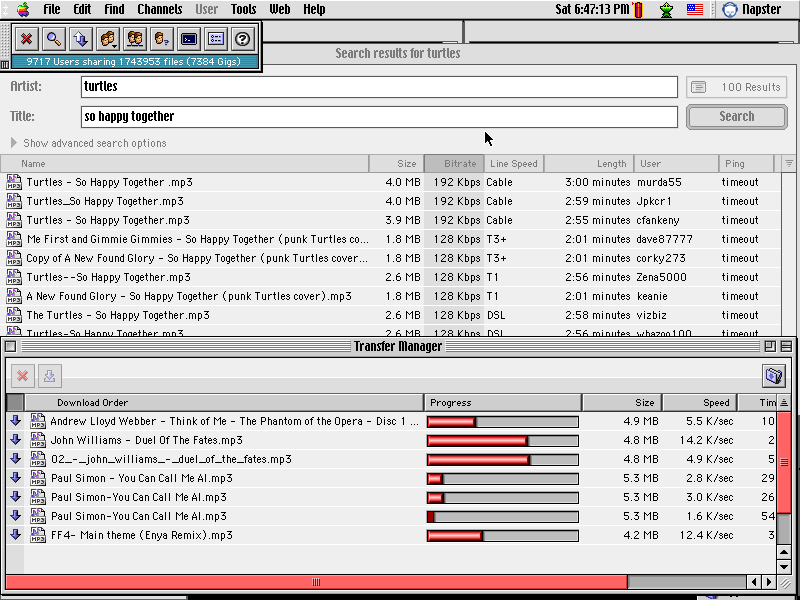
Napster was a pioneering peer-to-peer (P2P) file sharing application, founded by Shawn Fanning and Sean Parker, that revolutionized digital music distribution. Launched in 1999, it enabled users to easily share MP3 audio files. Its rapid popularity, however, led to significant copyright infringement lawsuits from the music industry. These legal challenges ultimately forced Napster to shut down in 2001 and declare bankruptcy in 2002. Despite its short lifespan, Napster profoundly impacted the music industry and paved the way for future digital music services.
June 1, 1999: Napster Platform Launch
On June 1, 1999, the Napster platform, a peer-to-peer file sharing application, was originally launched by Shawn Fanning and Sean Parker.


June 1999: Napster Service Launch
In June 1999, Napster was envisioned and founded by Shawn Fanning and Sean Parker as a peer-to-peer file sharing service.
December 6, 1999: RIAA Files Lawsuit Against Napster
On December 6, 1999, the Recording Industry Association of America (RIAA) filed a lawsuit against Napster for facilitating the transfer of copyrighted material, leading to increased publicity and millions of new users.
April 13, 2000: Metallica Files Lawsuit Against Napster
On April 13, 2000, Metallica filed a lawsuit against Napster after their song "I Disappear" and their entire back catalogue were found circulating on the network before the official release.
July 2000: Radiohead's Kid A Tracks Appear on Napster
In July 2000, tracks from Radiohead's album Kid A appeared on Napster three weeks before the album's release.
October 2000: Kid A Reaches Number One on Billboard 200
In October 2000, Radiohead's Kid A captured the number one spot on the Billboard 200 sales chart in its debut week, suggesting Napster could be a good promotional tool for music.
2000: RIAA Sues Napster
In 2000, A&M Records, along with other recording companies through the RIAA, sued Napster for copyright infringement under the US Digital Millennium Copyright Act (DMCA).
2000: Bertelsmann Collaboration
In 2000, Bertelsmann became the first major label to drop its copyright lawsuit against Napster and began collaborating with the company.
2000: Macintosh Client Developed for Napster
In 2000, Black Hole Media developed a Macintosh client called Macster, which was later acquired by Napster and renamed as the official Mac Napster client.
2000: Artists Defend Napster as a Promotional Tool
Since 2000, many unsigned musical artists have stated that Napster and similar networks helped get their music heard and improved their sales. DJ Xealot and Chuck D from Public Enemy publicly defended Napster as a promotional tool.
February 2001: Peak Napster Use and Settlement Proposal
In February 2001, Napster's verified usage peaked at 26.4 million users worldwide. In the same month, Napster proposed a settlement to record labels, offering $1 billion over five years via a subscription service.
March 5, 2001: Injunction Issued Against Napster
On March 5, 2001, following a failed appeal, an injunction was issued ordering Napster to prevent the trading of copyrighted music on its network.
July 11, 2001: Napster Shuts Down Network
On July 11, 2001, Napster shut down its entire network to comply with an injunction to prevent the trading of copyrighted music.
July 2001: Napster Service Shutdown
In July 2001, Napster had to close down its service after not being able to comply with a court order to restrict access to infringing material, despite an appeal.
September 24, 2001: Partial Settlement Reached
On September 24, 2001, Napster reached a partial settlement, agreeing to pay music creators and copyright owners $26 million for past unauthorized uses and $10 million in advance licensing royalties.
2001: Napster Ceases Operations
In 2001, Napster ceased operations after losing multiple lawsuits related to copyright infringement.
May 17, 2002: Bertelsmann to Acquire Napster
On May 17, 2002, Napster announced that its assets would be acquired by German media firm Bertelsmann for $85 million to transform Napster into an online music subscription service.
June 2002: Napster Files for Bankruptcy
In June 2002, Napster filed for bankruptcy following legal battles and ceased operations in 2001.
September 3, 2002: Sale to Bertelsmann Blocked
On September 3, 2002, an American bankruptcy judge blocked the sale of Napster to Bertelsmann and forced Napster to liquidate its assets.
2002: Napster Files for Bankruptcy
In 2002, Napster announced it had filed for bankruptcy and sold its assets to a third party.
September 2008: Napster Purchased by Best Buy
In September 2008, Napster was purchased by US electronics retailer Best Buy for US$121 million.
December 1, 2011: Best Buy Merges Napster with Rhapsody
On December 1, 2011, Best Buy purchased Napster and merged it with its Rhapsody streaming service.
July 14, 2016: Rhapsody Rebrands as Napster
On July 14, 2016, Rhapsody phased out the Rhapsody brand and rebranded its service internationally as Napster.
2016: Rhapsody Renamed Napster
In 2016, the original Napster branding was restored when Rhapsody was renamed Napster.
2018: Metallica Upheld Suing Napster
In a 2018 Rolling Stone article, Kirk Hammett of Metallica upheld the band's opinion that suing Napster was the "right" thing to do.
August 25, 2020: Napster Sold to MelodyVR
On August 25, 2020, Napster was sold to virtual reality concerts company MelodyVR.
May 10, 2022: Napster Sold to Hivemind and Algorand
On May 10, 2022, Napster was sold to Hivemind and Algorand, along with other investor consortiums.
2022: Napster Acquired by Hivemind and Algorand
In 2022, the Napster streaming service was acquired by two Web3 companies, Hivemind and Algorand, and Jon Vlassopulos was appointed as CEO.
Mentioned in this timeline

Best Buy is a multinational consumer electronics retailer founded in...

Dr Dre born Andre Romell Young is an influential American...

Metallica formed in by James Hetfield and Lars Ulrich is...
Music involves arranging sounds to create form harmony melody rhythm...

Black holes are regions in spacetime with gravity so strong...

September is the ninth month of the year in the...
Trending
4 hours ago Catherine Breed Makes History Swimming Entire 900-Mile California Coastline

4 hours ago League of Legends Patch 26.21 Introduces ARAM Mayhem and New Augments
4 hours ago U.S. and Israel Coordinate Potential Renewed Strike Plans Against Iran

4 hours ago England and Sri Lanka Battle for First Points in Rawalpindi Tri-Series Cricket Match

5 hours ago Al Pacino Vacates Iconic Former Jackie Collins Beverly Hills Home After 18 Years
5 hours ago Daniil Medvedev Faces Sho Shimabukuro at the 2026 ATP Almaty Open
Popular

Ken Paxton is an American politician and lawyer serving as...

Ilhan Omar is a prominent American politician currently serving as...

Michael Joseph Jackson the King of Pop was a highly...

Elon Musk is a visionary entrepreneur and engineer known for...

Cristiano Ronaldo widely considered one of the greatest footballers captains...

Linda Ronstadt is a versatile American singer renowned for her...