


VX Sagittarii is a massive, highly luminous red supergiant or hypergiant star located approximately 5,000 light-years away in the constellation Sagittarius. It is classified as a semi-regular variable star, meaning its brightness and size fluctuate significantly over time. As one of the largest known stars, its radius is estimated to be over 1,500 times that of the Sun. VX Sagittarii is characterized by a very low surface temperature and a high rate of mass loss, as it sheds its outer layers into the surrounding space. It serves as a significant subject for studying stellar evolution in the final stages of the lives of massive stars, providing astronomers with insights into the complex processes of dust formation and stellar winds in the interstellar medium.
1904: Discovery of Variability in BD−22°4575
In 1904, it was announced that astronomer Henrietta Leavitt identified the star known as BD−22°4575 as a variable star, marking a significant step in understanding its nature.


1911: Designation of VX Sagittarii
In 1911, the star previously identified as BD−22°4575 was officially given the variable star designation VX Sagittarii.
May 2018: Classification as a Red Hypergiant
In May 2018, research proposed that the star VX Sagittarii should be classified as a red hypergiant, placing it among a very small and exclusive group of stars.
2018: Commencement of Interferometric Observations
In 2018, the GRAVITY instrument on the Very Large Telescope began a multi-year period of interferometric observations to study the pulsation patterns of VX Sagittarii.
September 2019: Peak Radius Measurement
During September 2019, measurements confirmed that VX Sagittarii reached its maximum recorded radius of 1,798±127 R☉.
March 2020: First Detection of Brγ Hydrogen Lines
In March 2020, researchers documented the presence of Brγ hydrogen lines in the spectrum of VX Sagittarii, marking the first time such lines were detected in a single-system red supergiant star.
August 2021: Expansion of Atmospheric Layers
In August 2021, VX Sagittarii underwent an extreme mass loss event, which resulted in the expansion of its carbon monoxide and water atmospheric layers to a distance of 3,200 solar radii (R☉).
2021: Reclassification as an Extreme AGB Star
A 2021 study challenged previous findings, suggesting that in 2021, VX Sagittarii was more accurately categorized as an extreme asymptotic giant branch (AGB) or super-AGB star due to its luminosity and spectral rubidium content, surpassing theoretical bolometric magnitude limits.
2025: Conclusion of Interferometric Observation Cycle
By 2025, the interferometric observation cycle conducted via the GRAVITY instrument aboard the Very Large Telescope concluded, revealing that VX Sagittarii shifts its pulsation modes between active and quiescent phases.
2026: Red Supergiant Classification
Published in 2026, new analysis refuted the super-AGB hypothesis, concluding that the star's pulsational properties, massive radius, and high luminosity are only consistent with those of a red supergiant.
Mentioned in this timeline

A star is a self-gravitating luminous plasma spheroid exemplified by...
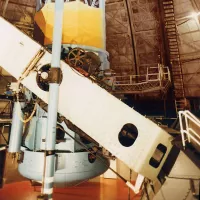
A telescope is an instrument used to observe distant objects...
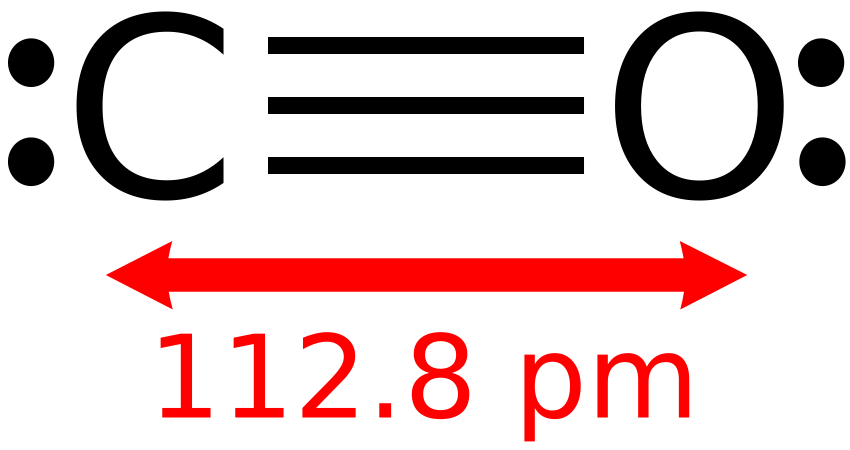
Carbon monoxide CO is a colorless odorless tasteless and flammable...

September is the ninth month of the year in the...
Time is a fundamental dimension used to sequence events measure...
Red is a color at the long wavelength end of...
Trending

4 hours ago Bernard Tomic Returns to ATP Masters 1000 Facing Matteo Arnaldi
4 hours ago Hubert Hurkacz Competes in Second Round at ATP Shanghai Masters Tournament

4 hours ago Dylan Sprouse and Barbara Palvin Welcome Their First Child Together

5 hours ago Chris Sale Slated for Game 3 Duel vs. Dodgers Following Relief Appearance
5 hours ago Rolex Shanghai Masters Tennis Tournament Matches Heat Up in China
5 hours ago Pirates Targeted Trevor Megill as Perfect Bullpen Upgrade
Popular

Ken Paxton is an American politician and lawyer serving as...

Elon Musk is a visionary entrepreneur and engineer known for...

Shakira Isabel Mebarak Ripoll the Queen of Latin Music is...

Cristiano Ronaldo widely considered one of the greatest footballers captains...

Jameis Winston is an American football quarterback currently playing for...

Michael Joseph Jackson the King of Pop was a highly...