


Americans are defined as citizens and nationals of the United States, with nationality based on citizenship rather than race or ethnicity. The U.S. comprises diverse ancestry groups, with White Americans being the largest (61.6%), followed by Hispanic/Latino Americans (18.7%), Black Americans (12.4%), and Asian Americans (6%). Native Americans account for roughly 1.1% of the population, with 574 tribes recognized by the federal government. A significant American diaspora exists, with an estimated seven million Americans residing abroad.


1964: Civil Rights Act of 1964
Following the end of the Reconstruction era, African Americans became disenfranchised and subject to Jim Crow laws, legislation that would persist until the passage of the Civil Rights Act of 1964 and Voting Rights Act due to the civil rights movement.
1976: Native Hawaiians and other Pacific Islanders referred to as Asian Pacific Americans
Native Hawaiians and other Pacific Islanders were referred to as Asian Pacific American, along with Asian Americans beginning in 1976.
1990: Introduction of "American" category in the 1990 census
The introduction of a new "American" category in the 1990 census led to an under-count of English and British Americans as they tended to self-report as simply "Americans".
1995: Term preferences as of 1995
As of 1995, 50% of those who fall within the OMB definition prefer the term "American Indian", 37% prefer "Native American" and the remainder have no preference or prefer a different term altogether.
1997: Change of terminology in 1997
The terminology used was changed in 1997, for Native Hawaiians and other Pacific Islanders.
2000: Self-identification of African immigrants on the 2000 U.S. census
According to United States Census Bureau data, very few African immigrants self-identified as African American. On average, less than 5% of African residents self-reported as "African American" or "Afro-American" on the 2000 U.S. census.
2000: Growth in the population compared to the 2000 United States census
As compared to the 2000 United States census, the population of Native Hawaiians and other Pacific Islanders grew by 40%.
2000: Decrease of African Americans in the Northeast and Midwest compared to 2000 United States census
Compared to the 2000 United States census, there has been a decrease of African Americans in the Northeast and Midwest.
2008: Multiracial Americans in 2008
Multiracial Americans numbered 7.0 million in 2008, or 2.3% of the population.
2009: Zakharaia et al. study in 2009
In 2009, Zakharaia et al. found a similar proportion of Yoruba associated ancestry in their African American samples, with a minority also drawn from Mandinka and Bantu populations.
2010: Record numbers of American citizens renounced their U.S. citizenship
From 2010 to 2020, record numbers of American citizens renounced their U.S. citizenship due to U.S. tax and financial reporting requirements.
2014: Finalizing ethnic classification of MENA origins in 2014
In 2014, the United States Census Bureau began finalizing the ethnic classification of people of Middle Eastern and North African (MENA) origins and announced it would establish a new MENA ethnic category separate from the "white" classification.
December 2015: Sampling strata for new MENA category in December 2015
As of December 2015, the sampling strata for the new MENA category included the Census Bureau's working classification of 19 MENA groups, as well as Iranian, Turkish, Armenian, Afghan, Azerbaijani, and Georgian groups.
2016: US citizens living outside of the United States
In 2016, approximately 9 million United States citizens were living outside of the United States.
January 2018: Census Bureau's announcement in January 2018 regarding MENA grouping
In January 2018, it was announced that the Census Bureau would not include the MENA grouping in the 2020 census.
2020: "Some other race" category in the 2020 United States census
According to the 2020 United States census, 8.4% or 27,915,715 Americans chose to self-identify with the "some other race" category.
2020: Hispanic and Latino Americans in the 2020 United States census
According to the 2020 United States census, Hispanic and Latino Americans formed the second largest group in the United States, comprising 62,080,044 people or 18.7% of the population.
2020: Native Americans or Alaska Natives in 2020
According to the 2020 United States census, there are 2,251,699 people who are Native Americans or Alaska Natives alone; they make up 0.7% of the total population.
2020: Native Hawaiians and other Pacific Islanders in the 2020 United States census
As of the 2020 United States census, there are 622,018 Native Hawaiians and other Pacific Islanders who reside in the United States, and make up 0.2% of the nation's total population.
2020: Multiracial Americans in 2020
By the 2020 census the multiracial population increased to 13,548,983, or 4.1% of the total population.
2020: Record numbers of American citizens renounced their U.S. citizenship
From 2010 to 2020, record numbers of American citizens renounced their U.S. citizenship due to U.S. tax and financial reporting requirements.
2020: English speakers in 2020
In 2020, about 245 million, or 78% of the population aged five years and older, spoke only English at home.
2020: Asian Americans in the United States Population 2020
In 2020, the Asian American population comprised 19,618,719 people, or 5.9% of the United States population.
2020: White Americans in the 2020 United States census
In the 2020 United States census, White Americans constituted the majority of the United States population at 61.6%. Non-Hispanic Whites accounted for 57.8% of the population and were the majority in 44 states. Six states and other U.S. territories had non-white majorities.
2020: European ancestry groups in the 2020 United States census
In the 2020 United States census, the four largest self-reported European ancestry groups were English Americans, German Americans, Irish Americans, and Italian Americans, constituting 62.4% of the white American population.
2020: Black and African Americans in the 2020 United States census
The 2020 United States census reported that there were 39,940,338 Black and African Americans in the United States, representing 12.4% of the population.
2020: No MENA grouping in the 2020 census
The Census Bureau did not include the MENA grouping in the 2020 census.
2024: Organization created to lobby the U.S. Congress for relief from citizenship-based taxation
In 2024, a new organization was created to lobby the U.S. Congress for relief from citizenship-based taxation, which is often cited as the reason for the record renunciations of citizenship.
March 2025: Executive Order 14224 in March 2025
Prior to the signing of Executive Order 14224 in March 2025, which declared English the official language of the U.S., some Americans advocated making English the country's official language.
Mentioned in this timeline
The United States of America is a federal republic primarily...

Nigeria located in West Africa is the continent's most populous...
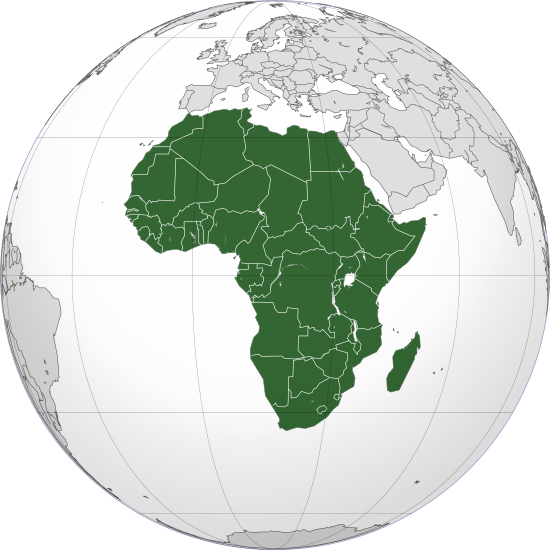
Africa is the second-largest and second-most populous continent home to...

Alaska a non-contiguous U S state in northwestern North America...
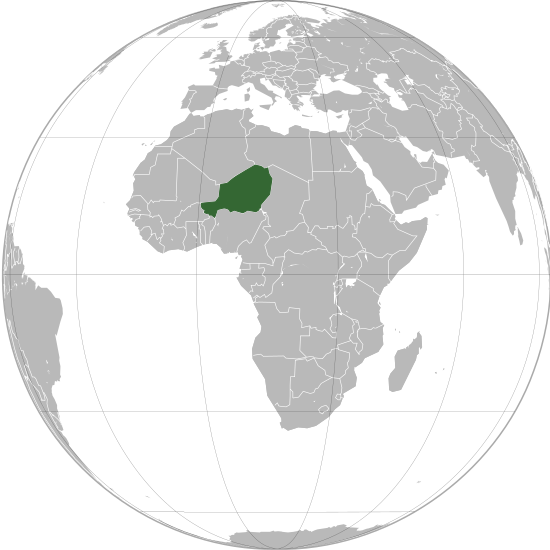
Niger is a landlocked country in West Africa bordered by...
Black is an achromatic color representing the absence of light...
Trending

3 hours ago Cleveland Browns Address Deshaun Watson's Contract Status Amidst Ongoing NFL Performance Speculation
3 hours ago Atlanta Falcons Urged to Prioritize Kyle Pitts to Boost Passing Offense

3 hours ago Omar Cooper Jr. Named NFL Rookie of the Week Amid Fantasy Football Breakout

3 hours ago Elizabeth Hurley Denies Prince Harry Rumors and Showcases Stylish Body-Hugging Dress

3 hours ago Tee Higgins Suffers Injury During Bengals vs Ravens NFL Week 7 Matchup

3 hours ago Michael Olise's Rising Star Trajectory and Potential Ballon d'Or Contention
Popular

Ilhan Omar is a prominent American politician currently serving as...

Ken Paxton is an American politician and lawyer serving as...

Elon Musk is a visionary entrepreneur and engineer known for...

Michael Joseph Jackson the King of Pop was a highly...

Barack Obama the th U S President - was the...

Greg Abbott is the current and th Governor of Texas...