


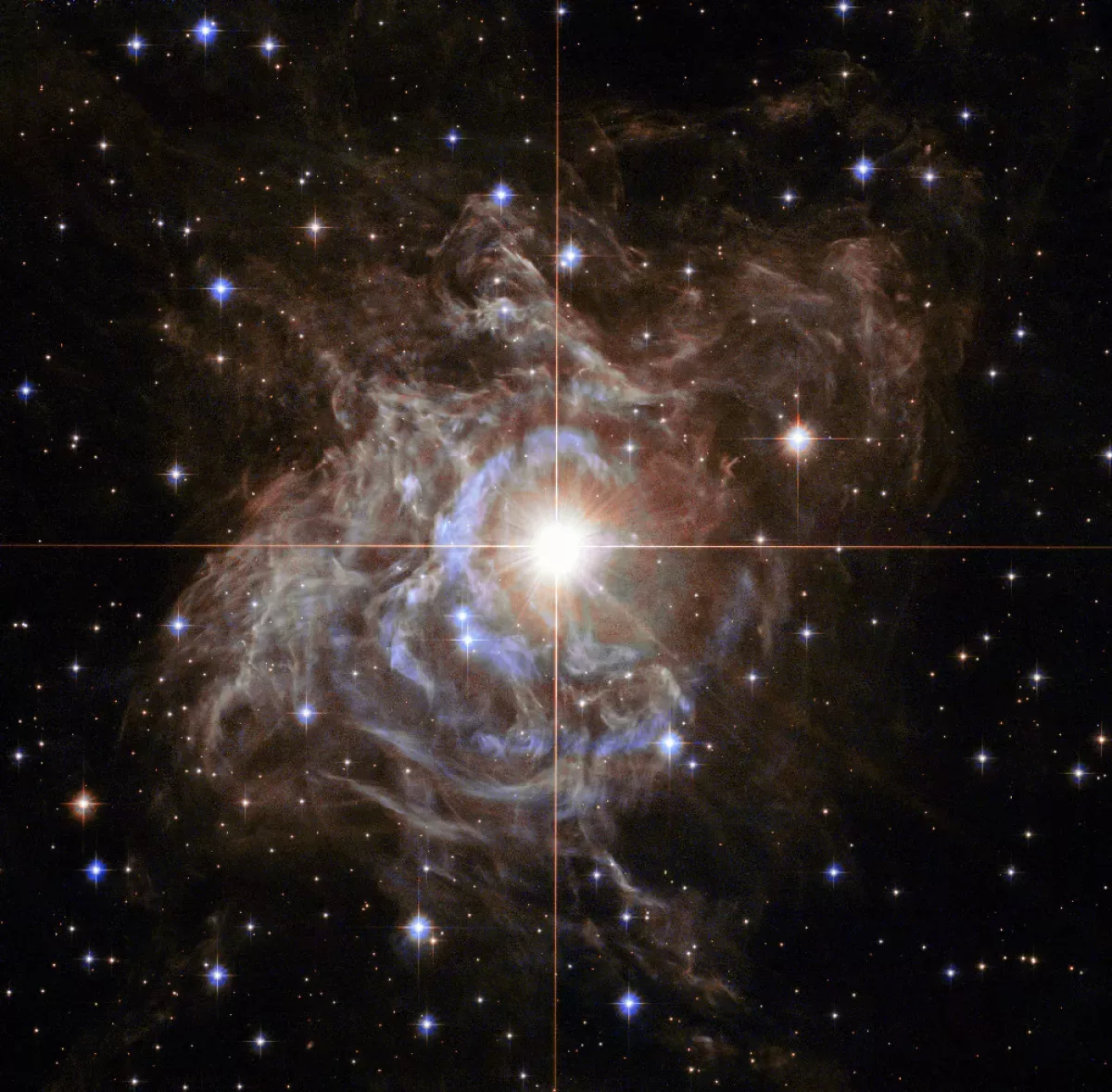
Cepheid variables are stars that expand and contract, changing in brightness, temperature, and diameter with a regular, stable period. This predictable pulsation pattern makes them essential tools for measuring distances in space. The relationship between a Cepheid variable's luminosity (intrinsic brightness) and its pulsation period (the time it takes to complete one cycle of brightening and dimming) provides a direct way to determine its distance. By measuring the period and apparent brightness (how bright it appears from Earth), astronomers can use the period-luminosity relationship to calculate the star's absolute luminosity. Knowing both the apparent and absolute luminosity, they can accurately determine how far away the Cepheid variable, and the galaxy containing it, actually are. This makes Cepheid variables invaluable 'standard candles' for establishing cosmic distances.
1908: Demonstration of the Adiabatic Radial Pulsation Period Relation
August Ritter demonstrated in 1908 that the adiabatic radial pulsation period for a homogeneous sphere is related to its surface gravity and radius.


1908: Discovery of Cepheid Period-Luminosity Relation
Henrietta Swan Leavitt discovered the relationship between a Cepheid variable's period and its luminosity in 1908. This pivotal discovery was based on her investigation of thousands of variable stars in the Magellanic Clouds.
1912: Publication of Cepheid Period-Luminosity Relation with Further Evidence
In 1912, Henrietta Swan Leavitt published her findings on the Cepheid period-luminosity relation, providing further evidence to support her 1908 discovery.
1913: First Distance Estimations to Cepheids
Ejnar Hertzsprung attempted to determine distances to 13 Cepheids using their motion through the sky in 1913. These measurements were a pioneering attempt to use Cepheids for distance determination, though they would later be revised.
1914: Rejection of the Binary System Theory for Cepheid Variability
Harlow Shapley demonstrated in 1914 that the observed radial velocity variations in Cepheids should not be interpreted as evidence of them being part of a binary system. This corrected a previous misconception about the nature of Cepheid variability.
1917: Proposal of the Stellar Pulsation Mechanism
Arthur Stanley Eddington proposed in 1917 that stellar pulsation functions as a heat-engine, providing a theoretical framework for understanding the dynamics of Cepheids.
1918: Using Cepheids to Constrain the Size and Shape of the Milky Way
Harlow Shapley used Cepheid variables in 1918 to estimate the size and shape of the Milky Way and determine the Sun's position within it. This work was crucial in understanding the structure of our galaxy.
1924: Establishing the Distance to Andromeda and the Nature of the Universe
In 1924, Edwin Hubble measured the distance to Cepheid variables in the Andromeda Galaxy, proving that it was a separate galaxy outside the Milky Way. This discovery resolved the "Great Debate" about the nature of the universe, confirming that the Milky Way is just one of many galaxies.
1929: Formulation of Hubble's Law and the Expanding Universe
Edwin Hubble and Milton L. Humason formulated Hubble's law in 1929. Using Cepheid distances and galaxy recession speeds, they demonstrated that the universe is expanding. This confirmed Georges Lemaître's theories.
1953: Identification of Ionized Helium's Role in Stellar Pulsation
S. A. Zhevakin identified ionized helium as a likely "valve" mechanism driving the heat-engine of stellar pulsations in 1953, adding a crucial detail to the understanding of Cepheid variability.


Trending
24 days ago Trabzonspor vs Galatasaray Süper Lig Match Preview and Starting XI Details

3 hours ago Alex de Minaur Proposes Significant Rule Changes to Tennis Serve Clock Procedures

17 days ago Sylvester Stallone Opens Up About Personal Struggles and Childhood Trauma in New Memoir

4 hours ago Pedro Martínez Emphasizes Identity and Improvement for Real Madrid Basketball Team
4 hours ago Druski Set to Become First Digital Creator to Host Saturday Night Live
4 hours ago Kimberly Birrell Achieves Career Milestone With Top 40 Ranking Debut
Popular

Ken Paxton is an American politician and lawyer serving as...

Cristiano Ronaldo widely considered one of the greatest footballers captains...

Jameis Winston is an American football quarterback currently playing for...

Michael Joseph Jackson the King of Pop was a highly...

Elon Musk is a visionary entrepreneur and engineer known for...

Ilhan Omar is a prominent American politician currently serving as...