History of Earthquake casualty estimation in Timeline


Earthquake casualty estimation involves predicting fatalities and injuries from earthquakes, typically before detailed on-site information is available. Tools like the USGS's PAGER system quickly evaluate potential impacts by integrating seismic data with population exposure and loss models to provide rapid assessments of the situation.
October 2003: QLARM team starts sending earthquake casualty estimates
In October 2003, the QLARM team began sending emails with estimates of human casualties and mean damage by settlement following earthquakes, initially using the QUAKELOSS program and dataset.


September 2005: GDACS issues color-coded earthquake alerts
In September 2005, the Global Disaster Alert and Coordination System (GDACS) began issuing color-coded earthquake alerts. The reports include comments on socio-economic conditions but can be misleading due to ignoring key disaster parameters.
May 12, 2008: Wenchuan earthquake death toll underestimation
On May 12, 2008, experts initially underestimated the death toll of the Wenchuan earthquake (Mw8) in China, believing for four days that the fatalities were less than 10,000.
May 2008: Wenchuan Earthquake Magnitude and Fatality Estimates
In May 2008, the Wenchuan earthquake was initially estimated at M7.5, later revised to M7.9-M8.0. The initial magnitude suggested a maximum of 4,000 fatalities, while the revised magnitude indicated a maximum of 100,000. The observed number of fatalities was 87,000.
April 2009: USGS issues PAGER alerts by email
In April 2009, the National Earthquake Information Center of the USGS began issuing PAGER alerts by email, including a color code indicating event seriousness, estimated population exposure to various intensity levels, tectonic information, and consequences from past nearby earthquakes.
2009: L'Aquila earthquake fatality estimation
In 2009, after the L'Aquila earthquake (M6.3), QLARM estimated 275 ±200 fatalities 22 minutes after the event, while the final death toll was 287, highlighting the potential usefulness of theoretical real-time fatality estimates for disaster relief, despite error margins.
January 2010: Haiti Earthquake Building Quality Underestimation
The Haiti earthquake (M7.3) on January 12, 2010, revealed a significant underestimation of building quality by the engineering community. Following the earthquake, a joint study by UNITAR-UNOSAT, EC-JRC, and the World Bank/ImageCAT estimated building damage using aerial images to support the PDNA.
May 2010: QLARM alerts based on the second generation tool and data set
Since May 2010, QLARM alerts are based on the second generation tool and data set called QLARM, which includes a map showing the expected mean damage for affected settlements. It superseded QUAKELOSS.
March 2011: Tohoku Earthquake Magnitude Underestimation
In March 2011, for the Tohoku, M9 earthquake, initial magnitude estimates varied: GFZ M8.5, NEIC M7.9, TWC M7.9, and EMSC M8.0. This underestimation occurred because longer wavelengths needed for accurate Mw measurements were not immediately available.
2013: Empirical fragility functions developed
In 2013, Hancilar et al. developed empirical fragility functions based on remote sensing and field data for predominant building typologies after the Haiti earthquake.
Mentioned in this timeline
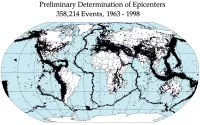
An earthquake is a sudden intense shaking of the Earth's...

China officially the People's Republic of China PRC is located...

A bank is a regulated financial institution licensed to accept...

The World Bank is an international financial institution offering loans...
Electronic mail or email revolutionized communication by providing a digital...

Haiti officially the Republic of Haiti is a Caribbean country...
Trending

3 hours ago Mark Ruffalo and Robert De Niro Rally Against Voter Suppression
3 hours ago Gulf Shipping Attacks Heighten Fears Amid G7 Oil Strategy Response
3 hours ago Jo Adell and Guardians Reset Following Disappointing ALDS Game 1 Loss

3 hours ago Miles Bridges Prepares to Strengthen Phoenix Suns Roster for New NBA Season

3 hours ago David Berson Succeeds Luis Silberwasser as Head of Merged TNT Sports Group

3 hours ago Ivar Stenberg Impresses as NHL-Ready Forward for San Jose Sharks
Popular

Ken Paxton is an American politician and lawyer serving as...

Shakira Isabel Mebarak Ripoll the Queen of Latin Music is...

Jameis Winston is an American football quarterback currently playing for...

Elon Musk is a visionary entrepreneur and engineer known for...

Bernie Sanders is a prominent American politician and the senior...

Cesar Chavez was a prominent American labor leader and civil...