


Furman University, established in 1826 in Greenville, South Carolina, is the oldest private institution of higher learning in the state. Named after Baptist pastor Richard Furman, it transitioned to a secular university in 1992, retaining its motto 'Christo et Doctrinae.' As of Fall 2021, Furman enrolls around 2,300 undergraduate and 150 graduate students on its 750-acre campus, providing a liberal arts education.
1924: Furman named a beneficiary of the Duke Endowment
In 1924, Furman was named one of four collegiate beneficiaries of the Duke Endowment.


1933: Students from Greenville Women's College began attending classes with Furman students
In 1933, students from the Greenville Women's College began attending classes with Furman students, leading to a merger and formation of the present institution.
1953: Construction began on new campus
In 1953, Furman began construction on its new campus, five miles north of downtown Greenville.
1954: Brown v. Board of Education Ruling
In 1954, the Brown v. Board of Education ruling found the "separate but equal" policy to be unconstitutional, which began the process of desegregating public schools. Furman, like most Southern colleges at that time, did not accept African Americans as students.
1955: Students support integration in The Echo
In 1955, some Furman students wrote in support of integration in The Echo, a student literary magazine, leading school administrators to destroy all 1,500 printed copies.
1958: Classes began on the new campus
In 1958, Furman University started holding classes on its new campus.
1963: Trustees voted to admit Black students
In 1963, enough faculty sided with students over racial desegregation that Furman's board of trustees voted to admit Black students, but the decision was postponed and later overturned.
1965: Joseph Vaughn enrolled as first black student
In 1965, Joseph Vaughn was the first black undergraduate student to enroll at Furman University.
1990: Furman ranked 23rd for PhD graduates
From 1990 to 1995, Furman ranked 23rd among all liberal arts colleges in number of graduates who went on to receive PhDs.
1992: Became a secular university
In 1992, Furman University became a secular university, while keeping Christo et Doctrinae (For Christ and Learning) as its motto.
1992: The South Carolina Baptist Convention ended its affiliation with Furman.
In 1992, the South Carolina Baptist Convention ended its affiliation with Furman. Furman's "heritage is rooted in the non-creedal, free church Baptist tradition which has always valued particular religious commitments while insisting not only on the freedom of the individual to believe as he or she sees fit but also on respect for a diversity of religious perspectives, including the perspective of the non-religious person."
1995: Furman ranked 23rd for PhD graduates
From 1990 to 1995, Furman ranked 23rd among all liberal arts colleges in number of graduates who went on to receive PhDs.
December 30, 1997: Timmons Arena Opening
On December 30, 1997, Timmons Arena opened as the home of the Furman University Paladins basketball team.
2007: Furman received $110 million from the Duke Endowment
Through 2007, Furman had received $110 million from the Duke Endowment, one of the nation's largest philanthropic foundations.
2008: Furman ranked 76th for PhD graduates
From 2008 to 2017, Furman ranked 76th among all universities in the nation of graduates that went on to receive PhDs.
2008: Cliffs Cottage opened
In 2008, the Southern Living showcase home called Cliffs Cottage opened. It is solar-powered and features geothermal heating and was featured in the article Our Most Innovative House Ever.
2011: Furman received a grade of "A−" from the Sustainable Endowments Institute
In 2011, Furman University received a grade of "A−" from the Sustainable Endowments Institute on its College Sustainability Report Card.
2012: New facility built for continuing education
In 2012, a new facility, named for alumni Sarah and Gordon Herring, was built for continuing education. The student center was expanded and renovated in 2012, with David Trone and his wife June contributing a $3.5 million gift, resulting in the center being named the Trone Student Center.
July 1, 2014: Elizabeth Davis became Furman's president
On July 1, 2014, Elizabeth Davis became the 12th president of Furman University.
2015: Furman included in Sierra Club's list of top 50 eco-friendly universities
In 2015, the Sierra Club included Furman University in its list of the top 50 eco-friendly universities in America.
October 2016: Publication of "Slavery, Memory and Reconciliation: What is the Furman Legacy?"
In October 2016, the article "Slavery, Memory and Reconciliation: What is the Furman Legacy?" was published in the university newspaper. The article pointed out that Richard Furman and his son James Clement Furman were slave owners and active defenders of slavery. This led to the formation of the Task Force on Slavery and Justice.
2016: Princeton Review ranked Furman in 5th place on its list of universities committed to national service
In 2016, The Princeton Review ranked Furman University in 5th place on its list of universities committed to national service.
2016: Furman's campus named 4th most beautiful campus by USA Today
In 2016, USA Today named Furman University's campus as the 4th most beautiful campus out of 10.
2017: Furman ranked 76th for PhD graduates
From 2008 to 2017, Furman ranked 76th among all universities in the nation of graduates that went on to receive PhDs.
2017: Times Higher Education named Furman's campus ninth most beautiful in the nation
In 2017, Times Higher Education named Furman University's campus ninth out of the ten most beautiful campuses in the nation.
October 2018: Task Force on Slavery and Justice issued Seeking Abraham report
In October 2018, the Task Force on Slavery and Justice at Furman University issued the 'Seeking Abraham' report with recommendations to acknowledge slavery and racism in the school's history.
2018: Furman placed 73rd in NACDA Directors' Cup Division I Final Standings
In 2018, Furman was placed 73rd out of 291 colleges in the NACDA Directors' Cup Division I Final Standings.
2019: Furman ranked 21st in list of top colleges in the South by Forbes
In 2019, Furman University was ranked 21st in a list of the top 25 colleges and universities in the South by Forbes.
2019: Furman listed as 23rd most beautiful college campus by Travel + Leisure
In 2019, Travel + Leisure listed Furman University as 23rd out of 25 of the most beautiful college campuses in the United States.
2019: Furman finished in 32nd place in NACDA Director's Cup Final Fall Standings
In the 2019–2020 season, Furman finished in 32nd place out of 157 institutions in the NACDA Director's Cup Final Fall Standings.
2020: Furman finished in 32nd place in NACDA Director's Cup Final Fall Standings
In the 2019–2020 season, Furman finished in 32nd place out of 157 institutions in the NACDA Director's Cup Final Fall Standings.
2021: Student Enrollment
As of Fall 2021, Furman University enrolls approximately 2,300 undergraduate students and 150 graduate students on its 750-acre campus.
2021: Furman received a gold rating in STARS
In 2021, Furman University received a gold rating in the Sustainability Tracking Assessment Ratings System (STARS).
2023: Furman featured in The Princeton Review's "Best 378 Colleges" list
As of 2023, Furman University is featured in The Princeton Review's "Best 378 Colleges" list and was named as one of 143 "Best Southeastern Colleges"
2023: Current Board Members
As of 2023, current Furman University board members include David Trone, U.S. representative for Maryland's 6th congressional district, and William Byrd Traxler Jr., Senior Judge of the United States Court of Appeals.
2023: Senior Administrators
As of 2023, eleven senior administrators manage academic and administrative departments at Furman University.
2023: Featured in Princeton Review's Green Colleges list
The Princeton Review featured Furman in its 2023 list of 455 Green Colleges; it received a green rating of 90.
2024: Most popular undergraduate programs
By 2024 graduates, Furman's most popular undergraduate programs are
2025: Timmons Arena renovation
In 2025, Timmons Arena is expected to receive a $40 million donor funded renovation.
2026: University hopes to achieve carbon neutrality
By 2026, Furman University hopes to achieve carbon neutrality through its conservation, reduction, recycling efforts, and solar farm.
Mentioned in this timeline
Basketball is a team sport played on a rectangular court...
The United States of America is a federal republic primarily...
The rapid advancement of artificial intelligence continues to dominate the...
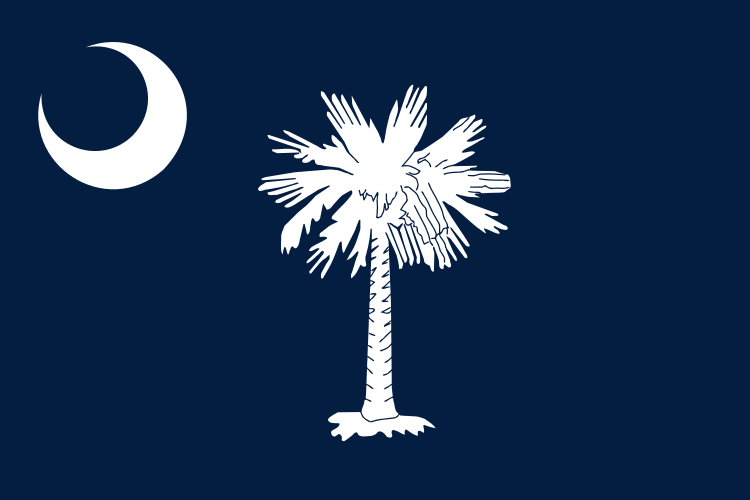
South Carolina located in the Southeastern South Atlantic and Deep...

Justice in its broadest sense is the concept of treating...

Travel involves the movement of people between geographical locations using...
Trending

3 hours ago Billionaire Len Blavatnik Extends Crucial Financial Support to Sports Streamer DAZN

3 hours ago Michael J. Fox Celebrates Christopher Lloyd's 88th Birthday with Back to the Future Tribute

13 days ago Sharon Osbourne Discusses Ozzy Osbourne's Emotional Farewell Concert Film Back to the Beginning

4 hours ago Alex de Minaur Faces Tomas Machac at the Erste Bank Open in Vienna

4 hours ago Kristen Bell Enlists Daughters to Monitor Husband Dax Shepard During His Parenting Time
4 hours ago Bleach Anime Series Reaches Its Epic Conclusion
Popular

Ilhan Omar is a prominent American politician currently serving as...

Ken Paxton is an American politician and lawyer serving as...

Elon Musk is a visionary entrepreneur and engineer known for...

Greg Abbott is the current and th Governor of Texas...
Michael Joseph Jackson the King of Pop was a highly...

Barack Obama the th U S President - was the...