


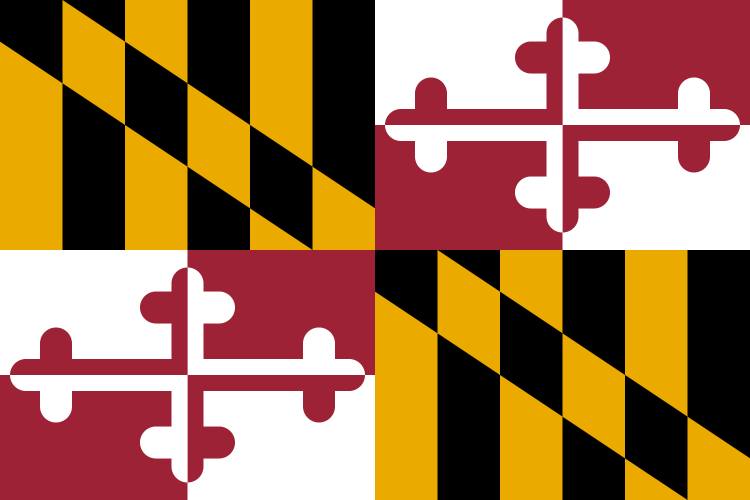
Maryland is a Mid-Atlantic U.S. state bordering Virginia, West Virginia, Pennsylvania, Delaware, the Atlantic Ocean, and Washington, D.C. It's the ninth-smallest state by land area but ranks 19th in population, making it densely populated. Annapolis is the capital, while Baltimore is the most populous city.
1902: Labor and Education Reforms
In 1902, the state regulated conditions in mines, outlawed child laborers under the age of 12, mandated compulsory school attendance, and enacted the nation's first workers' compensation law.


1904: Republican Coalition in State Government
In 1904, Blacks were part of a biracial Republican coalition elected to state government and comprised 20% of the electorate.
1904: The Great Baltimore Fire
In 1904, the Great Baltimore Fire burned for more than 30 hours, destroying 1,526 buildings and spanning 70 city blocks.
1905: Disenfranchisement Bills
In 1905, a disenfranchisement bill was rebuffed due to black opposition. Blacks comprised 20% of the electorate and immigrants comprised 15%, and the legislature had difficulty devising requirements against blacks that did not also disadvantage immigrants.
1907: Disenfranchisement Bills
In 1907, a disenfranchisement bill was rebuffed due to black opposition. Blacks comprised 20% of the electorate and immigrants comprised 15%, and the legislature had difficulty devising requirements against blacks that did not also disadvantage immigrants.
1908: Political Reforms Passed
In 1908, reformers worked for standard state-issued ballots, closed voting booths, primary elections and candidates listed without party symbols to discourage the illiterate from participating.
1909: College Park Airport founded
The College Park Airport is the nation's oldest, founded in 1909, and is still used.
1910: Workers' Compensation Law Enacted
In 1910, the workers' compensation law, after being redrafted, was finally enacted after being overturned in the courts.
1911: Disenfranchisement Bills
In 1911, a disenfranchisement bill was rebuffed due to black opposition. Blacks comprised 20% of the electorate and immigrants comprised 15%, and the legislature had difficulty devising requirements against blacks that did not also disadvantage immigrants.
1917: New Military Bases Established
In 1917, with the nation's entry into World War I, new military bases such as Camp Meade, the Aberdeen Proving Ground, and the Edgewood Arsenal were established, and existing facilities were greatly expanded.
1923: "Free State" Nickname Coined
In 1923, after Georgia congressman William D. Upshaw criticized Maryland for not passing Prohibition laws, Baltimore Sun editor Hamilton Owens coined the "Free State" nickname for Maryland, which was popularized by H. L. Mencken.
1932: "Bonus Army" Marched Through
In 1932, during the Great Depression, the "Bonus Army" marched through Maryland on its way to Washington, D.C.
1937: First Income Tax Instituted
In 1937, Maryland instituted its first income tax to generate revenue for schools and welfare.
1952: Chesapeake Bay Bridge Completed
In 1952, the eastern and western halves of Maryland were linked for the first time by the Chesapeake Bay Bridge, which replaced a nearby ferry service.
1953: Baltimore Colts Represent the NFL
From 1953, the Baltimore Colts represented the NFL in Baltimore.
1962: End of Steamboat Service
In 1962, passenger and freight steamboat service, once important throughout Chesapeake Bay and its many tributary rivers, ended.
1962: Jousting as State Sport
Since 1962, jousting has been the official state sport of Maryland.
1970: Population Composition
In 1970, the U.S. Census Bureau reported Maryland's population as 17.8 percent African-American and 80.4 percent non-Hispanic White.
1973: Spiro Agnew Resignation
In 1973, former Governor Spiro Agnew, a Republican, resigned after pleading no contest to tax evasion.
1974: Maryland Submits Desegregation Plans
In 1974, Maryland submitted plans to desegregate its state universities, and the plans were approved by the U.S. Department of Health, Education and Welfare.
1980: Maryland Votes for Jimmy Carter
In 1980, Maryland was among the six states that voted for Jimmy Carter in the presidential election.
1983: Baltimore Colts Move to Indianapolis
In 1983, the Baltimore Colts moved to Indianapolis.
1990: Increase in European Immigrants
The shares of European immigrants born in Eastern Europe increased significantly between 1990 and 2010.
1992: Bill Clinton's Performance in Maryland
In 1992, Bill Clinton performed better in Maryland than in any other state except Arkansas, his home state.
1994: Baltimore Stallions CFL season
The Baltimore Stallions were a Canadian Football Team in the CFL that played the 1994–95 season.
1996: Clinton's Sixth Best State
In 1996, Maryland was Clinton's sixth-best performing state.
1997: Arena Construction in Washington, D.C.
In 1997, the construction of an arena in Washington, D.C. (now known as Capital One Arena) led to the Washington Capitals and Washington Wizards playing there.
2000: Maryland Ranks Fourth for Gore
In 2000, Maryland ranked fourth in terms of support for Al Gore in the presidential election.
2001: Protections against discrimination
Since 2001, protections against discrimination enacted for sexuality.
2002: Robert Ehrlich Elected Governor
In 2002, Robert Ehrlich became the first Republican governor elected in Maryland in four decades.
2003: Robert Ehrlich in office
Construction of the Intercounty Connector was a major part of the campaign platform of former Governor Robert Ehrlich, who was in office from 2003 until 2007.
2003: Charter School Law Change
In 2003, Maryland law was changed to allow for the creation of publicly funded charter schools, which must be approved by local Boards of Education.
2003: Hoyer Becomes House Minority Whip
In 2003, Steny Hoyer began serving as House Minority Whip.
2004: Kerry's Fifth-Best Performance
In 2004, John Kerry had his fifth-best performance in Maryland during the presidential election.
2004: Lacrosse as Official Team Sport
Since 2004, lacrosse has been the official team sport of Maryland.
2005: Less Toxic Waste Per Capita
In 2005, Maryland managed less toxic waste per capita than all but six states.
February 2006: Dubai Ports World deal controversy
In February 2006, Baltimore City was one of six major U.S. ports involved in the controversy over the Dubai Ports World deal.
2006: Foreign Born Population Counted
In 2006, 645,744 people in Maryland were counted as foreign born, mainly from Latin America and Asia, with about four percent being undocumented immigrants.
2006: Hoyer Serves as House Minority Whip
In 2006, Steny Hoyer served as House Minority Whip.
2006: Democratic Dominance Continues
The 2006 election in Maryland saw Democratic Congressman Benjamin Cardin defeat Republican Lieutenant Governor Michael S. Steele in the race for the U.S. Senate, continuing the pattern of Democratic dominance.
April 2007: Joined Regional Greenhouse Gas Initiative
In April 2007, Maryland joined the Regional Greenhouse Gas Initiative (RGGI) to reduce greenhouse gas emissions.
2007: Robert Ehrlich out of office
Construction of the Intercounty Connector was a major part of the campaign platform of former Governor Robert Ehrlich, who was in office from 2003 until 2007.
2007: Steny Hoyer Elected Majority Leader
In 2007, U.S. Congressman Steny Hoyer (MD-5), a Democrat, was elected as Majority Leader for the 110th Congress.
May 2008: Maryland Leads in AP Exam Passing Rates
In May 2008, Maryland led the entire country in the percentage of students passing Advanced Placement examinations, with 23.4 percent earning passing grades.
2008: Obama Wins Maryland
In 2008, Barack Obama won Maryland's 10 electoral votes with 61.9 percent of the vote, while John McCain received 36.5 percent.
2008: Port of Baltimore ranking
In 2008, the Port of Baltimore ranked 17th in the U.S. by tonnage.
2008: Walking as Official State Exercise
In 2008, walking became the official state exercise of Maryland.
2008: McCain Wins More Counties
In the 2008 election, John McCain won 17 counties in Maryland, while Barack Obama won six counties plus Baltimore City; Obama won by 25 points statewide.
2009: Education Week Ranks Maryland #1
In 2009, Education Week ranked Maryland #1 in its nationwide Quality Counts reports.
2009: Education Budget
In 2009, Maryland's budget for education was $5.5 billion, representing about 40 percent of the state's general fund.
2009: Maryland High Schools Ranked by US News
In 2009, three Maryland high schools were ranked among the top 100 in the country by US News, based in large part on AP test scores.
February 2010: Attorney General Opinion on Same-Sex Marriages
In February 2010, Attorney General Doug Gansler issued an opinion stating that Maryland law should honor same-sex marriages from out of state, even though the state Supreme Court upheld marriage discrimination at the time.
2010: U.S. census
According to The Williams Institute's analysis of the 2010 U.S. census, 12,538 same-sex couples were living in Maryland, representing 5.8 same-sex couples per 1,000 households.
2010: Republicans Win Control of Most Counties
In 2010, Republicans gained control of most counties in Maryland, while the Democratic Party retained control of eight county governments, including Baltimore.
2010: Ehrlich Loses to O'Malley
In 2010, Robert Ehrlich ran for governor again but lost to the incumbent, Democrat Martin O'Malley.
2010: Increase in European Immigrants
The shares of European immigrants born in Eastern Europe increased significantly between 1990 and 2010.
January 2011: Gonzales Research & Marketing Strategies poll
A January 2011 Gonzales Research & Marketing Strategies poll showed 51% support for marriage in the state.
2011: Steny Hoyer as Majority Leader
In 2011, U.S. Congressman Steny Hoyer (MD-5) served as Majority Leader for the 111th Congress.
2011: Virginia Earthquake Felt
In 2011, the M5.8 Virginia earthquake was felt moderately throughout Maryland.
March 1, 2012: Freedom to marry bill signed into law
On March 1, 2012, Maryland Governor Martin O'Malley signed the freedom to marry bill into law after it passed in the state legislature.
May 2012: Court of Appeals ruling
In May 2012, Maryland's Court of Appeals ruled that the state will recognize marriages of same-sex couples who married out-of-state, no matter the outcome of the November election.
November 6, 2012: Voters uphold same-sex marriage bill
On November 6, 2012, voters upheld the same-sex marriage bill, passing Question 6 with 52% to 48%.
November 2012: Referendum on same-sex marriage law
In November 2012, opponents of same-sex marriage faced a referendum, as Question 6, to overturn the freedom to marry law.
2012: Multiply resistant ragweed
An unusual multiply resistant ragweed (Ambrosia artemisiifolia) was found by Rousonelos et al., 2012 with both ALS- and PPO-resistances.
2012: Hoyer Becomes House Minority Whip Again
In 2012, Steny Hoyer began serving as House Minority Whip again.
2012: Baltimore Sun's Top Athletes List
In 2012, The Baltimore Sun published a list of Maryland's top ten athletes in the state's history.
January 1, 2013: Same-sex couples begin marrying
On January 1, 2013, same-sex couples began marrying in Maryland.
2013: Wealthiest households in the country
According to the U.S. Census Bureau, Maryland households are currently the wealthiest in the country, with a 2013 median household income of $72,483, which puts it ahead of New Jersey and Connecticut. Maryland has the most millionaires per capita in 2013, with a ratio of 7.7 percent.
2013: Education Week Ranks Maryland #1
In 2013, Education Week ranked Maryland #1 in its nationwide Quality Counts reports.
2013: Same-sex marriage legalization
In 2013, same-sex marriage legalization in Maryland.
2014: Pew Research Center findings
According to the Pew Research Center in 2014, 69 percent of Maryland's population identified themselves as Christian, with nearly 52% being Protestants and Catholicism being the second largest religious affiliation at 15%.
2014: Healthcare payment reforms
In 2014, Maryland switched to a global budget revenue system for healthcare, whereby hospitals receive a capitated payment to care for their population.
2014: Protections against discrimination enacted for gender
In 2014, protections against discrimination enacted for gender.
2014: Maryland traffic fatalities
The Department of Transportation recorded over 500 traffic fatalities in Maryland for 2014.
2015: Highest Median Household Income
As of 2015, Maryland had the highest median household income of any state in the U.S., largely due to its proximity to Washington, D.C., and a diverse economy.
2015: Nepal earthquake
Following the 2015 Nepal earthquake, many Nepali Americans, including Bhutanese Americans of Nepali descent, sought asylum in Maryland.
2016: Most Spoken Languages
As of 2016, the most spoken languages in Maryland other than English were Spanish (9%), Chinese (1.2%), West African languages (mostly Yoruba and Igbo, 1%), French (1%), Korean (0.7%), Afro-Asiatic languages (mostly Amharic, 0.6% and Arabic, 0.4%), and Tagalog (0.6%).
2016: Ragweed resistance development
By 2016, the multiply resistant ragweed had developed a third, EPSP resistance.
2016: Change in Birth Data Collection
Since 2016, data for births of White Hispanic origin are not collected, but included in one Hispanic group; persons of Hispanic origin may be of any race.
March 2017: Ban on Fracking
In March 2017, Maryland became the first state with proven gas reserves to ban fracking by passing a law against it.
May 2017: Democratic Party registration
As of May 2017, the Democratic Party accounted for 54.9% of Maryland's registered voters.
2017: Health insurers market share
As of 2017, the top two health insurers including all types of insurance were CareFirst BlueCross BlueShield with 47% market share followed by UnitedHealth Group at 15%.
2017: Maryland Districts in Top Spending
Data from the 2017 census shows that four Maryland school districts are in the top six for per-pupil annual spending among large school districts.
2018: End of Hoyer's Term as Minority Whip
In 2018, Steny Hoyer's term as House Minority Whip came to an end.
2018: Top Countries of Origin for Immigrants
In 2018, The top countries of origin for Maryland's immigrants were El Salvador (11%), India (6%), China (5%), Nigeria (5%), and the Philippines (4%).
2018: Bans on conversion therapy
In 2018, bans on conversion therapy enacted.
July 1, 2019: Maryland Population Estimate
On July 1, 2019, The United States Census Bureau estimated that the population of Maryland was 6,045,680, a 4.71% increase from the 2010 United States census and an increase of 2,962, from the prior year.
2019: Hoyer Serves as Majority Leader Again
In 2019, U.S. Congressman Steny Hoyer served as Majority Leader again.
2019: Majority Minority State
In 2019, non-Hispanic white Americans were 49.8% of Maryland's population (White Americans, including White Hispanics, were 57.3%), which made Maryland a majority minority state.
2020: African American Portion of Population
As of 2020, African Americans form 31.1% of Maryland's population.
2020: Native American Identification
In 2020, 31,845 people in Maryland identified as being Native American alone, and 96,805 identified as being Native American in combination with one or more other races.
2020: LGBTIQ+ bill of rights
In 2020, Montgomery County unanimously passed an ordinance implementing an LGBTIQ+ bill of rights.
2020: United States Census
In the 2020 United States census, the United States Census Bureau found that population of Maryland was 6,185,278 people, a 7.1% increase from the 2010 United States census.
2020: Public Religion Research Institute findings
Per the Public Religion Research Institute in 2020, 61 percent of Maryland's population identified with Christianity, with Protestantism and Roman Catholicism dominating, the Jewish community remained at 3%, and the unaffiliated increased to 28% of the population.
2021: Abolition of the gay panic defense
In 2021, abolition of the gay panic defense.
March 2022: State's unemployment rate
As of March 2022, the state's unemployment rate was 4.6 percent.
May 7, 2022: Worst multiresistant weed problem
As of May 7, 2022, the multiply resistant ragweed population is the worst multiresistant weed problem in the state, affecting soybean cultivation.
2022: Homeless Population Estimate
According to HUD's 2022 Annual Homeless Assessment Report, there were an estimated 5,349 homeless people in Maryland.
2022: Wes Moore Elected Governor
In 2022, Wes Moore was elected as the Governor of Maryland, replacing Larry Hogan. Moore is the first African-American elected Governor of Maryland.
2022: Top private employers
In 2022, the top private employers by number of employees in Maryland were BYK Gardner, Clean Harbors, Holy Cross Hospital, Johns Hopkins Bayview Medical Center, Johns Hopkins University Applied Physics Laboratory, Johns Hopkins University School of Medicine, Maryland Neuroimaging Center, Northrop Grumman, University of Maryland, and University of Maryland Medical Center.
2023: Data on Haitian population
According to 2023 Census Bureau data, Maryland is home to nearly 17,000 Haitians.
2023: Warrior Run Coal Plant Retirement Announced
In 2023, AES Corporation announced its intent to retire the 23-year-old Warrior Run coal plant in June 2024.
2023: End of Hoyer's Term as Majority Leader
In 2023, U.S. Congressman Steny Hoyer's term as Majority Leader came to an end.
2023: Rights of transgender individuals
In 2023, issuance of an executive order protecting the rights of transgender individuals and 5.4% of Marylanders identify as lesbian, gay, bisexual, or transgender, 0.1% below the national average.
June 2024: Retirement of Warrior Run Coal Plant
In June 2024, AES Corporation intends to retire the 23-year-old Warrior Run coal plant. It was the state's last coal-fired power plant that did not already have plans to shut down.
2024: Gross State Product
The Bureau of Economic Analysis estimates that Maryland's Gross State Product in 2024 was $433 billion. Montgomery County’s Gross Domestic Product (GDP) of more than $117 Billion makes up 25% of the state’s total economy as of 2024. Per capita personal income in 2024 was $78,538.
2025: Small businesses in Maryland
In 2025, 99.6% of businesses in Maryland were small businesses, and employed 47.9% of the state's workforce.
2025: Maryland Legislation to Counter Trump's Immigration Orders
In 2025, Maryland passed the "Protecting Sensitive Locations Act", limiting ICE access to schools and health facilities, as a countermeasure to President Trump's immigration-related executive orders.
2025: Maryland traffic fatalities
The Maryland Department of Transportation reported 480 fatalities in Maryland for 2025, the first recording below 500 since 2014.
2027: MCAP to Determine 3rd Grade Promotion
As of 2027, the Maryland Comprehensive Assessment Program (MCAP) will be used to determine whether 3rd-grade students would need to repeat the grade level or could proceed to the 4th grade.
2031: Minorities Projected Majority of Voting Eligible Residents
By 2031, minorities are projected to become the majority of voting eligible residents of Maryland.
Mentioned in this timeline
Basketball is a team sport played on a rectangular court...
Barack Obama the th U S President - was the...
Bill Clinton served as the nd U S President from...
The United States of America is a federal republic primarily...
Babe Ruth an American professional baseball player - is widely...

Al Gore served as the th U S Vice President...
Trending

3 hours ago Alejandro Davidovich Fokina Faces Crucial Shanghai Masters Quarterfinal Matchup

4 hours ago Elina Svitolina Faces Hanyu Guo in WTA Wuhan Open Tennis Match
4 hours ago No Escape London Launches Nine Terrifying Horror Escape Rooms for Halloween 2026

4 hours ago Kevin Durant Gains Recognition in Latest NBA Player Rankings

3 hours ago Selena Gomez Shines at Rare Impact Fund Benefit Raising Millions for Mental Health
4 hours ago Harrison Ford Transforms Wyoming Ranch into Wildlife Sanctuary and Achieves Career Milestones
Popular
Ilhan Omar is a prominent American politician currently serving as...

Ken Paxton is an American politician and lawyer serving as...

Jameis Winston is an American football quarterback currently playing for...

Elon Musk is a visionary entrepreneur and engineer known for...

Kimberly Guilfoyle is an American television personality and former prosecutor...

Michael Joseph Jackson the King of Pop was a highly...