


A low-carbon economy (LCE) aims to balance greenhouse gas emissions with absorption, addressing human-caused climate change, predominant since the mid-20th century. Transitioning to an LCE involves various strategies, including promoting renewable energy sources, practicing energy conservation, and electrifying transportation systems. Zero-carbon cities serve as a concrete example of this approach.
2005: Kyoto Protocol Comes Into Force
In 2005, the Kyoto Protocol came into force, marking a significant early step towards a low-carbon economy. Under the protocol, most industrialized countries committed to reducing their carbon emissions.


2015: Paris Agreement on Climate Change
In 2015, the Paris Agreement on climate change set goals to reduce emissions as soon as possible and reach net-zero by mid-century.
2017: UK Office for National Statistics Definition
In 2017, the UK Office for National Statistics defined the low carbon economy as economic activities delivering goods and services that generate significantly lower greenhouse gas emissions, predominantly carbon dioxide.
2020: Low-Carbon Electricity Generation
In 2020, almost 40% of global electricity generation came from low-carbon sources, including nuclear power (about 10%), wind and solar (almost 10%), and hydropower and other renewables (around 20%). Very little low-carbon power came from fossil sources, mostly due to the cost of CCS technology.
2021: Expansion of Nuclear Energy
As of 2021, agencies like the United Nations Economic Commission for Europe, the International Energy Agency (IEA), and the International Atomic Energy Agency support the expansion of nuclear energy as a method of achieving a low-carbon economy.
2024: Clean Energy Cost
After 2024, clean energy is cheaper than ever. Global solar module prices fell 35 percent to less than 9 cents/kWh. EV batteries saw their best price decline in seven years.
2040: IEA Decarbonization Goal
The International Energy Agency (IEA) believes that widespread decarbonization must occur by 2040 in order mitigate the adverse effects of climate change and that nuclear power must play a role.
Mentioned in this timeline
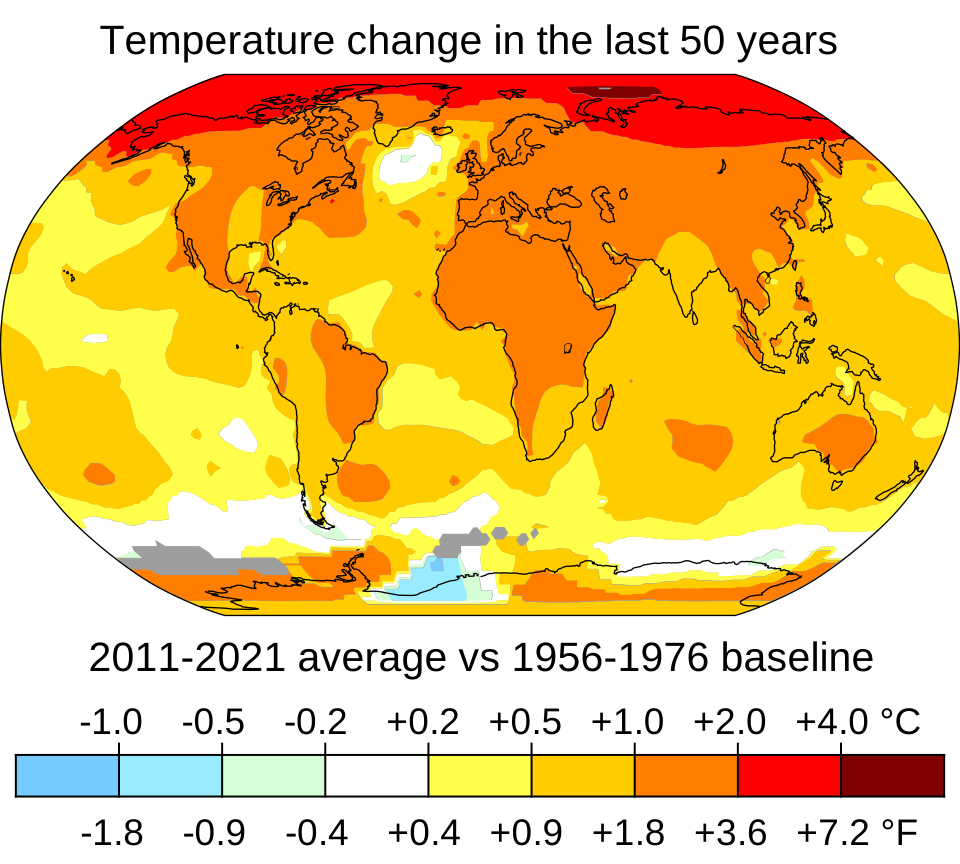
Climate change refers to long-term shifts in global temperatures and...
Paris is the capital and largest city of France situated...
The United Nations UN is an intergovernmental organization founded in...
A fossil is any preserved remain impression or trace of...

Gas is a state of matter characterized by the absence...
An economy encompasses the production distribution trade and consumption of...
Trending

4 hours ago Arthur Fils and Top Players Featured at the ATP 500 Basel Tournament

4 hours ago Rapper Yella Beezy Faces Trial for Alleged Involvement in Rapper Mo3 Murder

4 hours ago The View Executives Consider Future for Joy Behar Following Serious On-Set Injury

5 hours ago Carlos Alcaraz Joins Spain Squad for 2026 Davis Cup Final 8 in Bologna

5 hours ago Kyle Larson Secures First NASCAR Cup Series Victory at Talladega Amidst Controversy

5 hours ago FBI Conducts Raid on Beverly Hills Mansion Linked to Eric Swalwell Investigation
Popular

Ilhan Omar is a prominent American politician currently serving as...

Ken Paxton is an American politician and lawyer serving as...

Elon Musk is a visionary entrepreneur and engineer known for...

William Franklin Graham III known as Franklin Graham is an...

Barack Obama the th U S President - was the...

Greg Abbott is the current and th Governor of Texas...