


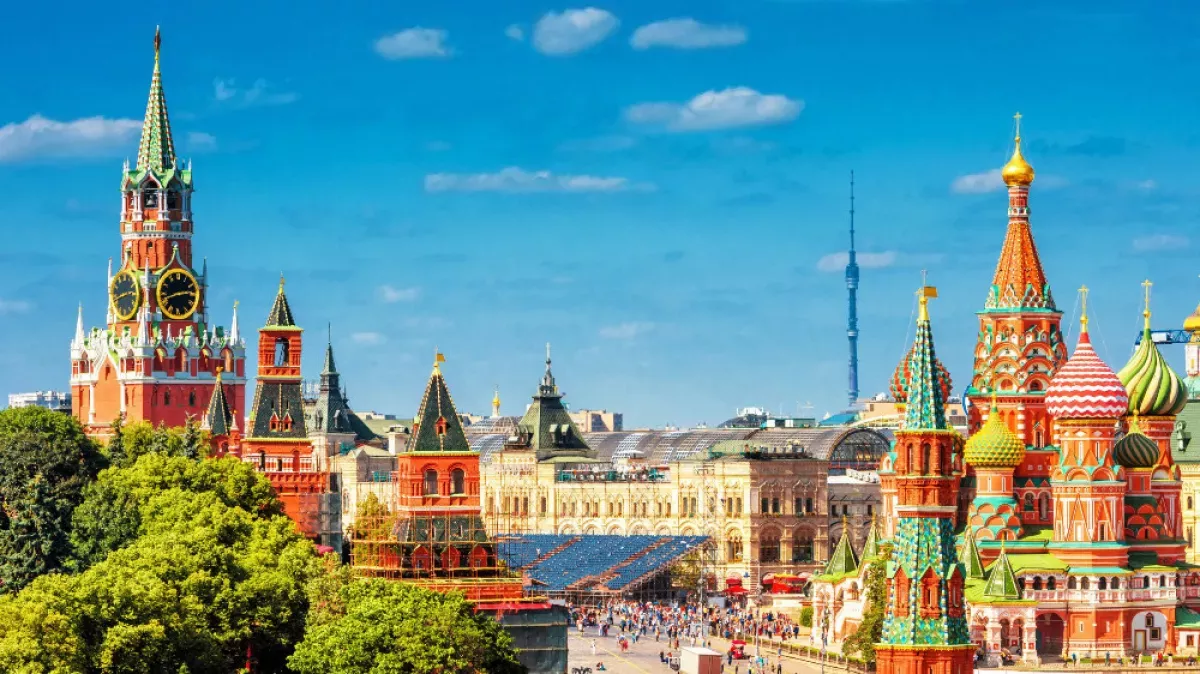
Moscow is the capital and largest city of Russia, situated on the Moskva River. It boasts a population exceeding 13 million within the city, over 19.1 million in its urban area, and over 21.5 million in its metropolitan area. Spanning 2,511 square kilometers, the city anchors the largest urban and metropolitan area in Europe, and is the largest city by land area on the European continent. It is one of the world's biggest cities.
8 hours ago : Massive Ukrainian Drone Attacks Target Moscow During Russian Parliamentary Elections
Ukraine launched a significant drone and missile assault against Moscow and an oil refinery, coinciding with the third day of Russia's parliamentary elections, resulting in casualties and infrastructure damage.


1902: Savyolovsky Rail Terminal built
In 1902, the suburban Savyolovsky Rail Terminal was built in Moscow.
1903: Moskvoretskaya water supply completed
In 1903 the Moskvoretskaya water supply was completed.
1903: Formation of Moskovskaya Okruzhnaya Zheleznaya Doroga
In 1903, the Moskovskaya Okruzhnaya Zheleznaya Doroga formed a ring around the now-downtown Moscow, serving as a non-electrified, fueled locomotive-only railway.
January 1905: Alexander Adrianov became Moscow's first official mayor
In January 1905, the institution of the City Governor, or Mayor, was officially introduced, and Alexander Adrianov became Moscow's first official mayor.
1906: Foundation of Pirogov Russian National Research Medical University
In 1906, the Pirogov Russian National Research Medical University (formerly known as Russian State Medical University) was founded in Moscow.
1915: Population reaches 1.8 million
By 1915, the population of Moscow had grown tenfold, reaching 1.8 million.
November 1917: Bolsheviks began their uprising
In November 1917, upon learning of the uprising in Petrograd, Moscow's Bolsheviks began their uprising.
March 1918: Capital moved back to Moscow
On 12 March 1918 Vladimir Lenin moved the capital back to Moscow.
1918: Capital moved back to Moscow
In 1918, following the Russian Revolution and the establishment of the Russian SFSR, the capital was moved back to Moscow.
1919: VGIK Foundation
In 1919, the Gerasimov All-Russian State Institute of Cinematography (VGIK) was founded by Vladimir Gardin.
1929: Anti-religious campaign launched
In 1929, a new anti-religious campaign was launched, coinciding with the collectivization of peasants.
1932: Destruction of churches peaked
Around 1932, the destruction of churches in the cities peaked.
November 1933: Opening of Moscow trolleybus system
On 15 November 1933, the Moscow trolleybus system was opened, becoming the world's 6th oldest operating trolleybus system.
1933: Arrest of British Engineers
In 1933, numerous British engineers from the Metropolitan Vickers Electrical Company were arrested by the NKVD for espionage and deported, ending British business involvement in the USSR.
1935: Greenbelt built
In 1935 Soviet-era urban-growth controls produced controlled and sustainable metropolitan development, typified by the greenbelt.
1935: Moscow Metro Opens
In 1935, the Moscow Metro began operations, becoming a centerpiece of the transportation system and a Stalinist device to promote Soviet realist art and values.
1937: Suggestion to rename Moscow rejected
In 1937, letters were written to the Central Committee of the Communist Party of the Soviet Union to rename Moscow to "Stalindar" or "Stalinodar", but Stalin rejected this suggestion.
1937: Built North River Terminal
The North River Terminal in Moscow was built in 1937, serving as the main hub for long-range river routes.
January 1940: Lowest temperature ever recorded in Moscow
In January 1940, the lowest ever recorded temperature was −42.1 °C (−43.8 °F).
September 1941: German Army Group Centre stopped at the outskirts of Moscow
Between 30 September 1941, and 7 January 1942, the German Army Group Centre was stopped at the outskirts of the city.
October 1941: German Army Group Centre stopped at the outskirts of Moscow
Between October 1941 and January 1942, the German Army Group Centre was stopped at the outskirts of the city.
January 1942: German Army Group Centre driven off in the Battle of Moscow
Between October 1941 and January 1942, the German Army Group Centre was driven off in the Battle of Moscow.
May 1944: Medal "For the defence of Moscow" instituted
On 1 May 1944, a medal "For the defence of Moscow" was instituted.
1944: Moscow State Institute of International Relations Foundation
In 1944, the Moscow State Institute of International Relations was founded.
1947: Medal "In memory of the 800th anniversary of Moscow" instituted
In 1947, another medal "In memory of the 800th anniversary of Moscow" was instituted.
1953: Moscow State University moved to new campus
In 1953, Moscow State University moved to its campus on Sparrow Hills.
1958: City of Zelenograd built
In 1958, the city of Zelenograd was built at 37 kilometres (23 miles) from the city centre to the north-west, along with the Leningradskoye Shosse.
1959: Anti-religious campaign launched by Khrushchev
In 1959, Nikita Khrushchev launched his anti-religious campaign, closing and demolishing many of Moscow's churches.
1960: Moscow Ring Road as Boundary
In 1960, the Moscow Ring Road (MKAD) became Moscow's boundary.
1961: Moscow Ring Road opened
The Moscow Ring Road (MKAD) was opened in 1961.
May 1965: Moscow awarded title of Hero City
On 8 May 1965, Moscow was awarded a title of the Hero City.
1979: Soviet Union's invasion of Afghanistan
In 1979, the Soviet Union invaded Afghanistan.
1979: Restoration of "Grand Designs" for Metro Stations
In late 1979, the tradition of "Grand Designs" was restored, decorating metro stations as single-themed installations.
1980: Moscow hosted Summer Olympic Games
In 1980, Moscow hosted the Summer Olympic Games.
1980: Host city of the Summer Olympics
In 1980, Moscow was the host city of the Summer Olympics.
1984: Construction of the newest tram line
In 1984, the newest tram line was built in Moscow, after the construction of the tram system started in 1899.
1988: Fyodorov Eye Microsurgery Complex Foundation
In 1988, the Fyodorov Eye Microsurgery Complex was founded by Svyatoslav Fyodorov.
1991: Coup attempt in Moscow
In 1991, Moscow was the scene of a coup attempt by conservative communists opposed to the liberal reforms of Mikhail Gorbachev.
1991: Average July temperature recorded
The average July temperature from 1991 to 2020 is 19.7 °C (67.5 °F).
1991: Moscow remains capital of Russian Federation
When the USSR was dissolved in 1991, Moscow remained the capital of the Russian Federation.
1992: Planning of Moscow International Business Center
In 1992, the Moscow government began planning the Moscow International Business Center, aiming to create a zone combining business, living space, and entertainment.
1995: MKAD ring road widened
In 1995–97 the MKAD ring road was widened from the initial four to ten lanes.
1998: Russian Financial Crisis Impact
Since the 1998 Russian financial crisis, business sectors in Moscow experienced exponential growth, but crime and corruption continue to hinder business development.
2000: Average Sunshine Hours recorded
Between 2004 and 2010, the average was between 1800 and 2000 hours with a tendency to more sunshine in summer months.
2001: Extreme heat observed in Moscow
During the summer of 2001, extreme heat was observed in Moscow.
December 2002: Bulvar Dmitriya Donskogo metro station opened
In December 2002, Bulvar Dmitriya Donskogo became the first Moscow Metro station that opened beyond the limits of MKAD.
2002: Extreme heat observed in Moscow
During the summer of 2002, extreme heat was observed in Moscow.
2003: Extreme heat observed in Moscow
During the summer of 2003, extreme heat was observed in Moscow.
2003: Local Self-Government Organization
In 2003, according to the law "On the organization of local self-government in the city of Moscow", municipalities became the executive bodies, and municipal assemblies, whose members are elected, became the representative bodies of local self-government.
2003: Park Pobedy Station Completion
In 2003, the Park Pobedy station of the Moscow Metro was completed, becoming one of the deepest stations in the world.
2004: Major Reform of Heating System
A major reform launched in 2004 consolidated various heating companies under the umbrella of MIPC, which became the municipal heat supplier.
2004: Average Sunshine Hours recorded
Between 2004 and 2010, the average was between 1800 and 2000 hours with a tendency to more sunshine in summer months.
2004: Opening of Moscow Metro monorail line
In 2004, the Moscow Metro opened a short monorail line (line 13) connecting Timiryazevskaya metro station and Ulitsa Sergeya Eisensteina, passing close to VDNH.
2004: Third Ring Road completed
In 2004, the Third Ring Road was completed.
2005: Reform of Mosenergo
In 2005, Mosenergo was reformed, separating around ten subsidiaries from it, including the District Heating Network Company (MTK).
2005: Third Automobile Ring Completion
In 2005, the Third Automobile Ring in Moscow was completed, following the radial-circle planning defining the city's development.
2005: Opening of the Delovoi Tsentr station
The Delovoi Tsentr station opened in 2005, as one of three metro stations planned for the Filyovskaya Line.
2006: Frosts reaching -30.0°C observed
At the end of January–February 2006, frosts reaching −30.0 °C (−22.0 °F) observed.
2006: Most Expensive City for Expatriates
In 2006, Mercer Human Resources Consulting named Moscow the world's most expensive city for expatriate employees, due to the stable Russian ruble and rising housing prices.
2006: Branch extended to the Mezhdunarodnaya station
In 2006, the branch extended to the Mezhdunarodnaya station.
2007: Most Expensive City for Expatriates
In 2007, Moscow ranked first in the Mercer Human Resources Consulting survey as the most expensive city for expatriate employees.
2007: Government Stake in MTK
In 2007, the Government of Moscow bought controlling stakes in the District Heating Network Company (MTK).
2007: Record high and average temperatures recorded
Record high and average temperatures were recorded for January, March, April, May, June, July, August, November, and December in 2007–2022.
2008: Most Expensive City Ranking
In 2008, Moscow was ranked as the most expensive city for the third consecutive year.
2008: Constitutional Court Relocation
In 2008, the Constitutional Court of the Russian Federation relocated to Saint Petersburg, while the legislative, executive, and judicial federal authorities remained in Moscow.
2009: Renaming of Delovoi Tsentr station
In 2009, the Delovoi Tsentr station was renamed Vystavochnaya, part of the Filyovskaya Line.
July 2010: Highest temperature ever recorded in Moscow
On 29 July 2010, the highest temperature ever recorded was 38.2 °C (100.8 °F) at the VVC weather station and 39.0 °C (102.2 °F) in the center of Moscow and Domodedovo airport during the unusual 2010 Northern Hemisphere summer heat waves.
2010: Average Sunshine Hours recorded
Between 2004 and 2010, the average was between 1800 and 2000 hours with a tendency to more sunshine in summer months.
2010: Extreme heat observed in Moscow
During the summer of 2010, extreme heat was observed in Moscow.
2010: Reconstruction into MCC
In the 2010's the Moskovskaya Okruzhnaya Zheleznaya Doroga was reconstructed into MCC.
2011: Extreme heat observed in Moscow
During the summer of 2011, extreme heat was observed in Moscow.
2011: Public Education Issues
In 2011, The New York Times reported on corruption issues affecting Moscow's public school system, with parents bribing officials for admissions and good grades.
2011: "Our city" Geo-Information Portal Creation
In 2011, the "Our city" geo-information portal was created under Mayor Sergei Sobyanin to build a constructive dialogue between Moscow residents and city authorities.
July 2012: Territorial expansion of Moscow
On 1 July 2012, Moscow's territory more than doubled, becoming the largest city on the European continent by area.
2012: Frosts reaching -30.0°C observed
At the end of January–February 2012, frosts reaching −30.0 °C (−22.0 °F) observed.
September 2013: Direct Elections Held
In September 2013, direct elections for the mayor of Moscow took place after the current mayor resigned, ahead of the planned 2015 elections.
2013: Frosts reaching -30.0°C observed
At the end of January–February 2013, frosts reaching −30.0 °C (−22.0 °F) observed.
July 2014: Record sunshine hours in July
In July 2014, Moscow recorded a record 411 hours of sunshine, 79% of possible sunshine.
2014: Forbes Most Expensive City Ranking
In 2014, according to Forbes, Moscow was ranked the 9th most expensive city in the world.
2014: Destruction of the trolleybus system began
In 2014, the municipal authority, headed by Sergey Sobyanin, began to destroy the trolleybus system in Moscow due to the planned replacement of trolleybuses by electric buses.
2015: Service platforms servicing taxi orders
In 2015, service platforms such as Yandex.Taxi, Uber and Gett were servicing more than 50% of all taxi orders in Moscow.
September 2016: Passenger service started on the Little Ring
On 10 September 2016, passenger service started on the Little Ring of the Moscow Railway, which was converted for frequent passenger service and fully integrated with Moscow Metro.
September 2016: Opening of Moscow Central Circle
On 10 September 2016, the Moscow Central Circle (M.C.C.) was opened for passenger use. It is a 54-kilometre-long urban-metro railway orbital line that encircles historical Moscow.
2016: Cutting of trolleybus wires
In 2016, almost all trolleybus wires inside the Garden Ring (Sadovoe Koltso) were cut due to the reconstruction of central streets ("Moya Ulitsa"), part of the broader effort to dismantle the system that began in 2014.
2016: New Circle Metro Railway Launched
In 2016, authorities launched a new circle metro railway to address transportation issues in Moscow.
2016: Completion of the Federation Tower
In 2016, the Federation Tower was completed, becoming the second-tallest building in Europe. Also four new metro stations were built in the territory.
December 2017: Darkest month in Moscow
December 2017 was the darkest month in Moscow since records began, with only six minutes of sunlight.
2017: Cutting of trolleybus wires
In 2017, almost all trolleybus wires inside the Garden Ring (Sadovoe Koltso) were cut due to the reconstruction of central streets ("Moya Ulitsa"), part of the broader effort to dismantle the system that began in 2014.
November 2018: Opening of cable car above Moskva River
On 26 November 2018, the mayor of Moscow Sergey Sobyanin participated in the ceremony to open the cable car above the Moskva River, connecting the Luzhniki sports complex with Sparrow Hills and Kosygin Street.
2018: Moscow trolleybus system decline
By 2018, the Moscow trolleybus system had declined to only 4 depots and dozens of kilometers of unused wires, continuing the trend that began in 2014.
2018: Host city of the FIFA World Cup
In 2018, Moscow was one of the host cities of the FIFA World Cup.
2018: Moscow's car sharing system became the biggest
In 2018, the mayor Sergey Sobyanin said Moscow's car sharing system has become the biggest in Europe in terms of vehicle fleet. Also in the end of the year Moscow carsharing became the second in the world with 16.5K available vehicles.
2018: Kamaz and GAZ won the Mosgortrans tender
In 2018, the vehicle companies Kamaz and GAZ won the Mosgortrans tender for delivering 200 electric buses and 62 ultra-fast charging stations to the city transport system.
2019: Expectations for Moscow public transport
According to expectations, by 2019, Moscow would become the leader amongst the European cities in terms of electric and gas fuel share in public transport.
2019: Metro Passenger Volume
In 2019, Moscow's metro handled 2.6 billion passengers.
2019: Cost of Living Surveys
In 2019, the Economist Intelligence Unit's Worldwide Cost of Living survey placed Moscow at 102nd, while ECA International's Cost of Living 2019 Survey ranked Moscow at number 120 worldwide.
2019: Launch of the first two lines
On 2019-11-21, the first 2 of 5 projected lines, were completed and launched.
September 2020: Launch of new Wi-Fi access points
In September 2020, Moscow launched 1,700 new access points to the urban Wi-Fi network, allowing citizens to use the internet without re-authorization.
2020: Average July temperature recorded
The average July temperature from 1991 to 2020 is 19.7 °C (67.5 °F).
March 2021: MTS announced pilot 5G network
On 5 March 2021, the cellphone service provider MTS announced they would begin the country's first pilot 5G network in Moscow.
August 2021: Completion of Wi-Fi access points launch
By August 2021, 1,700 new access points to urban Wi-Fi were launched in Moscow, enhancing the city's network of over 21.5 thousand Wi-Fi access points.
2021: Procuring only electric buses
As of 2021, Moscow planned to procure only electric buses, replacing the diesel bus fleet gradually.
2021: Extreme heat observed in Moscow
During the summer of 2021, extreme heat was observed in Moscow.
2021: Moscow Safety Ranking and Surveillance System
In 2021, Moscow was ranked 38th safest city by The Economist. Over 170,000 surveillance cameras connected to a facial recognition system were deployed throughout the city, including residential buildings, schools, transport stations, parks, and underground passages.
2021: Moscow's GRP
In 2021, Moscow's Gross Regional Product (GRP) reached almost ₽24.5 trillion (US$332 billion).
2022: Record high and average temperatures recorded
Record high and average temperatures were recorded for January, March, April, May, June, July, August, November, and December in 2007–2022.
Mentioned in this timeline
Uber Technologies Inc is a multinational transportation company headquartered in...
The Union of Soviet Socialist Republics USSR existed from to...

The apple is a widely cultivated edible fruit originating from...
FIFA or the F d ration Internationale de Football Association...
Music involves arranging sounds to create form harmony melody rhythm...

A car also known as an automobile is a wheeled...
Trending

4 hours ago Russell Wilson Transitions to Broadcasting Career After Fourteen Seasons in the NFL

4 hours ago Puka Nacua Status Uncertain for Monday Night Football Following Persistent Hip and Groin Injuries
2 days ago Terry Bradshaw Criticizes Modern NFL Rule Changes and Excessive Technology Use

4 hours ago Spain Announces New Nations League Squad Roster Featuring Key Stars
4 hours ago Jonathan David Makes Impact With First Goals and Derby Start for Atletico Madrid
4 hours ago Detroit Funeral Home Investigates Mistaken Cremation Case
Popular
Stan Lee - was a pivotal figure in the comic...

Ken Paxton is an American politician and lawyer serving as...
Kash Patel is an American lawyer who currently serves as...

Michael Joseph Jackson the King of Pop was a highly...

Shakira Isabel Mebarak Ripoll the Queen of Latin Music is...

Mitch McConnell is a prominent American politician and the longest-serving...