History of Oklahoma in Timeline


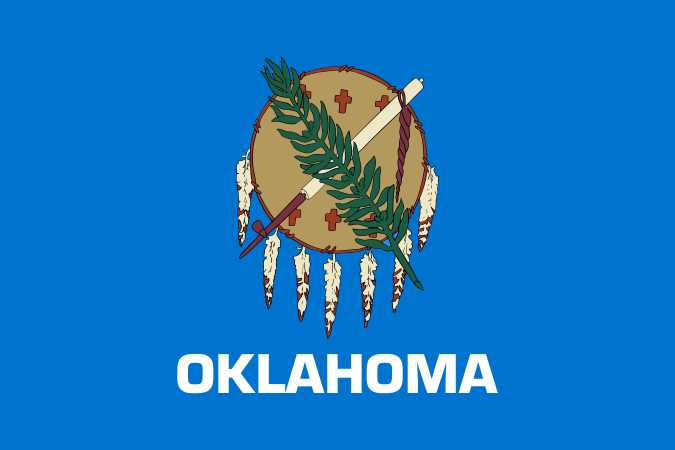
Oklahoma is a U.S. state located in the South Central and Southwestern regions, bordering six other states. It's the 20th-largest and 28th-most populous state, with residents called Oklahomans. Oklahoma City serves as its capital and largest city.
4 hours ago : Oklahoma Forecast: Rain Moving Out Tuesday, More Rainfall Expected Later This Week
Oklahoma experiences rain moving out on Tuesday, but more rainfall and storms are expected later in the week, offering relief but not completely ending the drought. Thursday will be an important day regarding the weather.


1900: White Land Ownership
By 1900, as a result of the Dawes Act of 1887 and the Curtis Act of 1898, about one-half of the land previously owned by Indian tribes was owned by whites, and much of the land allotted to individual Indian heads of families also became white-owned due to sales or fraudulent deprivation.
1901: Wichita Mountains Wildlife Refuge Founded
In 1901, the Wichita Mountains Wildlife Refuge was founded, encompassing 59,020 acres.
1905: Arkansas Acquires Territory
After petitioning Congress to hand over jurisdiction, in 1905, 57 acres of land was given to Arkansas.
1905: Sequoyah Statehood Convention
In 1905, the Sequoyah Statehood Convention laid the groundwork for the Oklahoma Statehood Convention, even though attempts to create an all-Indian state named Oklahoma and a later attempt to create an all-Indian state named Sequoyah had failed.
June 16, 1906: Congressional Statute for Statehood
On June 16, 1906, Congress passed a statute enabling the people of Oklahoma and Indian Territories, along with Arizona and New Mexico, to form a constitution and state government in order to be admitted as a state.
November 16, 1907: Oklahoma Statehood
On November 16, 1907, President Theodore Roosevelt issued Presidential Proclamation no. 780, officially establishing Oklahoma as the 46th state in the Union.
1907: Oklahoma Panhandle Acquired
In 1907, Oklahoma acquired the Oklahoma Panhandle territory upon gaining statehood.
November 11, 1911: Extreme Temperature Fluctuation in Oklahoma City
On November 11, 1911, the temperature in Oklahoma City reached 83 °F (28 °C), then a cold front caused it to plummet to 17 °F (−8 °C) by midnight.
1912: Oklahoma Tornado Outbreak
In 1912, Oklahoma experienced a tornado outbreak due to a warm front traveling along a stalled cold front, resulting in an average of about one tornado per hour.
1915: Revival of Ku Klux Klan
Social tensions were exacerbated by the revival of the Ku Klux Klan after 1915.
September 1918: First Cases of Spanish Flu
In late September 1918, the first cases of the Spanish flu appeared in Oklahoma, overwhelming health workers and local governing bodies, with the American Red Cross mobilizing to mitigate shortages in Oklahoma City.
1919: Spanish Flu Pandemic
In 1919, the Spanish flu pandemic ebbed in Oklahoma, with rough estimates indicating that approximately 100,000 people fell ill with the disease before the pandemic's end. Around 7,500 proved fatal, placing total mortality rates for the state at roughly 7.5%.
1920: Republican Victory
In 1920 Oklahoma was carried by the Republican Party in the presidential elections.
1920: First Radio Station
In 1920, Oklahoma's first radio station, WKY in Oklahoma City, began broadcasting.
1921: Tulsa Race Massacre
In 1921, the Tulsa race massacre occurred, with White mobs attacking Black people and carrying out a pogrom in Greenwood, resulting in the destruction of 35 city blocks, $1.8 million in property damage, and an estimated death toll of between 75 and 300 people.
1927: Campaign to Create U.S. Route 66
In 1927, Oklahoman businessman Cyrus Avery, known as the "Father of Route 66", began the campaign to create U.S. Route 66, using a stretch of highway from Amarillo, Texas to Tulsa, Oklahoma to form the original portion of Highway 66. Avery spearheaded the creation of the U.S. Highway 66 Association to oversee the planning of Route 66, based in his hometown of Tulsa.
1928: Republican Presidential Election Victory
In 1928, Oklahoma was carried by the Republican Party in the presidential elections.
1934: Severe Drought
In 1934, Oklahoma experienced a severe drought with weeks of rainlessness and highs over 100 °F (38 °C).
1939: "The Grapes of Wrath" Published
In 1939, John Steinbeck's novel "The Grapes of Wrath" was published, popularizing a negative cultural stereotype of Oklahomans as uneducated, poverty-stricken Dust Bowl-era farmers.

1940: Non-Hispanic White Population
In 1940, 90.1% of Oklahoma's population was non-Hispanic White.
1948: Political Shift
After the 1948 election, Oklahoma turned firmly Republican.
1949: Broadcast television begins
In 1949, broadcast television in Oklahoma began with KFOR-TV (then WKY-TV) in Oklahoma City and KOTV-TV in Tulsa starting their broadcasts a few months apart.
1950: Population Decline Due to the Dust Bowl
Over a twenty-year period ending in 1950, Oklahoma experienced its only historical decline in population, dropping 6.9 percent as impoverished families migrated out of the state after the Dust Bowl.
1952: Republican Presidential Preference
Since 1952, Oklahoma has been carried by Republican presidential candidates in all but one election.
1953: CBS Omnibus Television Broadcast
In 1953, Ridge Bond and the cast of Oklahoma! were featured on a CBS Omnibus television broadcast.
1954: Severe Drought
In 1954, Oklahoma experienced a severe drought with weeks of rainlessness and highs over 100 °F (38 °C).
1962: University of Oklahoma's Dance Program Founded
In 1962, ballerina Yvonne Chouteau and husband Miguel Terekhov founded the University of Oklahoma's dance program, the first fully accredited program of its kind in the United States.
1964: Democratic Victory
In 1964, Lyndon B. Johnson's landslide victory was the only election since 1952 where Oklahoma was not carried by a Republican presidential candidate.
1973: Black Fox Nuclear Power Plant Proposal
In 1973, the Public Service Company of Oklahoma proposed the Black Fox Nuclear Power Plant near Inola, Oklahoma.
1976: Inaugural Medieval Fair of Norman
In 1976, the Medieval Fair of Norman was first held on the south oval of the University of Oklahoma campus and became Oklahoma's first medieval fair.
1976: Capital Punishment
Oklahoma has capital punishment as a legal sentence since 1976.
1979: Protestors disrupted Black Fox project construction
In 1979, protestors disrupted the construction of the Black Fox Nuclear Power Plant project after the Three Mile Island accident.
1980: Life Expectancy
Between 1980 and 2014, male life expectancy in Oklahoma increased by an average of 4.0 years, compared to a male national average of a 6.7 year increase. Life expectancy for females in Oklahoma between 1980 and 2014, increased by 1.0 years, compared to a female national average of a 4.0 year increase.
1980: Severe Drought
In 1980, Oklahoma experienced a severe drought with weeks of rainlessness and highs over 100 °F (38 °C).
1980: TBN Affiliate in Oklahoma City
In 1980, TBN, a Christian religious television network, built its first entirely TBN-owned affiliate in Oklahoma City.
1980: Energy industry collapse
In 1980, a collapse in the energy industry began, leading to the loss of nearly 90,000 energy-related jobs between 1980 and 2000.
1982: Black Fox Nuclear Power Plant Cancelled
In 1982, the Black Fox Nuclear Power Plant project was cancelled after nine years of legal challenges.
1985: US Supreme Court Case Oklahoma v. Arkansas
In 1985, the US Supreme Court Case Oklahoma v. Arkansas decided that land would remain Arkansas, even though the Choctaw had not been notified or asked about the territory being handed over.
1987: Oklahoma City Pride Parade
Since 1987, the Oklahoma City Pride Parade has been held annually in late June in the gay district of Oklahoma City on 39th and Penn.
1990: Oklahoma Population
In 1990, 81% of Oklahoma's population was White.
1990: Percentage of English speakers at home
In 1990, 95% of the resident population in Oklahoma spoke only English at home.
1992: Education expenditures
Between 1992 and 2002, the growth of total education expenditures in Oklahoma ranked 22nd in the nation.
April 19, 1995: Oklahoma City Bombing
On April 19, 1995, Timothy McVeigh detonated a bomb outside the Alfred P. Murrah Federal Building in Oklahoma City, resulting in 168 deaths, including 19 children.
2000: Job losses due to energy industry collapse
Between 1980 and 2000, Oklahoma lost nearly 90,000 energy-related jobs because of a collapse in the energy industry.
2000: Population Growth in Oklahoma Cities
Between 2000 and 2010, the leading cities in population growth were Blanchard (172.4%), Elgin (78.2%), Jenks (77.0%), Piedmont (56.7%), Bixby (56.6%), and Owasso (56.3%).
2000: Congressional Delegation Reduction
Following the 2000 census, the Oklahoma delegation to the U.S. House of Representatives was reduced from six to five representatives.
2000: English speakers in Oklahoma
In 2000, 92.6% of Oklahoma residents, specifically 2,977,187 individuals aged five and older, primarily spoke only English at home.
2000: Religious Demographics
In 2000, Oklahoma had approximately 5,000 Jewish individuals and 6,000 Muslim individuals, each group having ten congregations.
2000: Oklahoma Physician Ranking
In 2000, Oklahoma ranked 45th in physicians per capita, but slightly above the national average in hospital beds per 100,000 people.
2000: Languages Spoken
In 2000, Spanish was the second most common language spoken in Oklahoma, with 141,060 speakers. German had 13,444 speakers, and Vietnamese was spoken by 11,330 people. Other languages included French, Chinese, Korean, Arabic, and various Asian and African languages.
June 11, 2001: Execution of Timothy McVeigh
On June 11, 2001, Timothy McVeigh was executed by the federal government for his role in the 1995 Oklahoma City bombing.
2001: U.S. Open Hosted at Southern Hills
In 2001, Southern Hills Country Club hosted the most recent U.S. Open.
2002: Education expenditures
Between 1992 and 2002, the growth of total education expenditures in Oklahoma ranked 22nd in the nation.
2003: Wind Farm Electricity Generation
In 2003, Oklahoma Gas & Electric (OG&E) became the first electric company in Oklahoma to generate electricity from wind farms.
2003: Medieval Fair of Norman Moved
In 2003, the Medieval Fair of Norman, having outgrown its previous location at the Duck Pond in Norman, moved to Reaves Park.
2004: Philanthropy Data Collection
In 2004, data was collected which would later be used in the 2006 Catalogue for Philanthropy to rank Oklahomans 7th in the nation for overall generosity.
2004: Pre-Kindergarten Education Ranking
In 2004, the National Institute for Early Education Research rated Oklahoma first in the United States regarding standards, quality, and access to pre-kindergarten education.
2004: Republican Wins in Every County
Since 2004, the Republican candidate has won every single county in Oklahoma in each election.
2005: Oklahoma Medical Funding
In 2005, Oklahoma was the 21st-largest recipient of medical funding from the federal government, totaling $75,801,364, with immunizations, bioterrorism preparedness, and health education being the top three most funded medical items.
2005: International Exports
In 2005, international exports from Oklahoma's manufacturing industry totaled $4.3 billion, accounting for 3.6 percent of its economic impact.
2005: Ancestral Makeup
In 2005, it was estimated that Oklahoma's ancestral makeup was primarily German (14.5%), American (13.1%), Irish (11.8%), English (9.6%), and African American (8.1%). Native Americans accounted for 11.4% (including 7.9% Cherokee), although only 8.1% identified as solely American Indian.
2005: Oklahoma's Uninsured Rate
In 2005, nearly 25 percent of Oklahomans between the age of 18 and 64 did not have health insurance, the fifth-highest rate in the nation.
2005: Cherokee Language Preservation Plan
In 2005, the Cherokee Nation implemented a ten-year plan to grow new speakers of the Cherokee language from childhood and encourage exclusive use at home, aiming for 80% fluency within fifty years.
2005: Foreign-Born Residents Data Collection
In 2011, data collected from 2005 to 2009 indicated about 5% of Oklahoma's residents were born outside the United States.
2006: Newspaper Landscape in Oklahoma
In 2006, Oklahoma had over 220 newspapers, with 177 being weekly publications and 48 being daily publications.
2006: Radio Stations in Oklahoma
In 2006, Oklahoma had over 500 radio stations broadcasting through various local or nationally owned networks, with five universities operating non-commercial public radio stations/networks.
2006: Tulsa's Oktoberfest Ranked
In 2006, Tulsa's Oktoberfest was named one of the top 10 in the world by USA Today.
2006: Oklahomans' Generosity Ranked
In 2006, the Catalogue for Philanthropy ranked Oklahomans 7th in the nation for overall generosity, based on data from 2004.
July 1, 2007: Oklahoma Degree Statistics
On July 1, 2007, statistics showed that the state of Oklahoma produces an average of 38,278-degree-holders per completions component (July 1, 2007 – June 30, 2008).
November 16, 2007: Oklahoma's Centennial Anniversary
On November 16, 2007, the 100th anniversary of Oklahoma's statehood was celebrated as part of the state's centennial celebration, which was named the top event in the United States for 2007 by the American Bus Association.
2007: High School Dropout Rate Decrease
Between 2007 and 2008, the high school dropout rate in Oklahoma decreased from 3.1% to 2.5%.
2007: Oklahoma Health Care Performance Ranking
In 2007, Oklahoma ranked last among the 50 states in a study by the Commonwealth Fund on health care performance.
2007: Tax burden
In 2007, Oklahoma was rated as having the 7th-lowest tax burden in the nation and was considered one of the most business-friendly states.
2007: Tulsa's Mayfest Festival
In 2007, Tulsa's Mayfest festival entertained more than 375,000 people in four days.
2007: Oil Industry Contribution
In 2007, oil accounted for $35 billion in Oklahoma's economy.
2007: University Rankings
In 2007, six of Oklahoma's universities were placed in the Princeton Review's list of best 122 regional colleges, and three made the list of top colleges for best value.
2007: Heartland Flyer to Tulsa
In early 2007, Lawmakers began seeking funding to connect the Heartland Flyer to Tulsa, but nothing came of this.
June 30, 2008: Oklahoma Degree Statistics
On June 30, 2008, statistics showed that the state of Oklahoma produces an average of 38,278-degree-holders per completions component (July 1, 2007 – June 30, 2008).
2008: Religious Adherents
According to the Pew Research Center's data from 2008, around 80% of Oklahoma's religious adherents were Christian. The percentage of Catholics was lower than the national average, while Evangelical Protestants made up a larger percentage, tying with Arkansas for the highest percentage among states.
2008: High School Dropout Rate
Between 2007 and 2008, the high school dropout rate in Oklahoma decreased from 3.1% to 2.5%.
2008: Busiest Highway
In 2008, I-44 in Oklahoma City was Oklahoma's busiest highway, with a daily traffic volume of 123,300 cars.
2008: Education Statistics
In 2008, Oklahoma had 638,817 students enrolled in public schools. Oklahoma spent $7,755 per student.
2008: Obama's Lack of County Wins
In 2008, Oklahoma was the only state where Barack Obama failed to carry any counties.
2008: Pew Research Center's data
In 2008, according to the Pew Research Center, approximately 80% of Oklahoma's religious adherents were Christian.
2009: Oil Well Production
In 2009, Oklahoma had 83,700 commercial oil wells producing 65.374 million barrels of crude oil and held 8.5% of the nation's natural gas supply, with 1.673 trillion cubic feet being produced.
2009: Energy Consumption
In 2009, Oklahoma ranked 13th for total energy consumption per capita, and the state's energy costs were eighth-lowest in the nation.
2009: Electricity Generation
In 2009, Oklahoma ranked low in usage of renewable energy. 94% of its electricity was generated by non-renewable sources, including 25% from coal and 46% from natural gas.
2009: Oklahoma Obesity Rate
In 2009, Oklahoma was the 5th most obese state in the nation, with 30.3 percent of its population at or near obesity.
2009: Foreign-Born Residents Data Collection
In 2011, data collected from 2005 to 2009 indicated about 5% of Oklahoma's residents were born outside the United States.
2009: Native American Student Enrollment
In the 2009–10 school year, Oklahoma had the highest enrollment of Native American students in the nation with 126,078 students.
2009: Failure to Protect Law in effect
Since 2009, 139 women in Oklahoma have been imprisoned solely for failure-to-protect charges.
2010: Oklahoma Population
At the 2010 census, Oklahoma's population was 3,751,675.
2010: Oklahomans Living with Undocumented Family
Between 2010 and 2014, it was estimated that 125,989 Oklahomans had lived with at least one undocumented family member.
2010: Rankings of Oklahoma Companies on Forbes List
In 2010, Love's Travel Stops & Country Stores ranked 18th, QuikTrip ranked 37th, and Hobby Lobby ranked 198th on the Forbes list of largest private companies.
2010: Structurally Deficient Bridges
In 2010, Oklahoma had the nation's third-highest number of bridges classified as structurally deficient, with nearly 5,212 bridges in disrepair, including 235 National Highway System bridges.
2010: Oklahoma Football Attendance Ranking
In 2010, Oklahoma's football program ranked 12th in attendance among American colleges, with an average of 84,738 people attending its home games.
2010: Oklahoma's Largest Cities
In 2010, Oklahoma's largest cities were Oklahoma City (579,999), Tulsa (391,906), Norman (110,925), Broken Arrow (98,850), Lawton (96,867), Edmond (81,405), Moore (55,081), Midwest City (54,371), Enid (49,379), and Stillwater (45,688).
2010: Airport Passenger Count
In 2010, Will Rogers World Airport in Oklahoma City averaged a yearly passenger count of more than 3.5 million, while Tulsa International Airport served more than 1.3 million boardings.
2010: English becomes official language
In 2010, the English language was officially recognized in the state of Oklahoma.
2010: Tulsa Shock Joins WNBA
In 2010, the Tulsa Shock joined the Women's National Basketball Association (WNBA).
2010: Census Data
In 2010, the census recorded that 8.6% of Oklahoma's population identified as American Indian and Alaska Native, 7.4% as Black or African American, 1.7% as Asian, and 0.1% as Native Hawaiian and other Pacific Islander. Additionally, 4.1% identified as some other race and 5.9% as two or more races. 8.9% of the population were of Hispanic, Latino, or Spanish origin.
2010: Church Memberships
In 2010, the largest church memberships in Oklahoma were within the Southern Baptist Convention (886,394 members), the United Methodist Church (282,347), the Roman Catholic Church (178,430), the Assemblies of God (85,926), and the Church of Jesus Christ of Latter-day Saints (LDS Church) (47,349).
2011: Oklahoma Execution Rate
Between 1976 and mid-2011, Oklahoma had the highest per capita execution rate in the nation.
2011: Severe Drought
In 2011, Oklahoma experienced a severe drought with weeks of rainlessness and highs over 100 °F (38 °C).
2011: Wind Energy Capacity
In 2011, Oklahoma was ranked eighth for installed wind energy capacity.
2011: Foreign-Born Residents
In 2011, data from 2005 to 2009 indicated about 5% of Oklahoma's residents were born outside the United States.
2011: Minority Population
In 2011, minorities made up 47.3% of Oklahoma's population under the age of one, indicating that they had at least one parent who identified as a non-Hispanic white.
2011: Civilian Labor Force
In mid-2011, Oklahoma had a civilian labor force of 1.7 million, and non-farm employment fluctuated around 1.5 million. The government sector provided the most jobs.
2012: Agricultural Production
In 2012, Oklahoma had 85,500 farms which produced $4.3 billion in animal products, less than $1 billion in crop output, and contributed more than $6.1 billion to the state's GDP.
2012: State Motto Change
In 2012, the House passed HCR 1024, which would change the state motto from "Labor Omnia Vincit" to "Oklahoma—In God We Trust!".
2013: All-Republican Congressional Delegation
From 2013 to 2019 Oklahoma had an all-Republican congressional delegation.
2014: Oklahomans Living with Undocumented Family
Between 2010 and 2014, it was estimated that 125,989 Oklahomans had lived with at least one undocumented family member.
2014: Oklahoma Life Expectancy
In 2014, males in Oklahoma lived an average of 73.7 years, and females lived an average of 78.5 years, both lower than the national averages.
2014: Oklahoma City Blue Relocates
In 2014, the Oklahoma City Blue, of the NBA G League, relocated to Oklahoma City from Tulsa, where they were formerly known as the Tulsa 66ers.
2014: Religious Demographics
In 2014, the Pew Research Center reported that the majority of Oklahoma's religious adherents remained Christian at 79% of the population. Evangelical Protestants remained the largest religious group in the state at 47%.
2015: Tulsa Shock Relocates
In 2015, the Tulsa Shock relocated to Dallas–Fort Worth and became the Dallas Wings.
2015: Republican Majority
Registered Republicans were a minority in Oklahoma until 2015.
May 31, 2016: Record Setting Flooding
On May 31, 2016, several cities in Oklahoma experienced record setting flooding.
2016: Trump's Victory in Oklahoma City
In 2016, Oklahoma City was the largest city in the United States carried by Republican Donald Trump.
2016: Teacher Pay Ranking
In 2016, teachers in Oklahoma had ranked 49th out of the 50 states in terms of teacher pay, according to the National Education Association.
2016: Life Expectancy Data Collection
Using 2016–2018 data, the Robert Wood Johnson Foundation calculated that life expectancy (all sexes) for Oklahoma counties ranged from 71.2 years for Okfuskee County to 79.7 years for Cimarron and Logan counties.
April 2, 2018: Oklahoma Teachers Strike
Beginning on April 2, 2018, tens of thousands of K–12 public school teachers in Oklahoma went on strike due to lack of funding.
June 26, 2018: Oklahoma Legalizes Medical Marijuana
On June 26, 2018, Oklahoma made marijuana legal for medical purposes.
2018: High Incarceration Rate
In 2018, Oklahoma was described as the "world's prison capital" due to its high incarceration rate of 1,079 per 100,000 residents.
2018: Oklahoma Immigrant Population
In 2018, approximately 236,882 immigrants resided in Oklahoma, making up 6% of the state's population at the time. The majority of immigrants came from Mexico, Vietnam, India, Germany, and Guatemala.
2018: Life Expectancy Data Collection
Using 2016–2018 data, the Robert Wood Johnson Foundation calculated that life expectancy (all sexes) for Oklahoma counties ranged from 71.2 years for Okfuskee County to 79.7 years for Cimarron and Logan counties.
2019: Electricity production
In 2019, 53.5% of electricity was produced from natural gas and 34.6% from wind power in Oklahoma.
2019: Teacher Pay Ranking Improved
In 2019, a survey found that the pay raise obtained by the strike lifted the State's teacher pay ranking to 34th in the nation.
2019: End of Previous Republican Delegation
Oklahoma had an all-Republican congressional delegation until 2019.
May 2020: Anti-Red Flag Law
In May 2020, Oklahoma became the first state to enact an anti-red flag law, prohibiting the acceptance of any grants or funding to enact red flag laws.
July 9, 2020: McGirt v. Oklahoma Supreme Court Decision
On July 9, 2020, the Supreme Court of the United States determined in McGirt v. Oklahoma that the reservations of the Five Tribes, comprising much of Eastern Oklahoma, were never disestablished by Congress and thus are still "Indian Country" for the purposes of criminal law.
2020: Religious survey by PRRI
According to the 2020 Public Religion Research Institute's survey, 73% of Oklahoma's population were Christian, with Evangelicalism making up 29% and Mainline Protestantism at 19%. Historically African-American and Latino churches made up 8% of the population. About 22% of the population had no religious affiliation.
2020: Native American Voters split
As of the 2020 election, Native American voters, 16% of the state's population, are split, with urban populations supporting the Democrats, and rural reservation populaces favoring the Republicans.
2020: Oklahoma Population
In 2020, 75.5% of Oklahoma's population was White, 11.9% Hispanic or Latino, 16% American Indian and Alaska Native, 9.7% Black or African American, 3.1% Asian, 0.4% Native Hawaiian and other Pacific Islander, and 9% some other race.
2020: Oklahoma City Named Softball Center
In 2020, ESPN called Oklahoma City "the center of the softball universe", referring to the fast-pitch version.
2020: Oklahoma City Metropolitan Area Population
In 2020, Oklahoma City had the largest metropolitan area in the state, with 1,425,695 people.
2020: Trump's Victory in Oklahoma City
In 2020, Oklahoma City was the largest city in the United States carried by Republican Donald Trump.
2020: COVID-19 Pandemic Start
The COVID-19 pandemic began in 2020 and impacted Oklahoma more than the average U.S. state.
March 2021: Nuclear Power Plants
As of March 2021, Oklahoma had no operational nuclear power plants.
2021: All-Republican Congressional Delegation
Oklahoma has had an all-Republican congressional delegation since 2021.
December 22, 2022: COVID-19 Impact in Oklahoma
As of December 22, 2022, Oklahoma has been impacted more by the COVID-19 pandemic (2020–2023) than the average U.S. state.
2022: Oklahoma Population
A 2022 American Community Survey estimate found that Oklahoma's population had surpassed 4 million residents for the first time.
2022: PGA Championship Hosted at Southern Hills
In 2022, Southern Hills Country Club in Tulsa hosted a PGA Championship.
April 2023: Sentencing Project Report on Failure to Protect Law
In April 2023, a report by The Sentencing Project highlighted Oklahoma's Failure to Protect law, noting its disproportionate impact on women and its role in imprisoning 139 women since 2009.
June 2023: Heartland Flyer Extension
In June 2023, Oklahoma and Kansas state officials began seeking federal approval and funding to extend the Heartland Flyer from Oklahoma City to Newton, Kansas.
November 2023: Heartland Flyer Potential Start Date
In November 2023, KDOT said the Heartland Flyer service extension would start in 2029 if approved, but could begin sooner were the project to be fast tracked.
2023: COVID-19 Pandemic
As of December 22, 2022, Oklahoma has been impacted more by the COVID-19 pandemic (2020–2023) than the average U.S. state.
2023: Median household income rank
In 2023, Oklahoma's median household income ranked 46th at $59,673.
2024: Teqball Competition Held in Tulsa
A teqball competition was held in Tulsa June 14–16, 2024.
2024: Oklahoma Dam Count
As of 2024, Oklahoma has more than 4,700 dams, about 20% of all dams in the U.S.
April 2025: Legislature Proclaims Christ the King
In April 2025, the Oklahoma Legislature passed a non-binding concurrent resolution proclaiming Christ the King and recognizing the enduring influence of the Christian faith.
May 2025: Unemployment Rate
As of May 2025, the state's unemployment rate was 3.1%.
2025: Gross Domestic Product and Per Capita Income
In 2025, Oklahoma's gross domestic product (GDP) was $274.4 billion and its per capita personal income was $66,660.
2028: Oklahoma City to Host Olympic Softball and Canoe Slalom
In 2028, Devon Park in Oklahoma City will host softball at the Summer Olympics, and the Riversport OKC complex will host canoe slalom at the Games.
2029: Potential Heartland Flyer Start Date
KDOT indicated in November 2023 that if approved, the Heartland Flyer service would start in 2029.
Mentioned in this timeline
Basketball is a team sport played on a rectangular court...

CBS or CBS Broadcasting Inc is a major American commercial...

Timothy James McVeigh was a domestic terrorist from the United...
Football encompasses a variety of team sports centered around advancing...
A tornado is a violently rotating column of air extending...
Dallas Texas is the ninth-most populous city in the U...
Trending

17 minutes ago De Niro slams Trump with Epstein jab during Colbert's CBS show farewell.
1 hour ago Nvidia Concedes China AI Chip Market to Huawei; Trump Pushed Nvidia Deal.

4 days ago William Shatner's New Metal Album and David E Kelley Collaboration Revealed.

2 hours ago Jazz Chisholm Jr. breaks slump with unconventional methods: Borrowed pants and bat.

2 hours ago Emilia Clarke Reflects on Surviving Two Brain Hemorrhages During 'Game of Thrones'
3 hours ago Cockroach Janta Party: Indian youth protest gains momentum, fueled by affordability concerns.
Popular

Thomas Massie is a Republican politician and engineer representing Kentucky's...

Ken Paxton is an American politician and lawyer serving as...
Michael Joseph Jackson the King of Pop was a highly...

William Franklin Graham III known as Franklin Graham is an...

Sir David Attenborough is a highly acclaimed English broadcaster natural...

Paula White-Cain is a prominent American televangelist and key figure...