


Williams College is a private liberal arts college located in Williamstown, Massachusetts, established in 1793. Founded as a men's college using funds from the estate of Ephraim Williams, who died in the French and Indian War, it is known for its strong academic reputation and selective admissions. The college offers a diverse range of undergraduate programs and emphasizes close interaction between faculty and students. It is a member of the Little Three, along with Amherst and Wesleyan, highlighting its historical significance and commitment to liberal arts education.
1902: Olmsted Brothers Commissioned
In 1902, the Olmsted Brothers design firm was commissioned to renovate a large part of the Williams College campus.


1912: Campus Renovations Completed
In 1912, the Olmsted Brothers completed campus renovations, including the President's House, the cemetery, and South College; as well as incorporating the George A. Cluett estate into the campus acreage.
June 18, 1923: Chapin Library Opens
The Chapin Library opened at Williams College on June 18, 1923, with an initial collection of 9,000 volumes contributed by alumnus Alfred Clark Chapin.
June 1931: Beatrice Irene Wasserscheid Receives Master's Degree
In June 1931, Beatrice Irene Wasserscheid (née Acly) became the first woman to be awarded a Williams degree, earning a master of arts degree in American literature.
1935: Emily Cleland Becomes First Woman to Teach at Williams
In 1935, Emily Cleland became the first woman to teach at Williams, completing her late husband's geology course after his death.
1958: Doris DeKeyselingk Oversees Russian Department
In 1958, Doris DeKeyselingk became the first tenured woman faculty member at Williams College, overseeing the Russian department.
1962: Abolition of Fraternities
In 1962, fraternities were abolished at Williams College following a student petition.
1967: Creation of Committee on Coordinate Education
In 1967, President John E. Sawyer created the Committee on Coordinate Education and Related Questions to explore coeducation options at Williams College.
June 1969: Trustees Vote to Admit Women
In June 1969, the trustees voted to regularly admit women undergraduate students beginning in fall 1971.
February 1970: First Female Dean Hired
In February 1970, Nancy McIntire was hired as the first female dean at Williams College.
October 1971: Gail Walker Haslett Elected Trustee
In October 1971, Gail Walker Haslett, at age 29, was elected as a three-year term trustee on the Williams College Board of Trustees, becoming the first woman to ever serve on the board.
1971: Women Admitted as Undergraduates
In fall 1971, Williams College welcomed 137 women as first-year students, marking the beginning of coeducation. They were joined by 90 transfer and exchange students from women's colleges who participated in the Ten College Exchange Program.
1972: Launch of Affirmative Action Program
In 1972, President John Chandler launched an affirmative action program to reinforce equal opportunity employment at Williams College, prioritizing the hiring and retention of African-American staff and faculty as well as women.
1975: Increase in Women Faculty
By 1975, as a result of the affirmative action program at Williams, the proportion of women full-time faculty increased from 4.5% to 11.7%, and 34% of the first-term assistant professors were women.
1975: First Fully Co-educational Class Graduates
In 1975, the first fully co-educational class graduated from Williams College.
1976: First Woman Alumni Trustee and Graduate on Executive Committee
In 1976, Pamela G. Carlton '76 became the first woman alumni trustee, and Janet Brown '73 became the first woman graduate of Williams to serve on the executive committee of the Society of Alumni.
1990: Endowment-Per-Student Ratio
In 1990, the endowment-per-student ratio at Williams College was $151,000.
1991: Installation of Reflecting Telescope
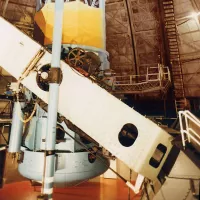
In 1991, the Hopkins Observatory's 0.6-m DFM reflecting telescope was installed elsewhere on the Williams College campus.
2001: Unified Science Center Addition
In 2001, the $38 million Unified Science Center was added to the Williams College campus, unifying the physics, chemistry, and biology departments' lab spaces and housing the Schow Science Library.
2003: Capital Campaign Launched
From 2003 through 2008, Williams conducted a capital campaign with the goal of raising $400 million by September 2008.
2003: Construction Projects Begin
In 2003, Williams College began the first of three massive construction projects: the construction of the '62 Center for Theatre and Dance, the Paresky Center, and the Stetson-Sawyer project.
2005: Planetarium Projectors Installed
In 2005, the Milham Planetarium installed a Zeiss Skymaster ZKP3/B optomechanical projector and an Ansible digital projector.
2005: '62 Center for Theatre and Dance Completed
In the spring of 2005, the $60 million '62 Center for Theatre and Dance was successfully completed at Williams College.
2006: Investment Office Started
In 2006, Williams College started the Williams College Investment Office to manage its endowment.
2006: First-Years Housed in Sage Hall, Williams Hall and Mission Park
Since the fall of 2006, first-year students at Williams have been housed in Sage Hall, Williams Hall, and Mission Park.
January 2007: CO2 Emission Reduction Goal
In January 2007, the Williams College board voted unanimously to reduce college CO2 emissions 10% below 1990 levels by 2020, or roughly 50% below 2006 levels.
February 2007: Paresky Center Opens
In February 2007, the $44 million student center, called Paresky Center, opened at Williams College.
June 2007: Capital Campaign Reaches $400 Million Goal
At the end of June 2007, Williams College's capital campaign reached its goal of $400 million.
September 2008: Capital Campaign Goal Achieved
In September 2008, Williams concluded a capital campaign that had raised $500.2 million, surpassing its initial goal of $400 million by the end of June 2007.
December 2008: President Schapiro Announces Departure
In December 2008, President Morton O. Schapiro announced his departure from Williams College to become president of Northwestern University.
2008: Stetson-Sawyer Project Delayed
In 2008, the Stetson-Sawyer project was delayed due to the financial crisis. The North Academic Building and South Academic Building were completed in the fall of 2008.
June 2009: William G. Wagner as Interim President
In June 2009, Dean of the Faculty William G. Wagner took the position of interim president of Williams College.
September 28, 2009: Adam Falk Appointed President
On September 28, 2009, the presidential search committee announced the appointment of Adam Falk as the 17th president of Williams College.
2009: Evaluation of Neighborhood System
During the spring 2009 semester, a committee formed to evaluate the neighborhood system, and released a report the following fall.
2009: South Academic Building Renamed Schapiro Hall
In the spring of 2009, the South Academic Building was renamed Schapiro Hall in honor of former president Morton O. Schapiro.
2009: Sustainability Report Card Grade
Williams received a 'B+' grade on the 2009 College Sustainability Report Card.
February 2010: Reintroduction of Student Loans
In February 2010, Williams College announced it would re-introduce loans to its financial aid packages beginning with the Class of 2015 due to the college's changed financial situation.
April 1, 2010: Adam Falk Begins Term as President
On April 1, 2010, Adam Falk began his term as the 17th president of Williams College.
2010: North Academic Building Renamed Hollander Hall
In spring 2010, the North Academic Building was renamed Hollander Hall.
2010: Grouping Undergraduates into Neighborhoods
Starting with the Class of 2010, Williams College grouped undergraduates into four geographically coherent clusters called "Neighborhoods".
2014: Endowment Above $2 Billion
In 2014, Williams College's endowment exceeded $2 billion.
2014: New Sawyer Library Completed
In 2014, construction of the new Sawyer Library was completed, and the old Sawyer Library was subsequently razed.
March 11, 2018: Maud Mandel Selected as President
On March 11, 2018, Maud Mandel was selected to be the 18th president of Williams College.
July 1, 2018: Maud Mandel Assumes Presidency
On July 1, 2018, Maud Mandel assumed the role of the 18th president of Williams College.
July 2018: Maud Mandel Begins Presidency
In July 2018, Maud Mandel began her tenure as the 18th and current president of Williams College, becoming the first woman to assume this role.
2020: Endowment-Per-Student Ratio Reaches $1.40 Million
In 2020, the endowment-per-student ratio at Williams College reached $1.40 million unadjusted for inflation.
2020: College Council Replaced
In 2020, the student body voted to replace College Council (CC), the student government of Williams College, with the Three Pillars plan.
2021: Faculty and Student Demographics
As of 2021, 45.6% of full-time faculty and 51.6% of the undergraduate class are women-identifying at Williams College.
2021: Endowment-Per-Student Ratio Exceeds $2 Million
In 2021, Williams' endowment-per-student ratio was one of nine colleges or universities to exceed $2 million.
April 2022: Transition to All Grants System
In April 2022, Williams College transitioned to an all grants system for financial aid, becoming one of the few institutions in the United States to do so.
2022: Williams College Enrollment in 2022
In 2022, Williams College had an enrollment of 2,021 undergraduate students and 50 graduate students.
2027: New WCMA Building to Open
A new 76,800 sf building for the Williams College Museum of Art (WCMA) is scheduled to open in 2027 and be constructed using mass timber.
Mentioned in this timeline
The United States of America is a federal republic primarily...
The rapid advancement of artificial intelligence continues to dominate the...

Inflation in economics signifies a rise in the average price...
A telescope is an instrument used to observe distant objects...

September is the ninth month of the year in the...
A house is a single-unit residential building ranging from simple...
Trending

6 days ago Donald Trump Considers Iran Strike Strategy Amid Rising Middle East Tensions

3 hours ago Shedeur Sanders Hires Travis Hunter's Agent Ahead of NFL Draft
4 hours ago Cricbuzz Provides Comprehensive Live Cricket News and Real-Time Match Updates
5 hours ago Teshome Mekonen and Fatima Alanis Win the 2026 NYRR Staten Island Half Marathon
5 hours ago Sony Delists Major First-Party PlayStation Titles From Digital Storefront
5 hours ago Nancy Mace Introduces Bill Shielding Assault Survivors From Defamation Lawsuits
Popular

Ilhan Omar is a prominent American politician currently serving as...

Ken Paxton is an American politician and lawyer serving as...

Jameis Winston is an American football quarterback currently playing for...

Cristiano Ronaldo widely considered one of the greatest footballers captains...

Michael Joseph Jackson the King of Pop was a highly...

Elon Musk is a visionary entrepreneur and engineer known for...