


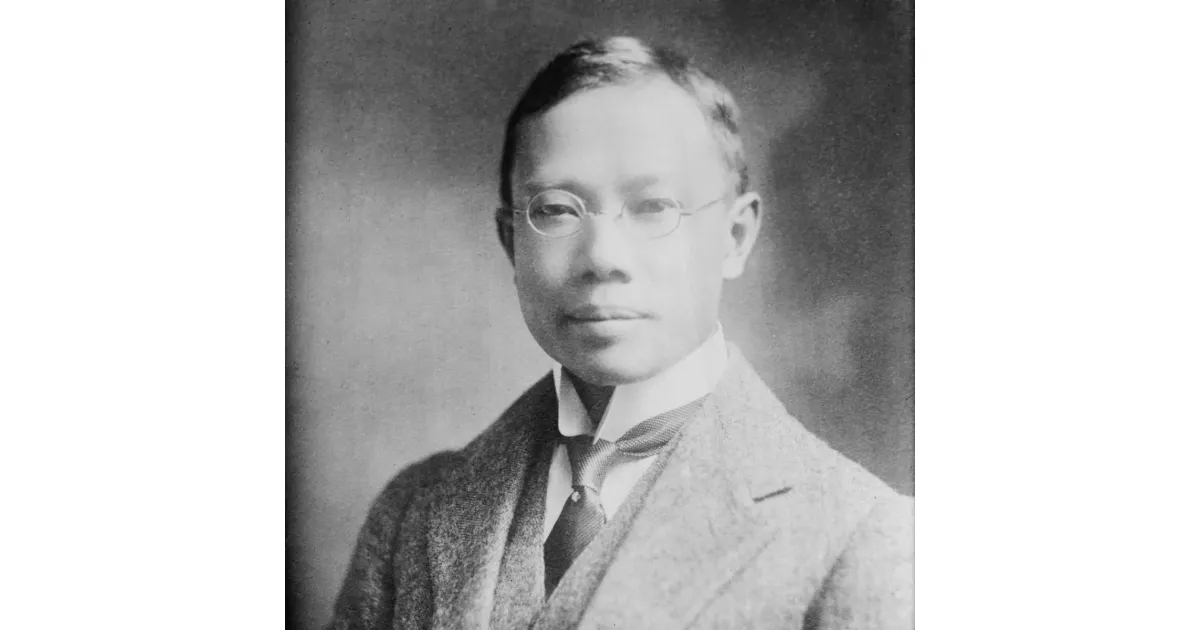
Wu Lien-teh was a Malayan physician who made significant contributions to public health. He is best known for his work during the Manchurian plague of 1910-1911, where he implemented measures to control the epidemic. Wu is also credited with inventing the Wu mask, a precursor to the modern N95 respirator, which played a crucial role in preventing the spread of the plague. His efforts were instrumental in containing the outbreak and demonstrated the importance of public health interventions in managing infectious diseases.
1901: Wong Nai Siong Moved
From 1901 to 1906, Wong Nai Siong moved to the area.


September 1903: Joined the Institute for Medical Research
In September 1903, Wu joined the Institute for Medical Research in Kuala Lumpur as the first research student.
1903: Returned to the Straits Settlements
In 1903, Wu Lien-teh returned to the Straits Settlements.
1904: Entered Private Practice
Towards the end of 1904, Wu entered private practice in Chulia Street, George Town, Penang.
1906: Wong Nai Siong Moved
From 1901 to 1906, Wong Nai Siong moved to the area.
1906: Organized Anti-Opium Conference
In the spring of 1906, Wu organized a nationwide anti-opium conference attended by approximately 3000 people, attracting attention from those involved in the opium trade.
1907: Convicted and Fined
In 1907, Wu's dispensary was searched, and he was convicted and fined for possessing one ounce of tincture of opium.
1908: Vice Director of the Imperial Army Medical College
In 1908, Dr. Wu accepted the offer to become the Vice Director of the Imperial Army Medical College in Tianjin.
1910: Manchurian plague of 1910–11
In 1910, Wu Lien-teh was noted for his work in public health, particularly regarding the Manchurian plague of 1910–11.
1910: Investigate Unknown Disease
In the winter of 1910, Wu was instructed to travel to Harbin to investigate an unknown disease, marking the beginning of the pneumonic plague epidemic.
April 1911: Chaired International Plague Conference
In April 1911, Wu chaired the International Plague Conference in Mukden (Shenyang), attended by scientists from various countries.
August 1911: Presented Plague Research Paper
In August 1911, Wu presented a plague research paper at the International Congress of Medicine in London, published in The Lancet.
1912: Director of the Manchurian Plague Service
In 1912, Wu became the first director of the Manchurian Plague Service.
1916: President of the Chinese Medical Association
From 1916–1920, Wu was a founder member and first president of the Chinese Medical Association.
1920: President of the Chinese Medical Association
From 1916–1920, Wu was a founder member and first president of the Chinese Medical Association.
1920: Combating Cholera Pandemic
In 1920, Wu led the efforts to combat the 1920-21 cholera pandemic in the north-east of China.
1929: Appointed Trustee of 'Nanyang Club'
In 1929, Wu was appointed a trustee of the 'Nanyang Club' in Penang.
November 1931: Detained by Japanese Authorities
In November 1931, during the Japanese invasion of Manchuria, Wu was detained and interrogated by the Japanese authorities on suspicion of being a Chinese spy.
1935: Nomination for Nobel Prize
In 1935, Wu Lien-teh became the first Malayan nominated for the Nobel Prize in Physiology or Medicine.
1937: Forced to Flee
In 1937, during the Japanese occupation, Wu was forced to flee, returning to the Settlements, and his home and books were burnt.
1939: Moved back to Malaya
Around 1939, Wu moved back to Malaya and continued to work as a general practitioner in Ipoh.
1943: Captured by Resistance Fighters
In 1943, Wu was captured by Malayan left-wing resistance fighters and held for ransom, and nearly prosecuted by the Japanese, but was protected by having treated a Japanese officer.
January 1960: Wu Lien-teh Death
In January 1960, Wu Lien-teh died of a stroke at the age of 80 in his home in Penang, after completing his autobiography, Plague Fighter.
January 1960: Death of Wu Lien-teh
On 21 January 1960, Wu died of a stroke in his home in Penang, after completing his autobiography.
1995: Publication of Biography
In 1995, Wu's daughter, Dr. Yu-lin Wu, published a book about her father.
2015: Wu Lien-Teh Institute Opened
In 2015, the Wu Lien-Teh Institute opened at Harbin Medical University.
2019: Lancet Prize in Honour
In 2019, The Lancet launched an annual Wakley-Wu Lien Teh Prize in honour of Wu.
May 2020: Video Conference Meeting
In May 2020, Dr. Yvonne Ho united the 22 known "medical and scientific descendants" of Dr. Wu Lien-Teh for a video conference meeting spanning 14 cities around the world.
July 2020: Article to Memorialize Dr. Wu
In July 2020, some of these medical and scientific descendants collaborated to publish an article to memorialize Dr. Wu's lifetime work in public health.
August 2020: Second Piece Collaborated
In August 2020, a second group of Wu's medical and scientific descendants collaborated on a similar piece.
March 2021: Honored with a Google Doodle
In March 2021, Wu was honoured with a Google Doodle, depicting Wu assembling surgical masks and distributing them.
Mentioned in this timeline

Google LLC is a multinational technology corporation specializing in a...
China officially the People's Republic of China PRC is located...
Books are a means of storing information as text or...

Travel involves the movement of people between geographical locations using...
September is the ninth month of the year in the...
Trending
3 hours ago Cavan Sullivan Sets Historic USMNT Record in Match Against Mexico

3 hours ago Sebastian Stan Promotes New Movie Fjord at Premiere

3 hours ago Michael King Shines as Key Pitcher for Padres in MLB Postseason Run
3 hours ago Heightened Tensions Escalate Along Mexico-US Border Amid Military Deployment and Security Disputes
3 hours ago Matteo Berrettini Competes in Shanghai Masters Tennis Tournament

3 hours ago Kyle MacLachlan Shares Exciting Filming Updates and Release Window for Fallout Season 3
Popular

Ken Paxton is an American politician and lawyer serving as...

Elon Musk is a visionary entrepreneur and engineer known for...

Cristiano Ronaldo widely considered one of the greatest footballers captains...

Shakira Isabel Mebarak Ripoll the Queen of Latin Music is...

Jameis Winston is an American football quarterback currently playing for...

Bernie Sanders is a prominent American politician and the senior...