History of Climate change in Timeline


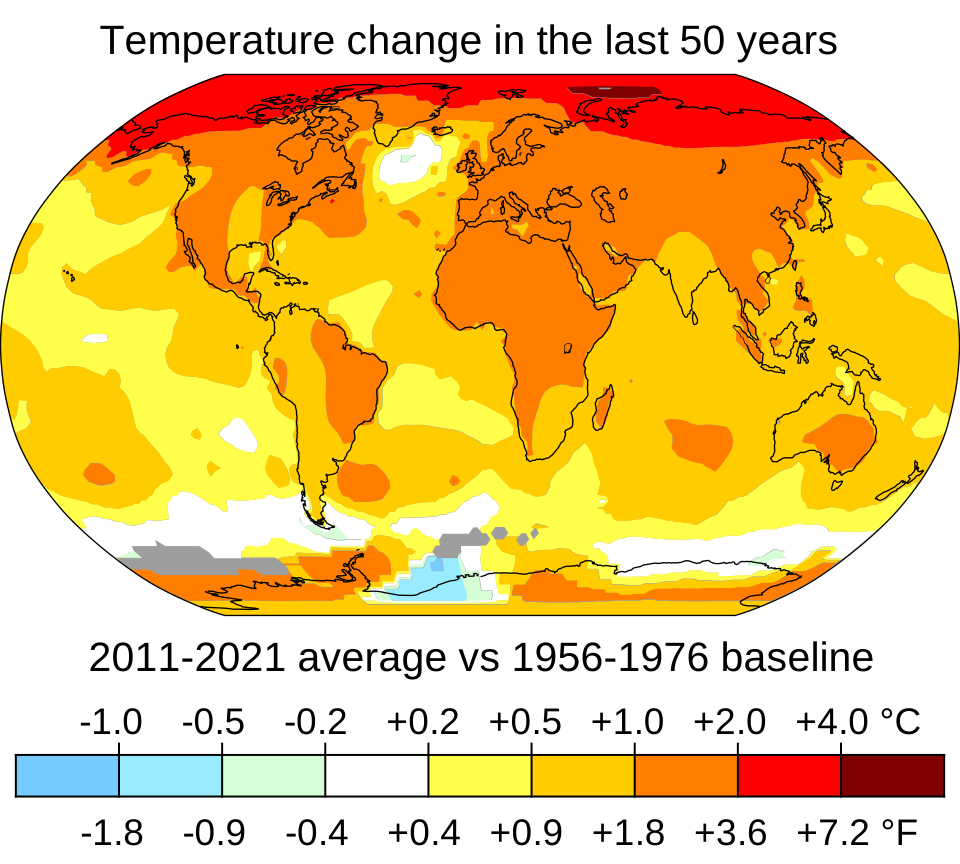
Climate change encompasses both the current increase in global average temperature (global warming) and its broader effects on Earth's climate system. This modern warming trend is largely driven by human activities, primarily the burning of fossil fuels since the Industrial Revolution. These activities, along with deforestation and certain agricultural and industrial practices, release greenhouse gases into the atmosphere. These gases trap heat, leading to a rise in atmospheric temperatures. The concentration of carbon dioxide, the primary greenhouse gas, is now about 50% higher than pre-industrial levels, a concentration not seen in millions of years.
1900: Pre-Industrial Baseline
The period from 1850 to 1900 serves as the pre-industrial baseline for measuring global warming.


1938: Callendar Publishes Evidence of Warming and Rising CO2 Levels
In 1938, Guy Stewart Callendar published evidence indicating that the climate was warming and that CO2 levels were rising. However, his calculations faced the same objections as previous studies.
1961: Start of Global Dimming
From 1961 to 1990, a gradual reduction in the amount of sunlight reaching the Earth's surface, known as global dimming, was observed.
1970: Marked Temperature Increase After 1970
After 1970, the increasing accumulation of greenhouse gases and controls on sulfur pollution led to a marked increase in global temperatures.
1970: Thermal Energy Growth in Climate System
Since at least 1970, the thermal energy in the global climate system has grown with only brief pauses, with over 90% of the extra energy stored in the ocean.
1975: Early Usage of 'Global Warming'
The term "global warming" was used as early as 1975 to describe the increasing temperatures of the Earth.
1979: National Research Council's Charney Report Supports Climate Models
In 1979, the National Research Council's Charney Report supported the accuracy of climate models that forecast significant warming.
1980: Increase in Monsoon Precipitation
Since 1980, monsoonal precipitation over the Northern Hemisphere has increased.
1987: Montreal Protocol
The 1987 Montreal Protocol, an international agreement to phase out production of ozone-depleting gases, has had benefits for climate change mitigation.
1988: James Hansen's Testimony on Human Causation of Global Warming
In 1988, James Hansen publicly presented testimony before a US Senate committee regarding human causation of observed global warming and the dangers of unmitigated warming. Also in 1988, the Intergovernmental Panel on Climate Change (IPCC) was set up.
1988: James Hansen's Testimony
In 1988, NASA climate scientist James Hansen used the term "global warming" in his testimony in the U.S. Senate, popularizing the term.
1990: End of Global Dimming Observation Period
From 1961 to 1990, a gradual reduction in the amount of sunlight reaching the Earth's surface, known as global dimming, was observed.
1990: Underestimation of Sea Level Rise
Sea level rise since 1990 was underestimated in older climate models, but more recent models agree well with observations.
1994: United Nations Framework Convention on Climate Change (UNFCCC)
In 1994, nearly all countries became parties to the United Nations Framework Convention on Climate Change (UNFCCC), aiming to prevent dangerous human interference with the climate system by stabilizing greenhouse gas concentrations.
1997: Kyoto Protocol Extends UNFCCC
In 1997, the Kyoto Protocol extended the UNFCCC, including legally binding commitments for most developed countries to limit their emissions.
1998: Start of Global Warming Hiatus
From 1998 to 2013, negative phases of the Pacific Decadal Oscillation (PDO) and Atlantic Multidecadal Oscillation (AMO) caused a short slower period of warming called the "global warming hiatus".
2000: Sea level rise after 2000
The result is an estimated total sea level rise of 2.3 metres per degree Celsius (4.2 ft/°F) after 2000 years.
2001: Deforestation and Agriculture Expansion
Between 2001 and 2018, 27% of deforestation was from permanent clearing to enable agricultural expansion for crops and livestock.
2004: Release of The Day After Tomorrow movie
In 2004, the climate fiction movie "The Day After Tomorrow" focused on climate change.
2006: Release of An Inconvenient Truth documentary
In 2006, the Al Gore documentary "An Inconvenient Truth" focused on climate change.
2009: Copenhagen Accord
In 2009, the Copenhagen Accord aimed to limit the global temperature rise to below 2 °C, set the goal of sending $100 billion per year to developing countries for mitigation and adaptation by 2020, and proposed the founding of the Green Climate Fund.
2010: Agriculture and forestry emissions baseline
From 2010 levels, a set of actions could reduce agriculture and forestry-based emissions by two-thirds. Actions include reducing food demand, increasing land productivity, protecting forests, and reducing emissions from agricultural production.
2010: Greenhouse Gas Emissions Baseline Year
In 2021, greenhouse gas emissions are compared to the levels of 2010.
2013: End of Global Warming Hiatus
From 1998 to 2013, negative phases of the Pacific Decadal Oscillation (PDO) and Atlantic Multidecadal Oscillation (AMO) caused a short slower period of warming called the "global warming hiatus".
2014: Increased Sea Level Rise
Between 2014 and 2023, sea level rise increased, reaching 4.8 cm per decade.
2014: Start of Warmest Decade
The decade from 2014 to 2023 warmed to an average of 1.19 °C compared to the pre-industrial baseline from 1850 to 1900.
2015: Paris Agreement Negotiated
In 2015, all UN countries negotiated the Paris Agreement, which aims to keep global warming well below 2.0 °C and contains an aspirational goal of keeping warming under 1.5 °C.
2015: Paris Climate Accord referenced in UN Court ruling
On 23 July 2025, the UN's International Court of Justice referenced the 2015 Paris Climate Accord in its advisory opinion, stating that states must implement their commitments in international agreements they are parties to, such as the Paris Climate Accord.
2016: Air pollution deaths estimate
In 2016, air pollution deaths were estimated at 7 million annually. Low-carbon energy improves human health by minimizing air pollution deaths.
2016: Kigali Amendment to the Montreal Protocol
The 2016 Kigali Amendment to the Montreal Protocol committed to reducing the emissions of hydrofluorocarbons, which are potent greenhouse gases.
2016: Climate Change and Poverty
The World Bank estimates that between 2016 and 2030, climate change could drive over 120 million people into extreme poverty without adaptation.
2017: Global Fossil Fuel Subsidies
In 2017, direct global fossil fuel subsidies reached $319 billion, and $5.2 trillion when indirect costs like air pollution are included.
2017: National Climate Assessment
In 2017, the United States-published National Climate Assessment noted that "climate models may still be underestimating or missing relevant feedback processes".
2018: Deforestation and Agriculture Expansion
Between 2001 and 2018, 27% of deforestation was from permanent clearing to enable agricultural expansion for crops and livestock.
2018: Start of the School Strike for Climate
In 2018, young people across the globe began protesting climate change by skipping school on Fridays, inspired by Greta Thunberg. This initiative is known as the School Strike for Climate.
2019: Scientific Consensus on Climate Warming Reaches Over 99%
As of 2019, agreement in recent literature reached over 99% regarding the scientific consensus that the climate is warming and that this is caused by human activities.
2019: Carbon Pricing Coverage
As of 2019, carbon pricing covers about 20% of global greenhouse gas emissions, using carbon taxes and emissions trading systems.
2019: Global Greenhouse Gas Emissions
In 2019, global human-caused greenhouse gas emissions were equivalent to 59 billion tonnes of CO2.
2019: Climate emergency declarations
In 2019, the United Kingdom parliament became the first national government to declare a climate emergency. The European Parliament also declared a "climate and environmental emergency".
2020: Under-delivery of Climate Funding
As of 2020, only $83.3 billion were delivered to developing countries for mitigation and adaptation, falling short of the $100 billion per year goal set by the Copenhagen Accord.
2020: Decrease Sulfur Content Fuel Oil
The effect of decreasing sulfur content of fuel oil for ships since 2020 is estimated to cause an additional 0.05 °C increase in global mean temperature by 2050.
2021: Estimated greenhouse gas emissions reduction based on national climate plans
As of 2021, based on information from 48 national climate plans, estimated total greenhouse gas emissions will be 0.5% lower compared to 2010 levels.
2021: Public Worry about Climate Change
In 2021, a majority of citizens in 30 countries expressed a high level of worry about climate change, or view it as a global emergency.
2021: European Commission releases "Fit for 55" legislation package
In 2021, the European Commission released its "Fit for 55" legislation package, which contains guidelines for the car industry.
2021: IPCC Report States Human Cause of Climate Change is Unequivocal
In 2021, the IPCC Assessment Report stated that it is "unequivocal" that climate change is caused by humans. Consensus has further developed that action should be taken to protect people against the impacts of climate change.
2021: IPCC Sixth Assessment Report
In 2021, the IPCC Sixth Assessment Report projected global warming to reach varying levels by 2100, depending on the emission scenario.
2022: Greenhouse Gas Concentrations in 2022
In 2022, the concentrations of CO2 and methane had increased by about 50% and 164%, respectively, since 1750.
2023: Carbon Budget Estimate
According to UNEP, global warming can be kept below 2.0 °C with a 50% chance if emissions after 2023 do not exceed 900 gigatonnes of CO2.
2023: Increased Sea Level Rise
Between 2014 and 2023, sea level rise increased, reaching 4.8 cm per decade.
2023: Oxfam report on emissions inequality
In 2023, Oxfam found that the wealthiest 10% of people were responsible for 50% of global emissions, while the bottom 50% were responsible for just 8%.
2023: Renewables Dominate New Electricity Generation
In 2023, renewables accounted for 86% of all new electricity generation installed.
2023: Climate Funding Target Expected to Be Achieved
Only in 2023 the target of sending $100 billion per year to developing countries is expected to be achieved.
2023: End of Warmest Decade
The decade from 2014 to 2023 warmed to an average of 1.19 °C compared to the pre-industrial baseline from 1850 to 1900.
2024: Global Population Demand for Climate Action
A 2024 survey across 125 countries found that 89% of the global population demanded intensified political action on climate change.
2024: Paris Agreement pledges and global warming projections
As of 2024, pledges made under the Paris Agreement would lead to a 66% chance of keeping global warming under 2.8 °C by the end of the century. Current policies would raise this to 3.1 °C. Limiting warming to 2 °C may result in higher economic benefits than economic costs globally.
2024: Temperature well above Recent Average
In 2024 the temperature was well above the recent average at more than +1.5 °C.
2024: Warmest Year on Record
In 2024, the global average temperature reached +1.60 °C (2.88 °F) above pre-industrial levels, marking it as the warmest year on record since regular tracking began in 1850.
2024: Five-Year Average Temperature Estimate
The World Meteorological Organization estimates there is almost a 50% chance of the five-year average global temperature exceeding +1.5 °C between 2024 and 2028.
March 2025: Ratification Status of the Paris Agreement
As of March 2025, 194 states and the European Union have acceded to or ratified the 2015 Paris Agreement.
July 2025: UN International Court of Justice advisory opinion
On 23 July 2025, the UN's International Court of Justice issued its advisory opinion, stating that states must act to stop climate change, and if they fail to accomplish that duty, other states can sue them.
2025: Establishment of the Open Coalition on Compliance Carbon Markets at COP30
At COP30 in 2025, the Open Coalition on Compliance Carbon Markets was established with the aim of creating a global cap and trade system. This could significantly increase emissions reduction and provide substantial funding for clean energy and social programs.
2025: Climate Reparations owed by top fossil fuel companies
From 2025 to 2050, the top 21 fossil fuel companies would owe cumulative climate reparations of $5.4 trillion.
2028: Five-Year Average Temperature Estimate
The World Meteorological Organization estimates there is almost a 50% chance of the five-year average global temperature exceeding +1.5 °C between 2024 and 2028.
2030: Fossil fuel use expected to peak
Prior to 2030, fossil fuel use is expected to peak in absolute terms and then decline, with coal use decreasing the most.
2030: Climate Change and Poverty
The World Bank estimates that between 2016 and 2030, climate change could drive over 120 million people into extreme poverty without adaptation.
2035: Zero-emission vehicles mandate in Europe
From 2035, all new cars on the European market must be zero-emission vehicles according to the "Fit for 55" legislation.
2050: Projected Climate Change Deaths
According to the World Economic Forum, 14.5 million more deaths are expected due to climate change by 2050.
2050: Projected Deaths from Malnutrition
According to the World Economic Forum, an increase in drought in certain regions could cause 3.2 million deaths from malnutrition by 2050 and stunting in children.
2050: Potential lives saved by limiting warming to 2°C
By 2050, meeting the Paris Agreement goals to limit warming to a 2°C increase could save about a million lives per year, whereas limiting global warming to 1.5°C could save millions.
2050: Climate Reparations owed by top fossil fuel companies
From 2025 to 2050, the top 21 fossil fuel companies would owe cumulative climate reparations of $5.4 trillion.
2050: Potential Reduction in Global Warming
Limiting new black carbon deposits in the Arctic could reduce global warming by 0.2 °C by 2050.
2050: Carbon-neutral pledges by South Korea and Japan
Major countries in Asia have made similar pledges: South Korea and Japan have committed to become carbon-neutral by 2050.
2050: European Green Deal goal
The European Commission presented its European Green Deal in 2019 with the goal of making the EU carbon-neutral by 2050.
2050: Renewable Energy Dominance for Carbon Neutrality
To achieve carbon neutrality by 2050, renewable energy would become the dominant form of electricity generation, rising to 85% or more in some scenarios. Investment in coal would be eliminated, and coal use nearly phased out by 2050.
2060: China's carbon-neutral pledge
China has committed to become carbon-neutral by 2060.
2070: Net-zero global greenhouse gas emissions needed
By 2070, global greenhouse gas emissions need to be net-zero to limit global warming to less than 2 °C. This requires significant changes in energy, land use, cities, transport, buildings, and industry.
Mentioned in this timeline

Greta Thunberg is a Swedish climate activist who gained international...

Al Gore served as the th U S Vice President...

NASA the National Aeronautics and Space Administration is the U...

China officially the People's Republic of China PRC is located...

Japan is an East Asian island country located in the...
The World Bank is an international financial institution offering loans...
Trending

15 days ago Polls Show Growing Support for Trump's Impeachment Amidst 25th Amendment Discussions.
SoundSticks are multimedia speakers manufactured by Harman Kardon initially co-developed with Apple Released in this system includes two satellite speakers...

1 month ago Benfica & SC Braga Battle for Taça de Portugal Spot; Braga Women eliminated.

1 month ago Cuba experiences total power system collapse leading to nationwide blackout and energy crisis.

Hulk Hogan born Terry Gene Bollea is a retired American professional wrestler recognized globally for his iconic status Renowned for...
21 days ago VTI Rises Amidst GOOGL Stock Movement; Vanguard ETF Snapshot and Analysis
Popular

William Franklin Graham III known as Franklin Graham is an...

Paula White-Cain is a prominent American televangelist and key figure...

Lindsey Graham is an American politician and attorney who has...

Kashyap Pramod Patel known as Kash Patel is an American...

Melania Trump is a Slovenian-American former model who served as...

Michael Joseph Jackson the King of Pop was a highly...