


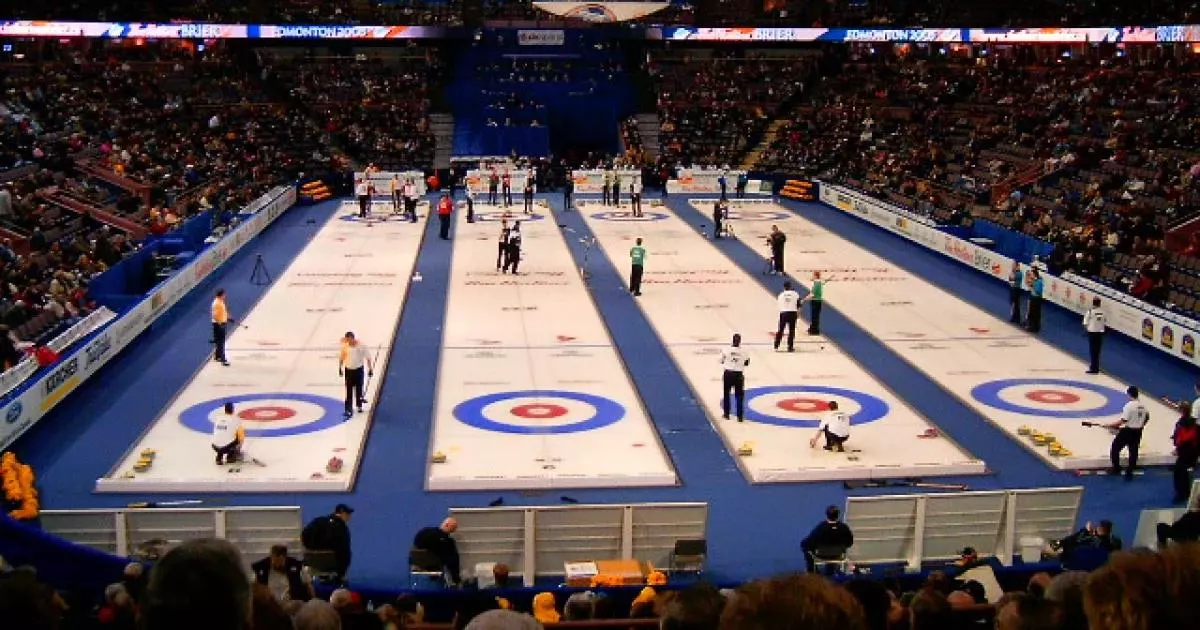
Curling is a team sport played on ice where two teams of four players slide heavy granite stones towards a circular target called the 'house'. Teams alternate throwing eight stones each, aiming to position them closest to the center of the house. Points are awarded at the end of each 'end' (when all stones have been thrown) based on the proximity of stones to the center, with only the closest stones of a team counting. A curling game typically consists of eight or ten ends, and the team with the highest cumulative score wins. The sport is related to bowls and shuffleboard.


1932: Demonstration tournament held during the Winter Olympic Games
In 1932, a demonstration curling tournament was held during the Winter Olympic Games, featuring teams from Canada and the United States, with Canada winning 12 games to 4.
1958: Invention of the Blackjack corn broom
In 1958, Fern Marchessault of Montreal invented the Blackjack, a corn broom with inverted corn straw in the center.
1959: First World Championship (Scotch Cup) held in Scotland
In 1959, the first world championship for men's curling, known as the Scotch Cup, was held in Falkirk and Edinburgh, Scotland. The Canadian team, from Regina, Saskatchewan, led by Ernie Richardson, won the first world title.
January 1990: Russ Howard suggests the Modified Moncton Rule
In January 1990, Russ Howard suggested the Modified Moncton Rule for the Moncton 100 cashspiel in Moncton, New Brunswick.
1990: The 1990 Brier is considered boring due to excessive peeling.
In 1990, observers noted that the 1990 Brier (Canadian men's championship) was considered boring to watch because of the amount of peeling.
1992: Canada Curling Stone Company begins producing curling stones
In 1992, the Canada Curling Stone Company started producing curling stones.
1993: Canada adopts a three-rock free guard zone rule
In 1993, Canada adopted a three-rock free guard zone rule for the 1993–94 season.
1998: Canada wins gold in women's curling at the Olympics and silver in men's curling
In 1998, Canada's women's curling team won gold, while the men's team won silver at the Olympics.
1998: Cathy King wins the World Bronze Medal
In 1998, Cathy King won the World Bronze Medal.
1998: Sandra Schmirler leads team to first-ever gold medal in women's curling
In 1998, Sandra Schmirler led her team to the first-ever gold medal in women's curling at the Winter Olympics.
1998: Curling becomes a medal sport in the Winter Olympic Games
In 1998, curling was introduced as a medal sport in the Winter Olympic Games, featuring men's and women's tournaments.
1999: Delivery stick invented for elderly curlers in Canada
In 1999, the delivery stick was invented specifically for elderly curlers in Canada.
February 2002: IOC recognizes 1924 Winter Olympics Curling as Official Event
In February 2002, the International Olympic Committee retroactively recognized the curling competition from the 1924 Winter Olympics as official Olympic events, awarding medals accordingly.
2002: Canada Curling Stone Company supplies stones for Winter Olympics
In 2002, the Canada Curling Stone Company supplied curling stones for the Winter Olympics.
2002: The Canadian Curling Association adopts the four-rock free guard zone
In 2002, the Canadian Curling Association adopted the four-rock free guard zone in the 2002–03 season.
2002: Canada wins silver in men's curling and bronze in women's curling at the Olympics
In 2002, the Canadian men's curling team secured silver, while the women's team earned bronze at the Olympics.
2005: Inauguration of the European Mixed Curling Championship
In 2005, the European Mixed Curling Championship was inaugurated.
2006: Canada wins gold in men's curling and bronze in women's curling at the Olympics
In 2006, Canada won gold in the men's curling event and bronze in the women's event at the Olympics.
2006: Kelly Scott scores an eight-ender at the Players' Championships
In 2006, Kelly Scott scored an eight-ender in one of her games against Cathy King at the Players' Championships.
2006: Men's final at the 2006 Winter Olympics serves as an example
In 2006, the men's final at the Winter Olympics is used as an example.
2006: Kays becomes the exclusive manufacturer of curling stones for the Olympics
Since the 2006 Winter Olympics, Kays of Scotland has been the exclusive manufacturer of curling stones for the Olympics.
2007: Kelly Scott becomes the World Champion
In 2007, Kelly Scott became the World Champion.
2008: Establishment of the World Mixed Doubles Curling Championship
In 2008, the World Mixed Doubles Curling Championship was established.
2010: Canada wins gold in men's curling and silver in women's curling at the Olympics
In 2010, the Canadian men's curling team won gold, while the women's team secured silver at the Olympics.
2013: Last harvest of Ailsa Craig granite by Kays
In 2013, Kays of Scotland conducted the last harvest of Ailsa Craig granite, extracting 2,000 tons.
2014: Development of floor curling by John Li Shek-chong
In 2014, an iceless variation of curling called "floor curling" was developed by Hong Konger John Li Shek-chong.
2014: Canada wins gold in men's and women's curling at the Olympics
In 2014, both the Canadian men's and women's curling teams won gold medals at the Olympics.
2014: Introduction of "directional fabric" brooms and the "broomgate" controversy
In 2014, new "directional fabric" brooms were introduced, leading to the "broomgate" controversy due to concerns about their impact on the sport.
2014: Grand Slam of Curling adopts a five-rock rule
In 2014, the Grand Slam of Curling series of bonspiels adopted a five-rock rule to reduce the effectiveness of the tick shot.
2015: World Mixed Curling Championship replaces the European Mixed Championship
In 2015, the European Mixed Championship was replaced with the World Mixed Curling Championship.
2015: Temporary ban on new brooms
In 2015, the new brooms were temporarily banned by the World Curling Federation and Curling Canada for the 2015–2016 season due to performance concerns.
2016: Initiative to allow delivery sticks in senior championships
In early 2016, an international initiative began to allow the use of delivery sticks by players over 60 years of age in World Curling Federation Senior Championships.
2016: Standardized brush head approved for competitive play
Since 2016, only one standardized brush head is approved by the World Curling Federation for competitive play, standardizing equipment and limiting performance enhancing features.
2017: The World Curling Federation adopts the five-rock rule
In 2017, the five-rock rule was adopted by the World Curling Federation and member organizations for official play, beginning in the 2018–19 season.
2018: Canada wins gold in mixed doubles curling at the Olympics
In 2018, Canada won gold in the mixed doubles curling event at the Olympics.
2018: Mixed doubles tournament held at the Olympic level for the first time
In 2018, a mixed doubles tournament was held at the Olympic level for the first time.
2018: The five-rock rule goes into effect for the 2018-19 season
In 2018, the five-rock rule went into effect for the 2018-19 season.
2018: Mixed doubles tournament debut in Winter Olympics
In 2018, the mixed doubles event was held for the first time at the Winter Olympics, expanding the curling program.
2020: Kays anticipates orders filled through 2020 with Ailsa Craig granite harvested in 2013
By 2020, Kays of Scotland anticipated that the 2,000 tons of Ailsa Craig granite harvested in 2013 would be sufficient to fill anticipated orders.
Mentioned in this timeline
The United States of America is a federal republic primarily...

The Winter Olympic Games a major international multi-sport event held...
The modern Olympic Games are a leading international sporting event...
France officially the French Republic is primarily in Western Europe...

Canada is a North American country spanning from the Atlantic...

Sport encompasses physical activities or games frequently competitive and structured...
Trending

3 hours ago Steven Kwan Makes Spectacular Defensive Play and Throw to Save Run for Guardians

3 hours ago Brandin Cooks Scores First Touchdown for San Francisco 49ers in Seattle Win
3 hours ago Kaitlyn Chen Emerges as a Key Playmaker for the Golden State Valkyries

4 days ago Brandon Aiyuk Faces Uncertainty Following 49ers Contract and Injury Struggles
3 hours ago Chandler Simpson Named 2026 American League Gold Glove Award Finalist
3 hours ago Ravens Re-sign Kicker Jake Moody to Practice Squad Amid Kicking Competition Concerns
Popular

Ilhan Omar is a prominent American politician currently serving as...

Ken Paxton is an American politician and lawyer serving as...

Elon Musk is a visionary entrepreneur and engineer known for...

Michael Joseph Jackson the King of Pop was a highly...

Cristiano Ronaldo widely considered one of the greatest footballers captains...

MrBeast the professional name of Jimmy Donaldson is the most-subscribed...