


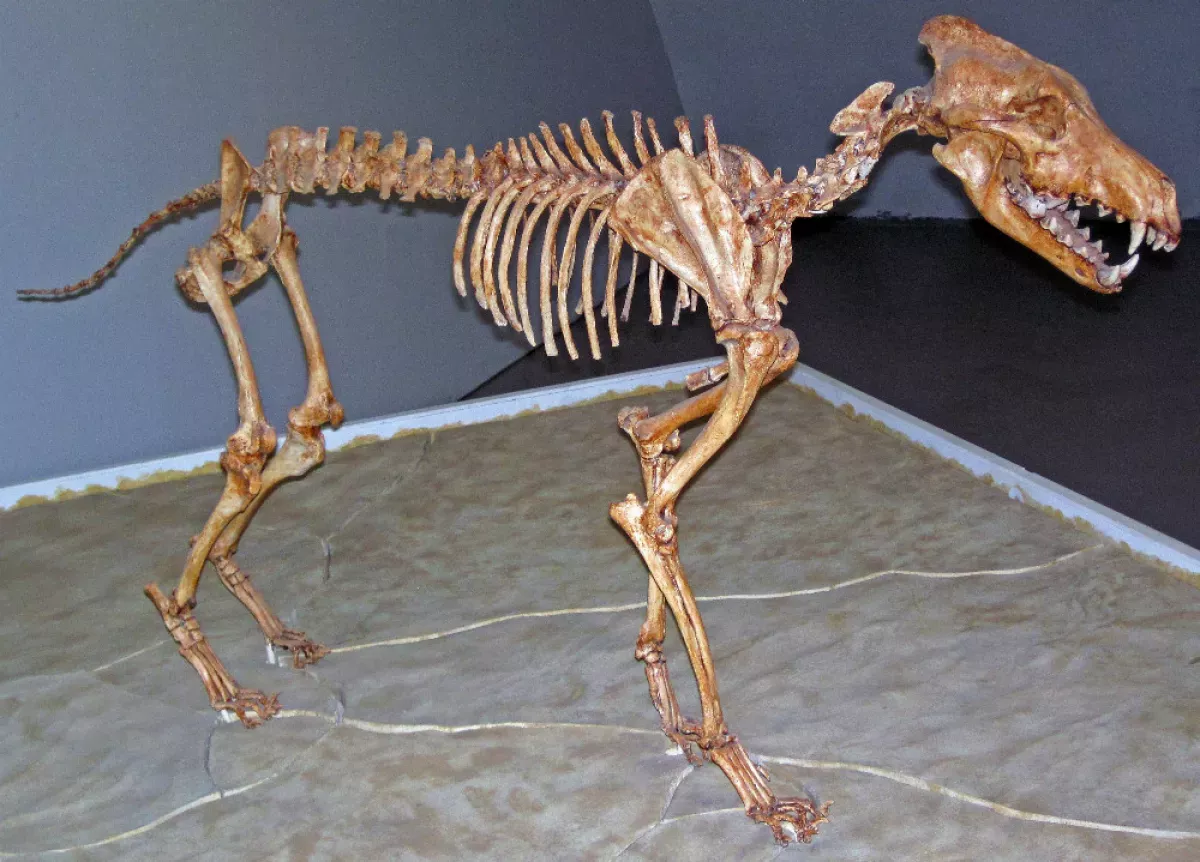
The dire wolf is an extinct canine that inhabited the Americas during the Late Pleistocene and Early Holocene epochs. The first specimen was found four years prior to the official naming of the species in 1858. There are two recognized subspecies: Aenocyon dirus guildayi and Aenocyon dirus dirus. The largest concentration of dire wolf fossils has been discovered at the Rancho La Brea Tar Pits in Los Angeles. A recent, contested fossil discovery was reported in northeast China, although its taxonomic attribution remains controversial.
1908: Discovery of Dire Wolf Fossils
In 1908, John Campbell Merriam began excavating numerous fossilized bone fragments of a large wolf from the Rancho La Brea tar pits.


1912: Formal Recognition of Canis dirus
By 1912, John Campbell Merriam had found a sufficiently complete skeleton to formally recognize the Rancho La Brea specimens, as well as previously found specimens, under the name Canis dirus (Leidy 1858).
1915: Synonymization of Canis indianensis
In 1915, Edward Troxell indicated his agreement with Merriam when he declared Canis indianensis a synonym of Canis dirus.
1918: Proposal of the Genus Aenocyon
In 1918, after studying these fossils, Merriam proposed consolidating the names of the fossils under the separate genus Aenocyon (from ainos, 'terrible' and cyon, 'dog') to become Aenocyon dirus. At that time not everyone agreed with this extinct wolf being placed in a new genus separate from the genus Canis.
1930: Naming of Aenocyon dirus nebrascensis
In 1930, Fossil specimens of C. dirus discovered at four sites in the Hay Springs area of Sheridan County, Nebraska, were named Aenocyon dirus nebrascensis (Frick 1930, undescribed).
1972: Recognition of Synonyms
In 1972, Ernest Lundelius recognized Canis ayersi (Sellards 1916) and Aenocyon dirus (Merriam 1918) as synonyms of Canis dirus.
1974: Proposed Classification of Armbruster's Wolf
In 1974, Robert A. Martin proposed that the large North American wolf C. armbrusteri (Armbruster's wolf) was C. lupus. Nowak, Kurtén, and Annalisa Berta proposed that C. dirus was not derived from C. lupus.
1979: Synonymization of all Taxa
According to Ronald M. Nowak, in 1979, all of the above taxa were declared synonyms of Canis dirus.
1984: Subspecies Proposal
In 1984, a study by Björn Kurtén recognized a geographic variation within the dire wolf populations and proposed two subspecies: Canis dirus guildayi for specimens from California and Mexico, and Canis dirus dirus for specimens east of the North American Continental Divide.
1984: Detection of Geographic Differences
In 1984, geographic differences in dire wolves were detected when a study of skeletal remains showed differences in cranio-dental features and limb proportions between specimens from California and Mexico (A. d. guildayi) and those found east of the Continental Divide (A. d. dirus).
1987: Hypermorph Hypothesis
In 1987, a new hypothesis proposed that a mammal population could give rise to a larger form called a hypermorph during times when food was abundant. Gloria D. Goulet proposed further that this hypothesis might explain the sudden appearance of C. dirus in North America and, judging from the similarities in their skull shapes, that C. lupus had given rise to the C. dirus hypermorph due to an abundance of game, a stable environment, and large competitors.
1992: Failed DNA Extraction Attempt
In 1992, an attempt was made to extract a mitochondrial DNA sequence from the skeletal remains of A. d. guildayi to compare its relationship to other Canis species, but the attempt was unsuccessful.
1993: Tooth Breakage Study
In 1993 a study proposed that the higher frequency of tooth breakage among Pleistocene carnivores compared with living carnivores was not the result of hunting larger game. The competition between carnivores increases, causing them to eat faster and thus consume more bone, leading to tooth breakage.
2009: Formal Description of Nebraska Specimens
In 2009, Tedford formally published a description of the specimens found in Hay Springs, Nebraska, and noted that, although they exhibited some morphological characteristics of both C. armbrusteri and C. dirus, he referred to them only as C. dirus.
2010: Sister Taxon Proposal
In 2010, Francisco Prevosti proposed that Canis dirus was a sister taxon to Canis lupus.
2014: Failed DNA Extraction Attempt from Tar Pits
In 2014, an attempt to extract DNA from a Columbian mammoth from the tar pits also failed, with the study concluding that organic compounds from the asphalt permeate the bones of all ancient samples from the La Brea pits, hindering the extraction of DNA samples.
2018: Canis gezi Classification
In 2018, a study found that Canis gezi did not fall under genus Canis and should be classified under the subtribe Cerdocyonina, however no genus was proposed.
2020: Dire Wolf Fossil Found in China
In 2020, a fossil mandible (IVPP V25381) later analyzed as a dire wolf's was found in the vicinity of Harbin, northeastern China. The fossil was taxonomically described and dated 40,000 YBP. This discovery challenges previous theories that the cold temperatures and ice sheets at northern latitudes in North America would be a barrier for dire wolves.
2020: Discovery in China
The 2020 discovery of a claimed dire wolf fossil in northeast China indicates that dire wolves may have crossed Beringia when it existed, though other researchers doubt that this specimen represents a dire wolf.
2021: DNA Study Findings
In 2021, a DNA study found the dire wolf to be a highly divergent lineage when compared with the extant wolf-like canines. This finding is consistent with the previously proposed taxonomic classification of the dire wolf as genus Aenocyon, as proposed by Merriam in 1918.
2021: Sequencing of Dire Wolf Nuclear DNA
In 2021, researchers sequenced the nuclear DNA taken from five dire wolf fossils. The study indicated the dire wolf to be a highly divergent lineage and concluded that the morphological similarity between dire wolves and gray wolves was due to convergent evolution. The study could find no indication of genetic admixture from the five dire wolf samples with extant North American gray wolves and coyotes nor their common ancestor.
2022: Doubts Regarding Chinese Specimen
In 2022, a study argued that the morphology and size of the Chinese specimen found in 2020 is inconclusive for its taxonomic determination as a dire wolf.
2023: Study on Joint Defects in Dire Wolf Specimens
In 2023, a study revealed high levels of subchondral defects in the joint surfaces of dire wolf and Smilodon specimens from the La Brea Tar pits. These defects resembled osteochondrosis dissecans. Researchers suggested that inbreeding might have contributed to this condition in the prehistoric species as they neared extinction, similar to modern dogs with the disease, but emphasized that further research is necessary to validate this hypothesis across different regions of the Americas.
2024: Baculum Study
In 2024 a study found the baculum of a male dire wolf to be proportionally longer than the baculum of modern canids, which may be indicative of stronger competition between males and unusual behaviors among canids including non-monogamous mating.
Mentioned in this timeline

California is a U S state on the Pacific Coast...

China officially the People's Republic of China PRC is located...
Mexico officially the United Mexican States is a North American...
The wolf or grey wolf is a canine native to...

Lupus or systemic lupus erythematosus SLE is an autoimmune disease...
Nebraska located in the Midwestern United States is the th...
Trending

4 hours ago Rudy Gobert Discusses Timberwolves Performance and Aims for Continued Offensive Dominance
4 hours ago MLB Fans Criticize John Smoltz for World Series Broadcasting Errors

4 hours ago Tropicana Field Hosts High-Stakes World Series Baseball Matchup
4 hours ago Jaden McDaniels Delivers Impressive Two-Way Performance for Minnesota Timberwolves

4 hours ago Derek Jeter Shares Relatable Dad Moment at Zoo and Goes Viral on Social Media
4 hours ago Tiger Woods Plans Full Golf Schedule Including TGL and Hero World Challenge
Popular

Ilhan Omar is a prominent American politician currently serving as...

Ken Paxton is an American politician and lawyer serving as...

Elon Musk is a visionary entrepreneur and engineer known for...

William Franklin Graham III known as Franklin Graham is an...

Barack Obama the th U S President - was the...

Michael Joseph Jackson the King of Pop was a highly...