


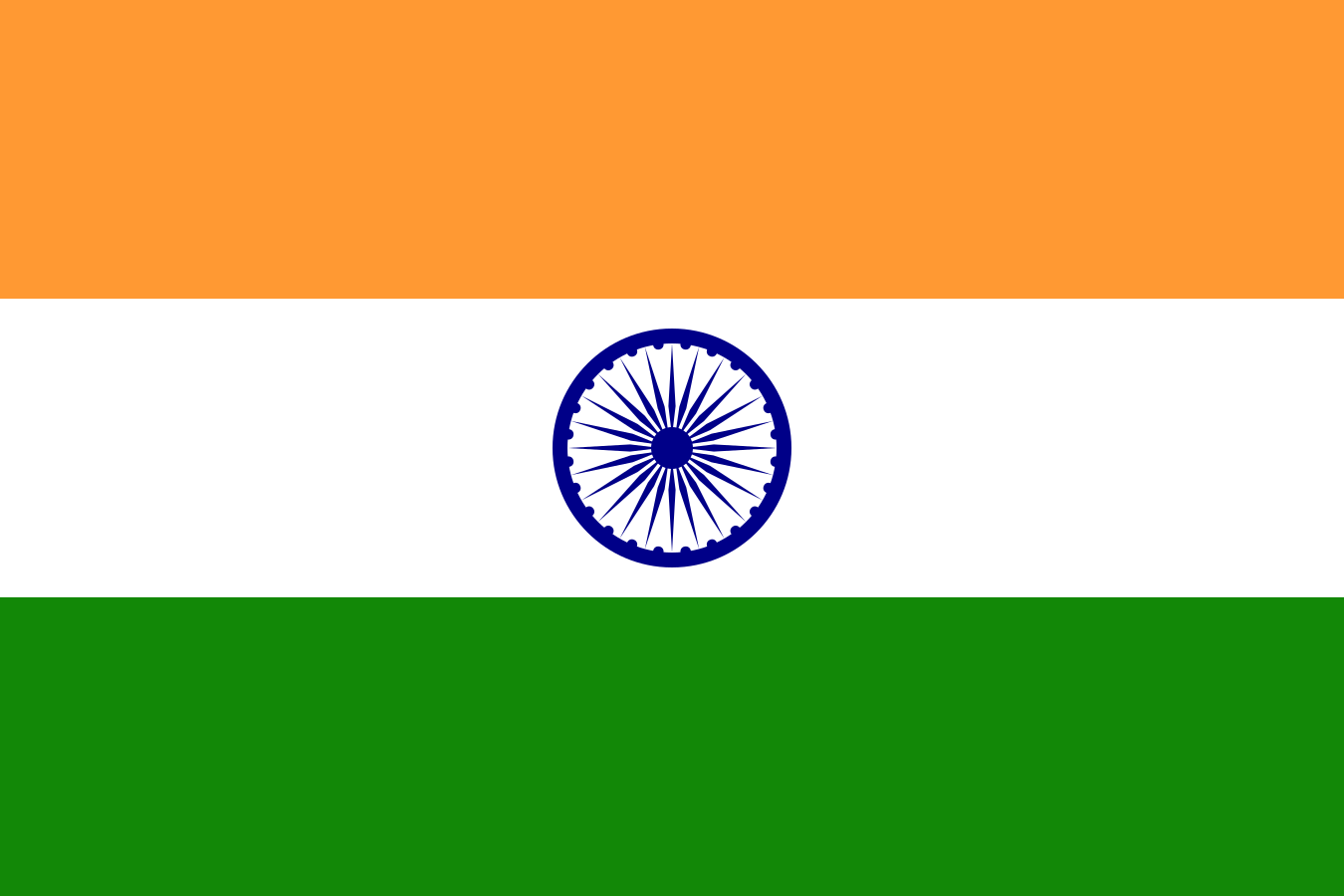
India, officially the Republic of India, is a South Asian country. It is the seventh-largest country by area and the most populous since 2023. Since its independence in 1947, it is the world's most populous democracy. It is bounded by the Indian Ocean, the Arabian Sea, and the Bay of Bengal. It shares land borders with Pakistan, China, Nepal, Bhutan, Bangladesh, and Myanmar. India is near Sri Lanka and the Maldives in the Indian Ocean. Its Andaman and Nicobar Islands share maritime borders with Myanmar, Thailand, and Indonesia.
5 hours ago : Trump Targets Russian Energy Sector With New Sanctions Bill
President Trump signs a new sanctions bill targeting Russia's energy sector, aiming to exert greater economic pressure on Putin. Moscow warns this legislative move threatens ongoing peace efforts and complicates future diplomatic relations between the United States and Russia.


1900: Indus Valley Civilisation
The Indus Valley Civilisation flourished in Pakistan and western India until 1900 BCE, featuring cities such as Mohenjo-daro and Harappa.
1901: Temperature Rise
Between 1901 and 2018, temperatures in India have risen by 0.7 °C (1.3 °F).
1911: Availability of primary schools
In 1911, there were under three primary schools for every ten villages.
1920: Nonviolent resistance
After 1920, a nationalist movement emerged in India noted for nonviolent resistance, which became the primary factor in ending British rule.
1921: Literacy rates
In 1921, the literacy rates were 7% overall, with 12% among men and 2% among women.
1928: Excavation of the Pashupati Seal
In 1928, the Pashupati seal was excavated in Mohenjo-daro, Pakistan. The seal is one of the best-known artifacts from the Indus Valley civilization.
1935: Government of India Act
The Government of India Act 1935 was used as a model and framework for drafting the Indian Constitution.
1935: National Parks
The system of national parks and protected areas was first established in 1935.
1946: Constituent Assembly
Between 1946 and 1949, the Constitution of India was drafted by the Constituent Assembly of India.
August 15, 1947: Independence
On August 15, 1947, Jawaharlal Nehru became the prime minister of the Dominion of India after the country's independence.
1947: India's Independence
In 1947, India achieved independence, marking a pivotal moment in its history.
1947: Independence and Partition
In 1947, India gained independence, which was tempered by the partition of India into India and Pakistan.
1947: War with Pakistan
In 1947, India went to war with Pakistan over the disputed territory of Kashmir.
1947: Ban on Temple Dances
In 1947, temple dances of Tamil devadasis, known as Bharatnatyam, were formally banned, being identified with "prostitutes and courtesans".
1947: Abolishment of Untouchability
In 1947, the Constituent Assembly of India abolished untouchability, marking a significant step towards social equality.
1947: Partition's impact on Punjabi cuisine
The popularity of tandoori chicken in the 1950s was caused by an entrepreneurial response among people from the Punjab who had been displaced by the 1947 partition.
September 1949: Official language of India
In September 1949, the Constituent Assembly of India chose the official language of India.
1949: Constitution Drafting
Between 1946 and 1949, the Constitution of India was drafted by the Constituent Assembly of India.
January 1950: Articles of India's constitution came into effect
On January 26, 1950, articles 343-351 of India's constitution, which addressed the official language, came into effect.
January 26, 1950: India becomes a Republic
On January 26, 1950, India became a republic, and Jawaharlal Nehru remained the caretaker prime minister.
1950: India becomes a republic
In 1950, India became a republic and remained a member of the Commonwealth of Nations. It also strongly supported decolonisation in Africa and Asia during the 1950s.
1950: Constitution Adoption
In 1950, India's constitution was adopted, establishing a secular, democratic republic.
1950: Formal Abolishment of Untouchability
In 1950, the Republic of India formally abolished untouchability, reinforcing the commitment to eliminate caste-based discrimination.
1950: Scheduled languages
In 1950, there were 14 scheduled languages: Assamese, Bengali, Gujarati, Hindi, Kannada, Kashmiri, Malayalam, Marathi, Oriya, Punjabi, Sanskrit, Tamil, Telugu and Urdu.
1950: Federal Republic
India became a federal republic in 1950, governed through a democratic parliamentary system.
1951: Population and Economic Status
In 1951, India's population was 361 million, with a nominal per capita income of US$64 annually and a literacy rate of 16.6%.
1951: First post-colonial census
In 1951, the first post-colonial census counted 361 million people.
1951: Literacy rates
In 1951, the literacy rates were 18% overall, with 27% among men and 9% among women.
1956: States Reorganisation Act
In 1956, the States Reorganisation Act led to the reorganization of states on a linguistic basis.
1957: General elections
In the general elections in 1957, the Congress, led by Nehru, won by comfortable margins.
1962: India-China War
In 1962, India and China went to war, resulting in a decisive defeat for India.
1962: Singh re-elected
In 2009, Singh became the first prime minister to be re-elected after Jawaharlal Nehru in 1962.
May 1964: Lal Bahadur Shastri becomes prime minister
After Nehru died in office in May 1964, Lal Bahadur Shastri was unanimously chosen by the Congress to be parliamentary leader, and thus prime minister.
1964: Missing women
During the period 1964-2014, the number of missing women in the country quadrupled from 15 million to 63 million.
1964: China's nuclear test
In 1964, China's nuclear test prompted India to begin producing nuclear weapons.
1965: India-Pakistan War
After the India–Pakistan war of 1965, Shastri died in January 1966, soon after signing the Tashkent Peace Declaration.
1965: War with Pakistan and ties with Soviet Union
In 1965, India and Pakistan engaged in another war, leading India to pursue closer military and economic ties with the Soviet Union.
1965: English as de facto formal language
In 1965, the Government of India announced that English would continue to be the de facto formal language of India.
1965: Threats to intervene in support of Pakistan
In 1965, threats to intervene in support of Pakistan caused India to produce nuclear weapons.
January 1966: Shastri's death
After the India–Pakistan war of 1965, Shastri died in January 1966, soon after signing the Tashkent Peace Declaration.
1967: India fends off Chinese excursions into Sikkim
By 1967, India was able to fend off Chinese excursions into Sikkim.
1967: Sindhi added to the scheduled languages
In 1967, Sindhi was added to the list of scheduled languages.
1967: Election victory
Indira Gandhi led the Congress to election victories in 1967.
1970: Life expectancy at birth
Between 1970 and 1975, the life expectancy at birth was 49.7 years.
1971: Election victory
Indira Gandhi led the Congress to election victories in 1971, the latter a landslide after Pakistan's defeat in the Bangladesh Liberation War.
1972: Wildlife Protection Act
In 1972, India enacted the Wildlife Protection Act and Project Tiger to safeguard crucial wilderness.
1974: First nuclear weapons test
In 1974, India conducted its first nuclear weapons test.
1975: Life expectancy at birth
Between 1970 and 1975, the life expectancy at birth was 49.7 years.
1975: State of emergency
In 1975, Indira Gandhi declared a state of emergency, suspending many civil liberties.
1977: Congress out of power
Following public discontent with the Emergency, the Congress was voted out of power in 1977; Janata Party, which had opposed the Emergency, was voted in.
1980: Forest Conservation Act
The Forest Conservation Act was enacted in 1980.
1981: Literacy rates
In 1981, the respective literacy rates for the total population, men and women were 41%, 53% and 29%.
October 31, 1984: Indira Gandhi assassination
On October 31, 1984, Indira Gandhi was assassinated by a Sikh bodyguard, and was succeeded as prime minister by Rajiv Gandhi.
1984: BJP Majority
In the 2014 general election, the BJP under Narendra Modi became the first political party since 1984 to win an absolute majority.
1985: Share of external trade in India's GDP
In 1985, the share of external trade in India's GDP stood at 6%.
1985: Reduction in poverty
Since 1985, some 431 million Indians have left poverty.
1988: Forest Conservation Act Amendments
Amendments were added to the Forest Conservation Act in 1988.
1989: National Front coalition
In 1989, a National Front coalition, led by the Janata Dal, in alliance with the Left Front, won the general elections.
1991: Growth in urban areas
Between 1991 and 2001, the number of people living in urban areas grew by 31.2%.
1991: Population growth rate
From 1991 to 2001, India's population growth was 21.54%.
1991: Rajiv Gandhi assassination
In 1991, Congress leader Rajiv Gandhi was assassinated by a member of a Sri Lankan Tamil separatist organisation.
1991: Economic liberalization
In 1991, an acute balance of payments crisis forced India to liberalise its economy and move towards a free-market system.
1991: Nominal GDP per capita
Since 1991, when economic liberalisation began, India's nominal GDP per capita increased steadily.
1992: Nepali, Manipuri and Konkani added to the scheduled languages
In 1992, Nepali, Manipuri, and Konkani were added to the list of scheduled languages.
1994: Under-five mortality rate
In 1994 the under-five mortality rate for the country was 113 per 1,000 live births.
January 1995: India becomes a member of WTO
On January 1995, India became a member of the World Trade Organization.
1996: BJP government formation
In 1996, the BJP briefly formed a government after winning the general election.
1998: Vajpayee becomes prime minister
After the 1998 Indian general election, Atal Bihari Vajpayee of the BJP became prime minister.
1998: Additional underground nuclear testing
In 1998, India carried out additional underground nuclear testing.
1999: War with Pakistan
In 1999, India and Pakistan engaged in another war.
1999: NDA Coalition
In 1999, after elections, the BJP, as part of the National Democratic Alliance (NDA), formed a coalition government led by Vajpayee.
2001: Growth of petrochemical and engineering goods
Between 2001 and 2011, the contribution of petrochemical and engineering goods to total exports grew from 14% to 42%.
2001: Population growth rate
From 2001 to 2011, India's population grew by 17.64%.
2001: Growth in urban areas
In 2001, the level of urbanisation was 27.81%.
2001: Rural-urban literacy gap
In 2001, the rural-urban literacy gap was 21.2 percentage points.
2004: Maithili, Dogri, Santali and Bodo added to the scheduled languages
In 2004, Maithili, Dogri, Santali and Bodo were added to the list of scheduled languages.
2004: UPA Coalition
In the 2004 general election, Congress formed a coalition known as the United Progressive Alliance (UPA).
2006: Share of external trade in India's GDP
In 2006, the share of external trade in India's GDP stood at 24%, up from 6% in 1985.
2007: Economic growth rate
Before 2007, India averaged an economic growth rate of 7.5% for several years.
2007: Viswanathan Anand becomes Chess World Champion
In 2007, Viswanathan Anand became the undisputed Chess World Champion.
2008: Exports of Automotive industry
During 2008, the Indian automotive industry increased exports by 36%.
2008: India's share of world trade
In 2008, India's share of world trade was 1.7%.
2008: Civilian nuclear agreement with the United States
In 2008, a civilian nuclear agreement was signed between India and the United States, ending restrictions on India's nuclear technology and commerce.
2009: Domestic sales of Automotive industry
During 2009, the Indian automotive industry increased domestic sales by 26%.
2009: UPA returns to power
The UPA returned to power in the 2009 general election with increased numbers, no longer dependent on external support.
2010: Domestic sales of Automotive industry
During 2010, the Indian automotive industry increased domestic sales by 26%.
2010: Nominal GDP per capita
In 2010, India's nominal GDP per capita was US$1,380.
2011: Census of India
According to the 2011 census of India, Hinduism, Islam, Christianity, Sikhism, Buddhism and Jainism are the most followed religions.
2011: Human sex ratio
According to the 2011 census, the human sex ratio is 940 females per 1,000 males.
2011: Employment in the Indian IT industry
At the end of 2011, the Indian IT industry employed 2.8 million professionals and generated revenues close to US$100 billion.
2011: Growth of petrochemical and engineering goods
Between 2001 and 2011, the contribution of petrochemical and engineering goods to total exports grew from 14% to 42%.
2011: GDP growth during 2011-2012
During 2011, India's GDP growth reached 6.1%.
2012: GDP growth during 2011-2012
During 2012, India's GDP growth reached 6.1%.
2012: Growth of the Indian biotech industry
In 2012, the Indian biotech industry grew by 15.1%.
June 2013: Indian biotech industry revenues
In June 2013, the Indian biotech industry's revenues increased to ₹235.24 billion (US$3.94 billion at June 2013 exchange rates).
2013: India as a textile exporter
In the 2013 calendar year, India was the world's second-largest textile exporter after China.
2013: End of Anand's reign as Chess World Champion
Viswanathan Anand held the status of Chess World Champion until 2013.
2014: Missing women
During the period 1964-2014, the number of missing women in the country quadrupled from 15 million to 63 million.
2014: BJP Majority
In the 2014 general election, the BJP under Narendra Modi won an absolute majority.
2017: Indian labour force
As of 2017, the Indian labour force consists of 522 million workers, making it the world's second largest.
2017: Deaths due to air pollution
In 2017, air pollution killed 1.24 million Indians.
2018: Temperature Rise
Between 1901 and 2018, temperatures in India have risen by 0.7 °C (1.3 °F).
2018: Leading cause of death
In 2018 chronic obstructive pulmonary disease was the leading cause of death after heart disease.
2018: Under-five mortality rate
In 2018, the under-five mortality rate for the country was 41.1 per 1,000 live births.
2019: BJP Majority
In the 2019 general election, the BJP won a larger majority.
2021: India as an importer and exporter
In 2021, India was the world's ninth-largest importer and the sixteenth-largest exporter.
2022: India becomes the world's third-largest vehicle market
In 2022, India became the world's third-largest vehicle market after China and the United States.
2022: Foreign exchange remittances
In 2022, India's foreign exchange remittances reached US$100 billion, contributed by 32 million Indians working abroad.
2022: Tuberculosis rates
World Health Organization (WHO) statistics for 2022 estimated 2.8 million new tuberculosis infections annually in India.
2023: Population Growth
By 2023, India's population grew to over 1.4 billion.
2023: Most Populous Country
In 2023, India became the world's most populous country.
2023: India's population
With an estimated 1,428,627,663 residents in 2023, India is the world's most populous country and the life expectancy at birth is 72.0 years.
2024: Indian economy worth $3.94 trillion
According to the International Monetary Fund, the Indian economy in 2024 was nominally worth $3.94 trillion.
2024: Coalition Government
After losing its majority in the 2024 general election, the BJP formed a coalition government with its NDA partners.
2024: India's consumer market
In 2024, India's consumer market was the world's third largest.
2026: Expected nominal GDP per capita
By 2026, India's nominal GDP per capita is expected to grow to US$3,264.
2026: Democratic Backsliding
Democratic backsliding in India was found by the 2026 V-Dem Democracy Report.
2030: Middle classes projected
By 2030, India's middle classes are projected to number around 580 million.
Mentioned in this timeline
China officially the People's Republic of China PRC is located...
A bank is a regulated financial institution licensed to accept...
The World Bank is an international financial institution offering loans...
The ICC Men's Cricket World Cup is a quadrennial international...
Russia is the world's largest country spanning Eastern Europe and...
A dictionary is a reference work containing lexemes from one...
Trending
5 hours ago Powerful El Niño Reaches Super Status Impacting California Winter Forecast
5 hours ago Trump Targets Russian Energy Sector With New Sanctions Bill
6 hours ago Concerns Rise Over President Trump's Hostility Toward Free Press and Journalists

6 hours ago Denver Broncos Set to Face Jacksonville Jaguars in Highly Anticipated Week 2 NFL Matchup

6 hours ago Texas Freezes New Permits and Funding for Public Flock Camera Installations
18 days ago Fidelity Investments Expands Tech ETF Strategy, Hires New Director, and Settles Data Breach Case
Popular

Stan Lee - was a pivotal figure in the comic...

Ken Paxton is an American politician and lawyer serving as...

Michael Joseph Jackson the King of Pop was a highly...
Kash Patel is an American lawyer who currently serves as...
Shakira Isabel Mebarak Ripoll the Queen of Latin Music is...
Mitch McConnell is a prominent American politician and the longest-serving...