


The KOSPI, or Korea Composite Stock Price Index, is the representative stock market index of all common stocks traded on the Korea Exchange (KRX). Launched in 1983 with a base value of 100, it serves as the primary benchmark for the South Korean economy. The index is market-capitalization-weighted, meaning larger companies have a more significant influence on its performance. It reflects the overall health of major South Korean industries, including electronics, automobiles, and shipbuilding. As home to global giants like Samsung Electronics, SK Hynix, and Hyundai Motor, the KOSPI is highly sensitive to fluctuations in global trade and the semiconductor market. Trading on the KRX is central to the nation's financial system, providing liquidity and capital for both domestic and international investors. Because of South Korea's heavy reliance on exports, the KOSPI is frequently analyzed by global analysts as a leading indicator of international economic sentiment.
4 hours ago : KOSPI Shares Plunge Amid Tech Sell-Off and Global Economic Pressures
South Korean stocks struggle as foreign investors offload shares following a cooling AI boom, compounded by rising inflation concerns and geopolitical tensions in the Middle East causing significant market volatility.


January 1980: Establishment of the KOSPI Base Value
On January 4, 1980, the KOSPI index was established with a foundational base value of 100, which serves as the reference point for all subsequent market performance measurements.
January 1980: Setting the KOSPI Base Market Capitalization
On January 4, 1980, the base market capitalization for the KOSPI index was established to serve as the denominator for future index calculations.
April 1989: KOSPI Crosses 1,000 Milestone
In April 1989, the KOSPI index reached a significant historical milestone by peaking above the 1,000-point threshold for the first time.
January 1990: Establishment of the KOSPI 200 Base Value
On January 3, 1990, the KOSPI 200 index, which tracks 200 major companies in the Stock Market Division, officially set its base value at 100.
November 1994: KOSPI Reaches 1,000-Point Peak
The KOSPI index achieved another peak above the 1,000-point mark during November 1994.
June 1998: KOSPI Hits All-Time Low
On 16 June 1998, the KOSPI index reached its all-time record low of 31.96 as a result of the ongoing Asian financial crisis.
June 1998: Record Percentage Gain for KOSPI
On 17 June 1998, KOSPI experienced its largest single-day percentage gain of 8.50% (23.81 points) as the market began its recovery from the Asian financial crisis.
January 2000: KOSPI January Peak
In January 2000, the KOSPI market index successfully peaked above the 1,000-point level.
September 2001: Record Percentage Drop for KOSPI
On 12 September 2001, KOSPI suffered its largest one-day percentage decline of 12.02% (64.97 points) in the immediate aftermath of the 9/11 attacks.
February 2005: KOSPI February Performance and Subsequent Volatility
On 28 February 2005, the KOSPI closed at 1,011.36 points; however, this was followed by a period of volatility that saw the index plunge to 902.88 in April of the same year.
November 2005: Official Renaming of KOSPI
In November 2005, the index underwent an official name change to 'Koseupi jisu' (코스피지수), standardizing its nomenclature in Korean.
April 2007: KOSPI Surpasses 200 Points
On 24 April 2007, the KOSPI index achieved a significant milestone by closing above the 200-point mark for the very first time.
July 2007: KOSPI Surpasses 2,000 Milestone
On 24 July 2007, the KOSPI index breached the 2,000-point level for the first time in its history, followed by a close of 2,004.22 on 25 July 2007.
August 2007: Record Single-Day Point Gain
On 20 August 2007, the KOSPI index achieved its largest single-day point increase of 93.20 (5.69%) as a market reaction to the U.S. Federal Reserve's decision to lower the discount rate.
2007: KOSPI Market Activity Growth
By 2007, the KOSPI market demonstrated significant scale, reaching a daily trading volume of hundreds of millions of shares with a total market value measured in the trillions of won.
October 2008: Significant Market Decline
On 16 October 2008, the KOSPI index experienced a sharp decline of 126.50 points (9.44%), triggered by a 7.87% drop in the Dow Jones Industrial Average.
2018: Previous KOSPI record set
In 2018, the KOSPI index established a market record that stood until it was finally surpassed in November 2020.
February 2020: KOSPI Decline During COVID-19
Beginning on 24 February 2020, the KOSPI index experienced a continuous downward trend as a result of the global COVID-19 pandemic.
November 2020: KOSPI breaks record high
On November 23, 2020, the KOSPI index reached a new record high of 2,602.59 points, surpassing the previous record set in 2018 following a significant market recovery from the lows caused by the 2020 coronavirus pandemic.
March 2025: Top 10 Market Capitalization Stocks Announcement
In March 2025, the exchange released data detailing the top 10 stocks by market capitalization, highlighting the leading companies currently driving the valuation of the KOSPI index.
Mentioned in this timeline

Coronaviruses are a family of RNA viruses affecting mammals and...
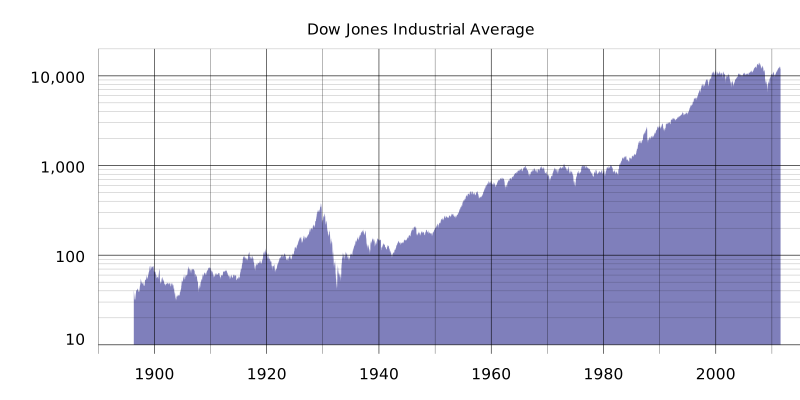
The Dow Jones Industrial Average DJIA often called the Dow...

Korea is a peninsular region in East Asia comprised of...

Stocks were a type of restraining device historically used as...

September is the ninth month of the year in the...
Time is a fundamental dimension used to sequence events measure...
Trending

3 hours ago Tommy Paul Continues Professional Tennis Journey Amidst Global Sports and Tech Industry Shifts
3 hours ago The New York Times Highlights Social Media Controversies and Personal Health Struggles

3 hours ago Shanghai Masters Tennis Tournament Updates and Match Previews

4 hours ago Alexander Bublik Faces Backlash After Intense Racket Smashing Outburst at Shanghai Masters

4 hours ago New Film Artificial Explores OpenAI Creators and Future of Humanity
4 hours ago KOSPI Shares Plunge Amid Tech Sell-Off and Global Economic Pressures
Popular

Ken Paxton is an American politician and lawyer serving as...

Jameis Winston is an American football quarterback currently playing for...

Cristiano Ronaldo widely considered one of the greatest footballers captains...

Michael Joseph Jackson the King of Pop was a highly...

Elon Musk is a visionary entrepreneur and engineer known for...

Shakira Isabel Mebarak Ripoll the Queen of Latin Music is...