History of Lake Tahoe in Timeline


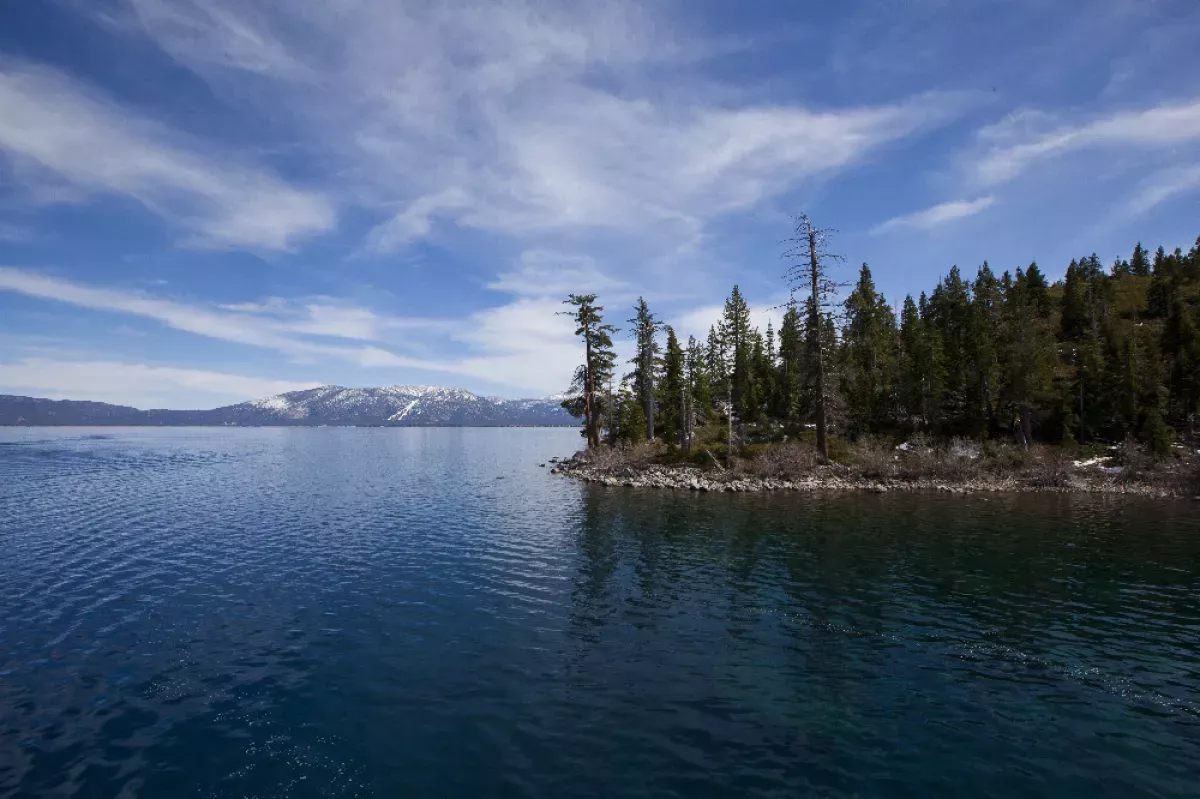
Lake Tahoe is a large freshwater lake in the Sierra Nevada mountains, located on the border between California and Nevada. It's North America's largest alpine lake, situated at an elevation of 6,225 feet. By volume, it is the second-largest lake in the United States, only surpassed by the Great Lakes. With a depth of 1,645 feet, Lake Tahoe is the second deepest lake in the United States, after Crater Lake.
5 hours ago : Lake Tahoe Residents Face Power Loss Due to AI Data Center Energy Diversion
Lake Tahoe residents are experiencing power outages as the main energy source is diverted to power AI data centers. This has led to homeowners seeking alternative solutions like solar and batteries due to unreliable utility services.


1900: Niagara scrapped at Tahoe City
In 1900, the steamboat Niagara was scrapped at Tahoe City.
1910: Hayford ellipsoid used
Around 1910, the Hayford ellipsoid of 1910 may later have been used by the United States Coast and Geodetic Survey.
1912: Congressional session for National Park designation
During the 1912 Congressional sessions, congressmen tried unsuccessfully to designate the Tahoe basin as a national park.
1913: Congressional session for National Park designation
During the 1913 Congressional sessions, congressmen tried unsuccessfully to designate the Tahoe basin as a national park.
1913: Lake Tahoe Dam built
In 1913, Lake Tahoe Dam was built at the lake's only outlet, the Truckee River, at Tahoe City.
1918: Congressional session for National Park designation
During the 1918 Congressional sessions, congressmen tried unsuccessfully to designate the Tahoe basin as a national park.
1926: First Casino Opens at Lake Tahoe
In 1926, the first casino at Lake Tahoe, the Cal-Neva Lodge, was built on the North Shore in Crystal Bay by Robert Sherman.
1929: Sale of the Cal-Neva Lodge
In 1929, the Cal-Neva Lodge was sold to Bill Graham and Jim McKay after Norman Henry Biltz acquired the property.
1929: Ray and Dagmar Dolby Home Built
The west shore lakefront home of Ray and Dagmar Dolby was built in 1929. The home was used in the 2014 film Last Weekend.
1931: Stateline Country Club
At South Shore, the Stateline Country Club had stood since 1931 and was purchased by Bill Harrah who built Harrah's Tahoe.
1931: Nevada Legalizes Gambling
In 1931, Nevada legalized gambling, although the first casino at Lake Tahoe had already been open for years.
1931: Tunnel blasted through Cave Rock
In 1931, a tunnel was blasted through Cave Rock for Highway 50, despite protests from the Washoe tribe, who considered the rock a sacred site.
1934: Beaver re-introduction
In 1934, the California Department of Fish and Wildlife and the U.S. Forest Service started to re-introduce North American beaver to the Tahoe Basin.
1934: Mail contract given to motorboat
In 1934, the mail contract around Lake Tahoe was given to the motorboat Marian B, powered by two Chevrolet engines.
1935: Emerald (II) leaves Lake Tahoe
In 1935, the Emerald (II) left Lake Tahoe to become a fishing boat in San Diego.
1937: Rebuilding of the Cal-Neva Lodge
In 1937, the Cal-Neva Lodge was rebuilt after a fire.
1937: Crystal Bay Club Built
In 1937, the Crystal Bay Club was first built as the Ta-Neva-Ho on the North Shore of Lake Tahoe.
May 17, 1941: Loss of Marian B
On May 17, 1941, the motorboat Marian B was lost during a storm while attempting mail delivery, leading to the end of mail delivery by boat.
1942: Boiler used until 1942
Until 1942, the boiler from the Governor Stanford steamboat, which was beached at Glenbrook, was used to heat cottages at Glenbrook Inn and Ranch.
1944: Salmon transplantation to Lake Tahoe
In 1944, non-native sockeye salmon were transplanted from the North Pacific to Lake Tahoe.
1945: Name officially changed to Lake Tahoe
In 1945, the California State Legislature reversed its previous decision, officially changing the name to Lake Tahoe.
1949: Beaver re-introduction
In 1949, the California Department of Fish and Wildlife and the U.S. Forest Service continued re-introducing North American beaver to the Tahoe Basin; this effort had been underway since 1934.
1953: Lake Tahoe Forest Reserve
President William McKinley proclaimed the "The Lake Tahoe Forest Reserve" (31 Stat. 1953) on April 13th 1898.
1955: Fred Rogers Swims Length of Lake Tahoe
In 1955, Fred Rogers became the first person to swim the length of Lake Tahoe.
1957: Founding of the League to Save Lake Tahoe
In 1957, the League to Save Lake Tahoe was founded in response to a proposal to build a four-lane highway around the lake, including a bridge over Emerald Bay. The League has been an environmental watchdog ever since.
1960: Winter Olympics and population boom
In 1960, the completion of interstate highway links for the Winter Olympics held at Olympic Valley (then known as "Squaw Valley"), and construction of gambling casinos in Nevada led to a dramatic increase in development within the Tahoe basin.
1962: First Woman Swims Length of Lake Tahoe
In 1962, Erline Christopherson became the first woman to swim the length of Lake Tahoe.
1963: Introduction of Opossum Shrimp
In 1963, opossum shrimp (Mysis diluviana) were introduced to Lake Tahoe to enhance the food supply for the Kokanee salmon.
1969: Lake Tahoe warming trend
Analysis of the temperature records in Lake Tahoe has shown that the lake warmed (between 1969 and 2002) at an average rate of 0.027 °F (0.015 °C) per year.
1969: Expansion of the Cal-Neva Lodge
In 1969, the Cal-Neva Lodge was expanded, most notably with the addition of a high-rise hotel.
1969: Tahoe Regional Planning Agency established
In 1969, the U.S. Congress and the California and Nevada State Legislatures created a compact establishing the Tahoe Regional Planning Agency (TRPA).
1970: Lake Tahoe mixed to a depth
Since 1970, Lake Tahoe has mixed to a depth of at least 1,300 ft (400 m) a total of six or seven times.
1971: Cladoceran Populations Disappear
By 1971, the opossum shrimp introduced to Lake Tahoe had decimated the lake's cladoceran populations (Daphnia and Bosmina), causing them to virtually disappear.
December 9, 1972: All-time minimum temperature recorded
On December 9, 1972, the all-time minimum temperature of −16 °F (−27 °C) was recorded at the Lake Tahoe Airport.
1974: The Godfather Part II Filmed at Lake Tahoe
In 1974, the film The Godfather Part II used the lakeside estate Fleur de Lac as the location for several scenes.
1980: Population increase and development slowdown
By 1980, the permanent residential population increased from about 10,000 to greater than 50,000, and the summer population grew from about 10,000 to about 90,000. Since the 1980s, development has slowed due to controls on land use.
1980: Supreme Court and boundary dispute
In 1980, the Supreme Court of the United States partially heard a case regarding the legally binding surveys marking the boundary, where the doctrine of acquiescence was invoked.
1980: Tahoe Transportation District established
In 1980, the U.S. Congress amended the Compact with public law 96-551, designating a new agency, the Tahoe Transportation District (TTD).
1980: Lake Tahoe Interagency Monitoring Program Established
Since 1980, the Lake Tahoe Interagency Monitoring Program (LTIMP) has been measuring stream discharge and concentrations of nutrients and sediment in tributary streams in the Lake Tahoe Basin.
1987: Beaver population density
By 1987, beaver populations on the upper and lower Truckee River had reached a density of 0.72 colonies (3.5 beavers) per kilometer.
July 22, 1988: All-time maximum temperature recorded
On July 22, 1988, the all-time maximum temperature of 99 °F (37 °C) was recorded at the Lake Tahoe Airport.
1988: Filming of "Things Change"
The 1988 film Things Change was also filmed at the west shore lakefront home of Ray and Dagmar Dolby.
1996: Lake and river overflow
Around New Year 1996, a Pineapple Express atmospheric river melted snow, causing Lake Tahoe and the Truckee River to overflow, inundating Reno and surrounding areas.
1997: Lake and river overflow
Around New Year 1997, a Pineapple Express atmospheric river melted snow, causing Lake Tahoe and the Truckee River to overflow, inundating Reno and surrounding areas.
1997: Lowest Secchi depth recorded
In 1997, the lowest average Secchi depth of 64.1 feet (19.5 m) was recorded in Lake Tahoe.
2002: Lake Tahoe warming trend
Analysis of the temperature records in Lake Tahoe has shown that the lake warmed (between 1969 and 2002) at an average rate of 0.027 °F (0.015 °C) per year.
September 2004: Ponderosa Ranch Closes
In September 2004, the Ponderosa Ranch of the TV series Bonanza closed its doors after being sold to developer David Duffield.
2006: Goldfish Observed in Lake Tahoe
Since 2006, goldfish have been observed in Lake Tahoe, where they have grown to "giant size". As an invasive species, they may have descended from former pets or fishing bait.
June 2007: Angora Fire Burns South Lake Tahoe
In June 2007, the Angora Fire burned approximately 3,100 acres (1,300 ha) throughout the South Lake Tahoe area. While the immediate impact of ash on the lake was minimal, the potential for future erosion remained a concern.
2010: Second-lowest Secchi depth recorded
In 2010, the average Secchi depth was recorded to be 64.4 feet (19.6 m), which was the second-lowest ever recorded.
2011: Lake clarity increase
From 2011 to 2014, the clarity of Lake Tahoe increased by nearly 20 percent.
2014: Lake clarity increase
From 2011 to 2014, the clarity of Lake Tahoe increased by nearly 20 percent.
2014: Last Weekend Film Location
In 2014, the film Last Weekend, starring Patricia Clarkson, used the west shore lakefront home of Ray and Dagmar Dolby as the primary location for its interiors and exteriors.
2018: Federal survey monument removed
Around 2018, a federal survey monument was removed to the Lake Tahoe Historical Society.
2018: Tahoe Album Release
In 2018, Dedekind Cut released Tahoe, an ambient album.
2019: First Discovery of Microplastics
In 2019, microplastics were found for the first time in Lake Tahoe by the Desert Research Institute, indicating pollution in the water from local and global sources.
2019: Cutthroat trout reintroduction
In 2019, reintroduction efforts for cutthroat trout started in Lake Tahoe after the fish had been completely extirpated from the lake in the early 20th century due to competition from introduced fish.
2021: NHL Outdoor Games at Lake Tahoe
In 2021, the NHL hosted two outdoor games at Lake Tahoe.
2023: High Microplastic Concentrations
In 2023, updated measurements revealed that Lake Tahoe contained some of the highest microplastic pollution concentrations among 38 lakes and reservoirs measured.
Mentioned in this timeline

Fred Rogers known as Mister Rogers was an influential American...
California is a U S state on the Pacific Coast...
A desert is a landscape characterized by minimal precipitation leading...
Nevada a landlocked state in the Western US is the...

Fire is a rapid oxidation process specifically combustion that releases...

A supreme court the highest court in a legal jurisdiction...
Trending

15 minutes ago Taiwan watches Trump-Xi summit amid arms sales uncertainty and policy change warnings.
15 minutes ago Andor: A Prescient Star Wars Reflection on Truth, Lessons, and Binged Lightsabers.

1 hour ago Stephen Curry's Future: Retirement Plans and Strong Message to the Warriors.
1 hour ago Russia tests RS-28 Sarmat, a powerful nuclear-capable missile, showcasing military strength.
2 hours ago Barcelona Prepares for La Liga Match Against Alavés; Eyes Julián Alvarez
2 hours ago Cisco stock surges on AI orders, plans 4,000 job cuts, exceeding forecast.
Popular

Michael Joseph Jackson the King of Pop was a highly...

Ted Turner is an American entrepreneur and media mogul best...

Thomas Massie is a Republican politician and engineer representing Kentucky's...

William Franklin Graham III known as Franklin Graham is an...

Kash Patel is an American lawyer who currently serves as...

Paula White-Cain is a prominent American televangelist and key figure...