


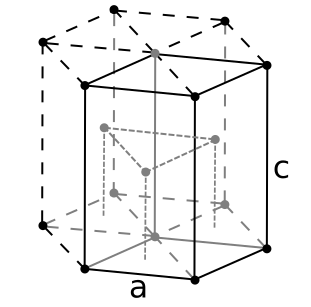
Nihonium (Nh), element 113, is a synthetic, extremely radioactive element. Its most stable isotope, nihonium-286, has a half-life of approximately 10 seconds. Located in the p-block of the periodic table, it belongs to period 7 and group 13, classifying it as a transactinide element. Due to its short half-life and synthetic nature, much of its chemical and physical properties remain unknown.
1908: Masataka Ogawa's Discovery of "Nipponium"
In 1908, Japanese chemist Masataka Ogawa discovered what he believed to be element 43 and named it "nipponium" after Japan. However, this claim was later disproven, leaving the name available for future use.


1979: IUPAC Naming Recommendations
In 1979, IUPAC recommended the name "ununtrium" (Uut) as a placeholder for element 113 until its discovery was confirmed and an official name was decided. While adopted in educational settings, scientists generally continued to refer to it as "element 113" or similar designations.
2003: JINR's claim for elements 115 and 113
In 2003, JINR claimed production of elements 115 and 113, which factored into their later contestation of IUPAC's decision to solely credit Riken with the discovery of element 113.
2003: Initial claims for element 113
Several isotopes of element 113 were claimed to have been discovered in 2003.
2003: Original Am + Ca Experiment
The original Am + Ca experiment was performed in 2003.
2004: JINR-LLNL Collaboration
In 2004, the JINR-LLNL collaboration conducted experiments related to the production of element 113 as a daughter of element 115.
June 2006: Claimed synthesis of a new isotope of element 113
In June 2006, a joint team from the Joint Institute for Nuclear Research (JINR) and Lawrence Livermore National Laboratory (LLNL) announced they had synthesized a new isotope of element 113 by bombarding neptunium-237 with calcium-48 nuclei.
2006: Further claims for element 113
Additional isotopes of element 113 were claimed to have been discovered in 2006.
2006: Investigation of the Am + Mg reaction
In 2006, researchers at the Heavy Ion Research Facility in Lanzhou, China, investigated the Am + Mg reaction, successfully producing four atoms of Bohrium (Bh). The decay chains of these atoms were analyzed, with some undergoing alpha decay to Dubnium (Db) and subsequent spontaneous fission, while others continued to Lawrencium (Lr) through further alpha decay.
2007: JINR-LLNL Collaboration
In 2007, the JINR-LLNL collaboration conducted further experiments related to element 113.
2009: Direct synthesis of Bohrium and study of its decay
In early 2009, the Riken team directly synthesized Bohrium (Bh) using the Cm + Na reaction. This was done to establish the link between Bh and element 113. They also observed that Db, a decay product of Bh, decayed through both spontaneous fission and alpha decay to Lr.
2009: Synthesis of element 117 and its decay to element 113
In late 2009, the JINR-LLNL collaboration, along with researchers from Oak Ridge National Laboratory (ORNL) and Vanderbilt University, synthesized two isotopes of element 117 through the Bk + Ca reaction. These isotopes decayed to element 115, and subsequently to element 113.
March 2010: Failed synthesis attempt of Roentgenium
In March 2010, the Riken team attempted to synthesize Roentgenium (Rg) directly using the Tl + Zn reaction, but this attempt was unsuccessful, and the approach was subsequently abandoned.
2010: Preliminary Chemical Experiments Begin
Between 2010 and 2012, preliminary chemical experiments at JINR explored the volatility of nihonium, but faced challenges in detection, suggesting either noble-gas-like behavior or low volatility.
2010: JINR-LLNL-ORNL-Vanderbilt Collaboration
In 2010, the JINR-LLNL-ORNL-Vanderbilt collaboration discovered elements 117 and 115, and observed the production of element 113 as a decay product.
2011: Joint Working Party (JWP) report on elements 113-116 and 118
In 2011, the JWP published its report on elements 113-116 and 118. They acknowledged the JINR-LLNL's discovery of elements 114 and 116 but didn't accept either team's claim for element 113, nor the JINR-LLNL claims for elements 115 and 118, citing insufficient evidence and theoretical limitations.
2011: Tōhoku earthquake and tsunami impact on research
The 2011 Tōhoku earthquake and tsunami led to increased electricity prices and subsequent shutdowns of accelerator programs to conserve costs. However, Morita's team at Riken was permitted to continue their experiment related to element 113.
August 2012: Confirmation of element 113 synthesis
In August 2012, the Riken team produced and identified another atom of element 113, following 450 more days of bismuth irradiation with zinc projectiles. This confirmed their earlier synthesis of the element.
2012: Challenges in Nihonium Volatility Studies
By 2012, initial attempts to study the volatility of nihonium posed technical difficulties, suggesting that it either behaved similar to noble gases or had lower-than-expected volatility. The potential for using hydroxide formation (NhOH) for easier transport was raised.
2012: Repetition of the Bk + Ca experiment at JINR
In 2012, the Bk + Ca experiment was repeated at JINR.
August 2013: Confirmation of 2003 Am + Ca experiment
Researchers at Lund University and GSI confirmed the findings of the 2003 Am + Ca experiment conducted by the JINR-LLNL collaboration, which aimed to synthesize element 115.
2014: Repetition of the Bk + Ca experiment at GSI
In 2014, the Bk + Ca experiment was repeated at GSI.
August 2015: Confirmation of Element 115 and its Daughters
In August 2015, the team at the Lawrence Berkeley National Laboratory (LBNL) published confirmation of the synthesis of element 115 and its decay products, including element 113.
December 2015: IUPAC assigns discovery credit of element 113 to Riken
In December 2015, IUPAC officially recognized Riken's discovery of element 113, while elements 115, 117, and 118 were credited to collaborations involving JINR. This marked the first time a team of Asian physicists named a new element.
January 2016: Official Publication of JWP Report and Recognition of Element 113 Discovery
In January 2016, the JWP officially published their report recognizing Riken's discovery of element 113. Despite inconsistencies in individual decay energies, the consistent sum of decay energies confirmed the identity of element 113. The JWP acknowledged the production of element 113 by the JINR-LLNL collaborations in 2004 and 2007 but didn't grant shared credit due to insufficient characterization of the produced nuclides.
February 2016: Name Selection Process Begins
Following official recognition of their discovery, the Riken team initiated discussions in February 2016 to select a name for element 113, aiming for a name that would honor its discovery in Japan.
March 2016: "Nihonium" Proposed
In March 2016, after deliberations that included considerations of names like "japonium," the Riken team formally proposed "nihonium" (Nh) to IUPAC, derived from "Nihon," a Japanese word for Japan. This proposal aimed to recognize the discovery in Japan, honor the public support for the research, and pay homage to chemist Masataka Ogawa's prior discovery of then "nipponium."
May 2016: Critique of JWP's element 113 discovery criteria
In May 2016, a study from Lund University and GSI criticized the JWP's rationale for recognizing element 113, specifically the "sum argument," due to the possibility of gamma decay or internal conversion influencing decay chain properties. However, they ultimately endorsed the IUPAC's approval of element 113 based on the congruence of Riken's data.
June 2016: Public Review and Controversy
The proposed name "nihonium" was publicized in June 2016 with a five-month period for public review. This followed criticism concerning the lack of transparency in the element naming process.
November 2016: Official Approval of Nihonium
In November 2016, IUPAC officially approved the name "nihonium" (Nh) for element 113, marking a historic milestone in chemistry and a point of national pride for Japan.
2016: Planned joint announcement by IUPAC and IUPAP
A joint announcement by IUPAC and IUPAP regarding element discovery was scheduled for 2016 but was preempted by IUPAC due to a leak to Japanese newspapers about Riken's credit for element 113.
June 2017: JINR's response to criticism
In June 2017, members of the JINR team published a rebuttal to the criticisms of their data on elements 113, 115, and 117, defending the IUPAC's approval of their discoveries.
2017: Further Chemical Studies and Unexpected Surface Interaction
A 2017 experiment at JINR modified the setup to address previous challenges, but no nihonium atoms were observed after separation. This indicated an unexpected high retention of nihonium on PTFE surfaces, contradicting theoretical predictions. The need for high-temperature techniques and alternative carrier gases like bromine were proposed for future investigations.
2024: Adsorption Studies and Reactivity of Nihonium
In 2024, a GSI experiment studied the adsorption of nihonium on SiO2 and gold. Nihonium exhibited less reactivity with SiO2 than thallium, but more than copernicium and flerovium, attributed to the relativistic stabilization of the 7p1/2 shell.
Mentioned in this timeline
The periodic table organizes chemical elements into rows periods and...
An earthquake is a sudden intense shaking of the Earth's...
China officially the People's Republic of China PRC is located...
Japan is an East Asian island country located in the...

A tsunami is a series of powerful waves caused by...

Tokyo is the capital and most populous city of Japan...
Trending

3 hours ago Education Department Extends Deadline for Student Loan Interest Rate Discount
3 hours ago Olivia Dean Faces Plagiarism Allegations Over Bill Withers Song Similarities

3 hours ago Novak Djokovic Defeats Zverev to Advance to China Open Semifinals

3 hours ago Daniil Medvedev Set for High-Stakes Clash at China Open in Beijing
4 hours ago US Coast Guard Personnel Exchange Fire With Shooters Near Mexico Border

15 days ago Florida Records First Dengue Fever Death Amid Rising Case Numbers in Hillsborough County
Popular

Ken Paxton is an American politician and lawyer serving as...

Shakira Isabel Mebarak Ripoll the Queen of Latin Music is...

Jameis Winston is an American football quarterback currently playing for...

Elon Musk is a visionary entrepreneur and engineer known for...

Bernie Sanders is a prominent American politician and the senior...

Michael Joseph Jackson the King of Pop was a highly...