


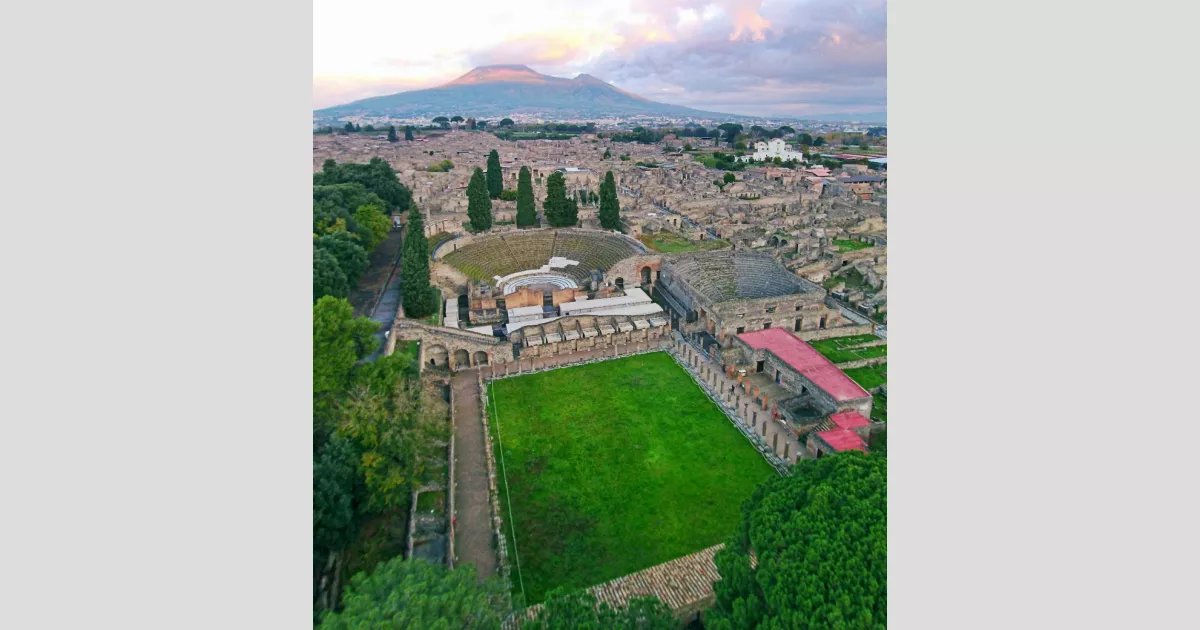
Pompeii was an ancient Roman city located near modern-day Naples, Italy. In 79 AD, Mount Vesuvius erupted, burying Pompeii, Herculaneum, and Stabiae under meters of volcanic ash and pumice, effectively preserving them for centuries. The eruption resulted in the death of thousands. Rediscovered centuries later, the remarkably preserved ruins provide invaluable insights into Roman life, architecture, and culture, offering a detailed snapshot of a Roman city frozen in time. Pompeii is now a UNESCO World Heritage Site and a popular tourist destination.
1943: Antiquarium Damaged in Bombing
In 1943, the Antiquarium of Pompeii suffered extensive damage during World War II bombings.


1954: Pompeii Scene in "Journey to Italy"
In 1954, the film "Journey to Italy" included a scene filmed at Pompeii, where the characters witness the excavation of casts of people who died in the eruption.
1960: Most of Pompeii Uncovered
By 1960, most of Pompeii had been uncovered, but left in decay. Further major excavations were banned or limited to targeted, prioritised areas to prevent further damage.
1971: Pink Floyd: Live at Pompeii filmed
In 1971, the rock band Pink Floyd filmed "Pink Floyd: Live at Pompeii", a live concert featuring six songs performed in Pompeii's ancient Roman amphitheater with only the film crew and local children as the audience.
1980: Severe Earthquake Causes Great Destruction
In 1980, a severe earthquake caused significant destruction in Pompeii, leading to questionable reconstruction efforts that have made it difficult to distinguish original ruins from later additions.
1980: Etruscan Inscriptions and Necropolis Excavated
In 1980, excavations revealed Etruscan inscriptions and a 6th-century BC necropolis, indicating the significant Etruscan influence on Pompeii during that period.
1980: Antiquarium Damaged by Earthquake
In 1980, the Antiquarium of Pompeii suffered further damage due to an earthquake.
1981: Etruscan Inscriptions and Necropolis Excavated
In 1981, continuing excavations revealed Etruscan inscriptions and a 6th-century BC necropolis, indicating the significant Etruscan influence on Pompeii during that period.
1985: "Cities in Dust" Song Release
In 1985, Siouxsie and the Banshees wrote and recorded "Cities in Dust", a song describing the disaster that befell Pompeii and Herculaneum in AD 79, which appeared on their album Tinderbox.
1996: Pompeii Included in World Monuments Watch
In 1996, Pompeii was included in the World Monuments Watch by the World Monuments Fund, highlighting the urgent need for repair and restoration efforts to preserve the ancient city.
1997: Pompeii Declared a UNESCO World Heritage Site
In 1997, Pompeii was declared a World Heritage Site by UNESCO, recognizing its outstanding universal value and cultural significance.
1998: Pompeii Included in World Monuments Watch
In 1998, Pompeii was included in the World Monuments Watch by the World Monuments Fund, highlighting the urgent need for repair and restoration efforts to preserve the ancient city.
1998: Rediscovery of Priapus Fresco
In 1998, the Priapus fresco, depicting the ancient god of sex and fertility, which had been hidden away "out of prudishness", was rediscovered due to rainfall.
1999: Excavation Moratorium
In 1999, new excavations at Pompeii were generally ceased due to a moratorium imposed by Professor Pietro Giovanni Guzzo, the superintendent of the site.
2000: Pompeii Included in World Monuments Watch
In 2000, Pompeii was included in the World Monuments Watch by the World Monuments Fund, highlighting the urgent need for repair and restoration efforts to preserve the ancient city.
2000: Naples "Secret Museum" Re-opened
In 2000, after being closed for nearly 100 years, the Naples "Secret Museum", which houses erotic artwork from Pompeii, was finally re-opened for viewing, albeit with restrictions on minors.
2003: "Pompeii" Novel Published
In 2003, Robert Harris's novel "Pompeii" was published, featuring an account of the aquarius's race to fix the broken aqueduct in the days before the eruption of Vesuvius.
2008: Pompeii Attracts Millions of Visitors
By 2008, Pompeii was attracting almost 2.6 million visitors per year, making it one of Italy's most popular tourist sites and a key destination on the Grand Tour.
2010: Study Concludes Heat as Main Cause of Death
In 2010, a study indicated that heat from pyroclastic flows, reaching at least 250 °C (480 °F), was the main cause of death at Pompeii, contrary to previous beliefs of ash suffocation.
2010: Collapse of the Schola Armatorum
In 2010, the Schola Armatorum ('House of the Gladiators') collapsed due to heavy rainfall and inadequate drainage, sparking controversy and accusations of neglect.
2012: Study Recommends Improved Strategy for Site Interpretation
A 2012 study recommended an improved strategy for the interpretation and presentation of the Pompeii site as a cost-effective method of improving its conservation and preservation in the short term.
2012: "Grande Progetto Pompei" Project Begins
In 2012, the "Grande Progetto Pompei," a five-year project funded by the European Union, was initiated to stabilize and conserve buildings in the highest-risk areas of Pompeii.
June 2013: UNESCO Warns Pompeii Could Be Placed on List of World Heritage in Danger
In June 2013, UNESCO warned that if restoration and preservation works at Pompeii "fail to deliver substantial progress in the next two years," the site could be placed on the List of World Heritage in Danger.
2013: "Pompeii" Song Release
In 2013, the British band Bastille released the song "Pompeii," which references the city and the eruption of Mount Vesuvius in its lyrics.
2014: UNESCO Receives New Management Plan
In 2014, UNESCO headquarters received a new management plan for Pompeii to help integrate the property's management, conservation, and maintenance programs.
2014: "Pompeii" Film Release
In 2014, the German-Canadian historical disaster film "Pompeii", produced and directed by Paul W. S. Anderson, was released.
2016: David Gilmour Concert at Pompeii
In 2016, 45 years after Pink Floyd's recordings, guitarist David Gilmour returned to the Pompeii amphitheater to perform a live concert for his Rattle That Lock Tour. The event was considered the first in the amphitheater to feature an audience since the AD 79 eruption of Vesuvius.
2016: Antiquarium Reopening for Temporary Exhibitions
In 2016, the Antiquarium of Pompeii reopened to the public for temporary exhibitions after being closed for 36 years.
2017: Moratorium Lifted
In 2017, the moratorium on new excavations at Pompeii, which had been in place since 1999, was lifted, potentially allowing for renewed archaeological work at the site.
December 2018: Remains of Harnessed Horses Discovered
In December 2018, the remains of harnessed horses were discovered in the Villa of the Mysteries, providing insights into transportation and daily life in Pompeii.
2018: Stable Discovered in Civita Giuliana
In 2018, a stable was discovered in the luxurious villa in Civita Giuliana, north of Pompeii, where a ceremonial chariot would be uncovered in 2021.
2018: Erotic Fresco of "Leda and the Swan" Discovered
In 2018, an ancient fresco depicting an erotic scene of "Leda and the Swan" was discovered at Pompeii, adding to the collection of erotic art found at the site.
2018: Charcoal Inscription Discovered
In 2018, the discovery of a charcoal inscription at the site, which includes the date of October 17, provided evidence suggesting a later eruption date for Mount Vesuvius.
2018: New Discoveries in Previously Unexplored Areas
Since 2018, prioritized excavations have led to new discoveries in previously unexplored areas of Pompeii, revealing more about the city's history.
November 2020: Remains of Two Men Found in Ash Layer
In November 2020, the remains of two men, believed to be a rich man and his slave, were found in a 2-meter-thick layer of ash. These individuals likely survived the initial eruption but were killed by a subsequent blast.
December 2020: Thermopolium Excavated in Regio V
In December 2020, a thermopolium (inn or snack-bar) was excavated in Regio V, revealing brightly colored frescoes, remnants of meals (including duck, goat, pig, fish, and snails), and various cooking and serving vessels. The discovery offers insights into the culinary practices and social life of Pompeii.
2020: Domus Gardens, Orchards and Vineyards Recreated
In 2020, many domus gardens, orchards, and vineyards in Pompeii were carefully recreated using depictions in frescoes and archaeological finds to provide better insights into their appearance before the eruption.
January 2021: "Large, four-wheel ceremonial chariot" Uncovered
In January 2021, a well-preserved "large, four-wheel ceremonial chariot" was uncovered in the portico of a luxurious villa in Civita Giuliana, north of Pompeii. The carriage is made of bronze and black and red wooden panels, with engraved silver and bronze medallions at the back.
January 2021: Antiquarium Reopening as Permanent Exhibition Venue
On January 25, 2021, the Antiquarium of Pompeii was re-opened as a permanent exhibition venue, displaying archaeological discoveries, casts of eruption victims, and Pompeii's settlement history.
2021: Painted Tomb Containing Mummified Remains Discovered
In 2021, an exceptional 1st century AD painted tomb of a freed slave, Marcus Venerius Secundio, containing mummified human remains, was discovered outside the Porta Sarno gate. The discovery provides insights into the social status, religious affiliations, and cultural activities of the deceased.
2021: Several Long-Closed Domus Re-Opened After Restoration
In 2021, several long-closed domus in Pompeii were re-opened to the public after undergoing restoration, including the House of the Ship Europa, House of the Orchard, and House of the Lovers. Additionally, the newly excavated House of Leda and the Swan was opened.
2022: Collaborative Study Determines Eruption Date
A collaborative study in 2022 determined that the eruption of Mount Vesuvius occurred on 24–25 October, based on the available evidence and historical accounts.
2023: Archaeology Reveals Building Collapses Due to Earthquakes During Eruption
Archaeological findings in 2023 revealed that some buildings in Pompeii collapsed due to one or more earthquakes during the eruption of Mount Vesuvius, resulting in the deaths of occupants.
2023: Ceremonial chariot Restored for Display
In 2023, the ceremonial chariot discovered in January 2021 was restored for display at the Baths of Diocletian.
April 2024: Dining Hall with Rare Frescoes Excavated
In April 2024, a dining hall lined with rare frescoes was excavated in Pompeii, featuring depictions of Helen of Troy and Paris, and Apollo and Princess Cassandra. The discovery enriches understanding of Roman art and culture in Pompeii.
June 2024: Shrine with Blue-Painted Walls Discovered
In June 2024, a shrine with rare blue-painted walls covered with paintings of females thought to represent the four seasons (Horae) was discovered. 15 amphorae, two bronze jugs and two bronze lamps were among the findings.
2024: Pompeii to Limit Daily Sales of Personalised Tickets
In 2024, the management of Pompeii announced that it would limit daily sales to a maximum of 20,000 personalised tickets per day and introduce timed entry schemes in the peak summer season, to combat problems associated with tourism.
Mentioned in this timeline

An earthquake is a sudden intense shaking of the Earth's...
Italy officially the Italian Republic is a country in Southern...
War is defined as an armed conflict involving the armed...

The horse scientifically known as Equus ferus caballus is a...

Books are a means of storing information as text or...

Pink is a pale tint of red or rose named...
Trending

4 hours ago Measles Exposure Reported at Philadelphia International Airport and CHOP NICU

4 hours ago Police Increase Safety Measures for Oxford Freshers’ Week

4 hours ago Cody Bellinger Revives MLB Career with Swing Adjustments for Postseason Success
4 hours ago Hawks Trade Buddy Hield and Ryan Nembhard to Hornets for Dorian Finney-Smith

4 hours ago Missing 8-Year-Old Boy from Arvada Found Safe Following Amber Alert

5 hours ago LSU Tigers Prepare for Texas A&M Matchup Following Disappointing Loss
Popular

Jameis Winston is an American football quarterback currently playing for...

Ken Paxton is an American politician and lawyer serving as...

Shakira Isabel Mebarak Ripoll the Queen of Latin Music is...

Michael Joseph Jackson the King of Pop was a highly...

Kash Patel is an American lawyer who currently serves as...

Lane Kiffin is an American football coach with a notable...