


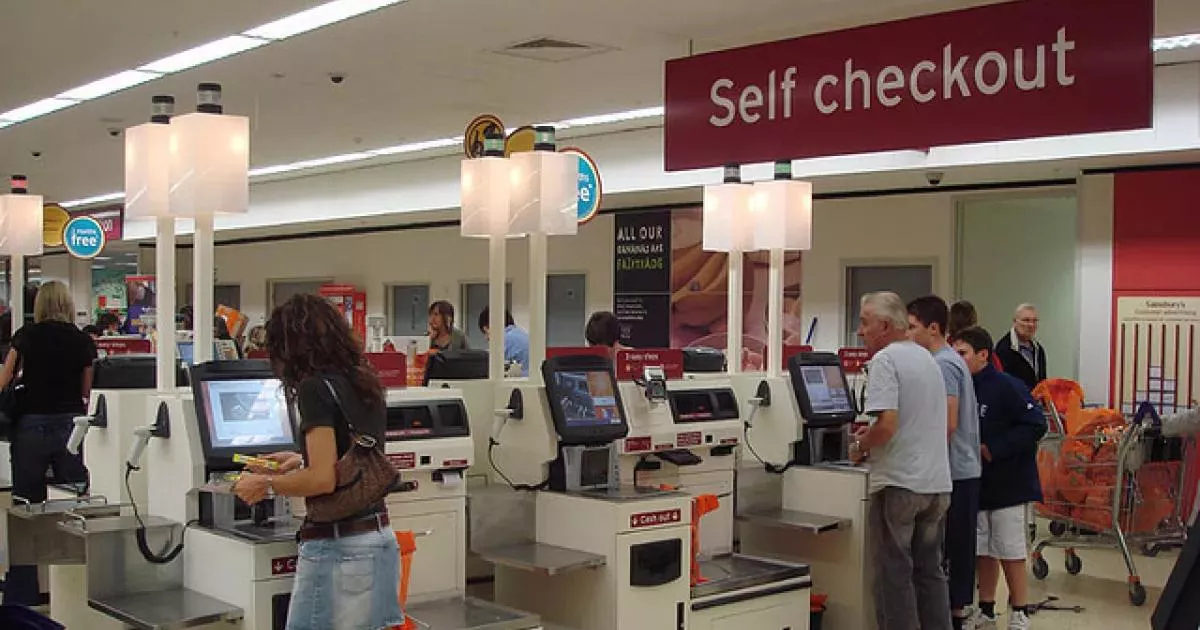
Self-checkouts (SCOs), or assisted checkouts (ACOs), are machines enabling customers to independently complete transactions with retailers. Customers scan item barcodes and pay without direct staff assistance. Primarily found in supermarkets, but also in department and convenience stores, SCO areas are typically supervised by staff who assist with transactions, price corrections, and other services.


2002: Study on accessibility of self-checkout machines
In 2002, a study showed that existing self-checkout machines were not designed for accessibility for people with disabilities.
2010: Open-source-self-check project announced
In 2010, the open-source-self-check project was announced. By using hardware and open source software, this library self-checkout system costs less than one-tenth of the commercial version.
September 2013: California court confirms law banning alcohol sales through self-checkout
In September 2013, a California appeal court confirmed a law banning the sale of alcohol through self-checkouts. The law requires alcohol only to be sold in face-to-face transactions with staff members.
2013: Self-checkout units deployed worldwide
As of 2013, there were 191,000 self-checkout units deployed around the globe.
2014: NCR survey on self-checkout
In a 2014 survey by NCR, 42% of customers said they liked the convenience of self-checkout, while 39% said it was faster than the cashier-assisted line. 90% of those surveyed responded as being users of self-checkout, with 7% of respondents saying they will always use self-checkout regardless of store lines and number of items.
2015: Tesco replaces robotic announcements
In 2015, in response to criticism, supermarket Tesco replaced the robotic announcements with more human-sounding voice prompts on its self-service checkouts.
December 2016: Amazon announces Amazon Go store
In December 2016, Amazon announced a brick-and-mortar store in Seattle under the name Amazon Go, which uses cameras and sensors to track what customers are putting into their shopping bags. Customers scan a QR code via a companion app linked to their Amazon.com account upon entry, and are automatically charged when they exit.
2018: Walmart China launches Wechat-based "Scan and Go" program
In the summer of 2018, Walmart China launched its Wechat-based "Scan and Go" program, which allowed customers to scan items into their carts without downloading another mobile app, while paying through Wechat Payment or Alipay. The "Scan and Go" program carried 30% of all payments made in Chinese stores and even improved sales in certain markets by 10%.
2019: Marks & Spencer replaces checkout announcers with Britain's Got Talent judges
In 2019, Marks & Spencer replaced its regular checkout announcers with the voices of judges from that year's season of Britain's Got Talent. The new voices led to an increase in customer complaints, with many questioning the appropriateness of some of the comments.
2020: Kroger signs up with systems that detect skipped scans
In 2020, Kroger signed up with new systems that detect a skipped scan and shows a video to the consumer who is given the opportunity to correct their mistake. If they repeat the action, then an employee is notified.
2020: Oregon AFL-CIO backs measure to limit self-checkout machines
In 2020, the Oregon AFL–CIO backed a proposed ballot measure in Oregon, US, to prohibit stores from operating more than two self-checkout machines.
2021: Raydiant report on self-checkout failures
A 2021 report by Raydiant found that 67% of users have experienced at least one failure of a self-checkout system. 25% said they would avoid self-checkout because of prior bad experiences or slows. 65% worry about cleanliness. Many customers experience frustration at self-checkout when they need assistance.
2021: Costco introduces self-checkout screens for food courts
In 2021, Costco began to institute self-checkout screens for their food courts during the COVID-19 pandemic, allowing the food court's kitchen staff to focus solely on food preparation and service. The system requires payment via debit or credit card, ending the need for customers to exchange paper money or coinage with those employees, a potential vector for disease transmission.
2021: US self-checkout system market value
In 2021, it was estimated that the self-checkout system market in the U.S. reached $1.4 billion, accounting for 41% of the global market.
April 2022: Camera-based self-checkout machines in use at baseball stadiums
As of April 2022, camera-based self-checkout machines are in use at some baseball stadiums in the United States. Systems manufactured by Caper Counters allow customers to put items in a designated area but not align them to expose the barcode.
2022: Accessibility issues persist with self-checkout machines
As of 2022, blind people, wheelchair users and others continue to struggle with the design of typical self-service machines, which prevents them from shopping independently. Disabled advocates are pushing for equal access, and the US is considering regulations for accessibility of self-checkouts.
2022: Sainsbury's introduces receipt-scanning system
Since 2022, the British retailer Sainsbury's has introduced a receipt-scanning system in its stores. Self-checkout customers are held within a barriered area and are required to scan their printed receipt on an optical scanner to open an automatic gate before they are permitted to exit the store. The system has been criticized for presuming customers to be potentially guilty of theft until they are able to prove their innocence by presenting a receipt.
2023: Target limits self-checkout items and closes lanes due to theft increase
In 2023, in response to a 120% increase in retail theft, some Target stores countered by limiting how many items customers can take through self-checkout, and some stores closed all their self-checkout lanes.
2023: Booths to cease operating self-checkouts
In 2023, the British retailer Booths announced that it would cease operating self-checkouts in its stores to improve customer service, citing difficulties with usability and technical problems.
2024: Lidl trials check weigher
In 2024, the German supermarket chain Lidl started trials using a check weigher at some self-checkout terminals.
2025: Predicted number of self-checkout units worldwide
By 2025, it is predicted that 1.2 million self-checkout units will be installed worldwide.
Mentioned in this timeline

Kroger is an American retail corporation that runs supermarkets and...
The United States of America is a federal republic primarily...
California is a U S state on the Pacific Coast...
WeChat also known as Weixin in Chinese is a multipurpose...
Walmart Inc is a multinational retail corporation operating hypermarkets discount...
Seattle is the most populous city in Washington and the...
Trending
4 hours ago Tennis Prediction Markets for Upcoming Professional Matches
5 hours ago Multiple Earthquakes Reported Across California Regions

24 hours ago New Netflix Docuseries Explores Life and Legacy of Matthew Perry
6 hours ago Leylah Fernandez Secures New Position in Updated WTA World Rankings

6 hours ago Katie Volynets Set For WTA Guangzhou Clash Against Dayana Yastremska

5 hours ago Zeynep Sönmez Featured in Tennis Prediction Markets
Popular

Ilhan Omar is a prominent American politician currently serving as...

Ken Paxton is an American politician and lawyer serving as...

Elon Musk is a visionary entrepreneur and engineer known for...

William Franklin Graham III known as Franklin Graham is an...

Barack Obama the th U S President - was the...

Kathy Hochul is an American politician and lawyer who has...