Most Talked-About Controversies Linked to Caster Semenya


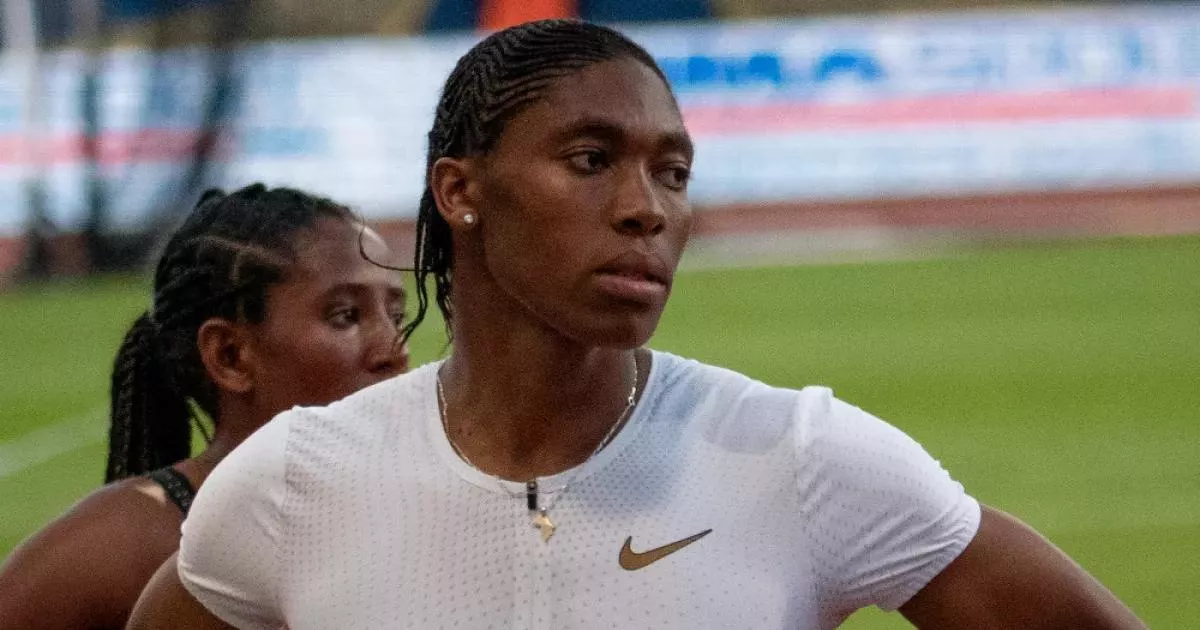
Public opinion and media debates around Caster Semenya—discover key moments of controversy.
Caster Semenya is a South African middle-distance runner celebrated for her achievements in the 800 metres, including two Olympic gold medals and three World Championships. Her victories include gold at the 2009 World Championships, the 2016 Olympics, and the 2017 World Championships, where she also won a bronze in the 1500 metres. She was later awarded gold medals for the 2011 World Championships and the 2012 Olympics following the disqualification of Mariya Savinova.
September 2009: Coach Resigns and ASA President Admits to Testing
In September 2009, Caster Semenya's coach, Wilfred Daniels, resigned, feeling ASA did not advise her properly. ASA President Leonard Chuene admitted to having subjected Semenya to testing and lying about it.


2009: Sex Testing Controversy
Following Caster Semenya's victory at the 2009 World Championships, she was made to undergo sex testing, sparking controversy in the sporting world and in her home country of South Africa.
2009: Controversy Surrounding Sex Testing
In 2009, news broke that the IAAF requested sex testing for Caster Semenya before the World Championships 800 m final, leading to negative reactions and accusations of racism and imperialism.
2010: Testosterone-Suppressing Medication Intake
Caster Semenya claimed that testosterone-suppressing medication, which she had taken from 2010 to 2015, had made her feel "constantly sick" and caused her abdominal pain, and that the IAAF had used her as a "guinea pig" to test the medication's effects.
July 2015: Suspension of IAAF Policy on High Testosterone Levels
In July 2015, the IAAF policy on high natural levels of testosterone in women was suspended following the case of Dutee Chand v. Athletics Federation of India (AFI) & The International Association of Athletics Federations.
November 2015: World Anti-Doping Agency Recommended Savinova be Banned
In November 2015, the World Anti-Doping Agency recommended that Mariya Savinova and four other Russian athletes be given a lifetime ban for doping violations at the Olympics.
2015: Testosterone-Suppressing Medication Intake
Caster Semenya claimed that testosterone-suppressing medication, which she had taken from 2010 to 2015, had made her feel "constantly sick" and caused her abdominal pain, and that the IAAF had used her as a "guinea pig" to test the medication's effects.
April 2018: IAAF Announces New Rules
In April 2018, the IAAF announced new rules effective 8 May 2019 that applied to athletes with certain disorders of sex development (DSDs) that result in androgen sensitivity and testosterone levels above 5 nmol/L.
June 2018: Announces Legal Challenge to IAAF Rules
In June 2018, Caster Semenya announced that she would legally challenge the IAAF rules, calling them "discriminatory, irrational, [and] unjustifiable".
May 2019: Effective Date of IAAF Rules
In April 2018, the IAAF announced new rules effective 8 May 2019 that applied to athletes with certain disorders of sex development (DSDs) that result in androgen sensitivity and testosterone levels above 5 nmol/L.
2019: New IAAF Rules and Legal Challenges
In 2019, new IAAF (World Athletics) rules came into force requiring athletes like Caster Semenya with certain disorders of sex development (DSDs) to take medication to suppress testosterone levels to participate in certain women's events. Semenya refused and filed legal cases arguing the rules are discriminatory.
November 2023: Semenya's case referred to the Grand Chamber of the ECtHR
In November 2023, after a request from the Swiss government, Caster Semenya's case was referred to the Grand Chamber of the European Court of Human Rights (ECtHR) for a final ruling.
July 2025: Grand Chamber of the ECtHR upholds decision
On July 10, 2025, the Grand Chamber of the ECtHR upheld the 2023 decision of the Swiss Federal Tribunal, ruling that Semenya's appeal against World Athletics' regulations for athletes with differences of sexual development "had not been properly heard".
Mentioned in this timeline

The rapid advancement of artificial intelligence continues to dominate the...
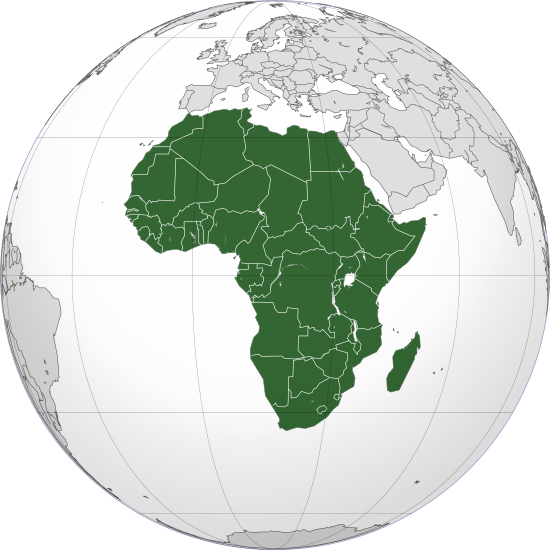
Africa is the second-largest and second-most populous continent home to...

Football commonly known as soccer in many regions is the...

Books are a means of storing information as text or...
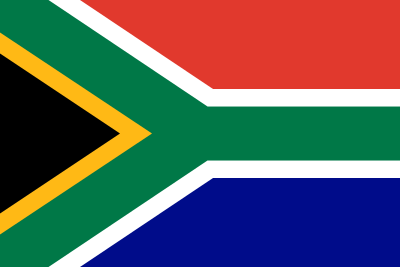
South Africa located at the southern tip of the African...

Tokyo is the capital and most populous city of Japan...
Trending

4 hours ago Joao Pedro Discusses Cole Palmer Influence and Xabi Alonso Impact on Chelsea Career Path

4 hours ago Robert Whittaker Discusses Jiu-Jitsu Training Benefits and Jealousy Towards Khamzat Chimaev's Wrestling Skills
4 hours ago CJ Carr Supports Brother Tommy Carr During First Michigan Quarterback Start
4 hours ago Auburn Football Manages Byrum Brown's Health and Usage After Recent Injury Scare

4 hours ago NASCAR Faces Significant Challenges Amidst Declining TV Ratings and Shifting Fan Engagement
5 hours ago Bryce Underwood Remains on Sideline as Tommy Carr Starts for Michigan Against Indiana
Popular

Ilhan Omar is a prominent American politician currently serving as...

Ken Paxton is an American politician and lawyer serving as...

Elon Musk is a visionary entrepreneur and engineer known for...
Michael Joseph Jackson the King of Pop was a highly...

Elizabeth Holmes is an American entrepreneur and the founder of...

Cristiano Ronaldo widely considered one of the greatest footballers captains...