History of Curaçao in Timeline


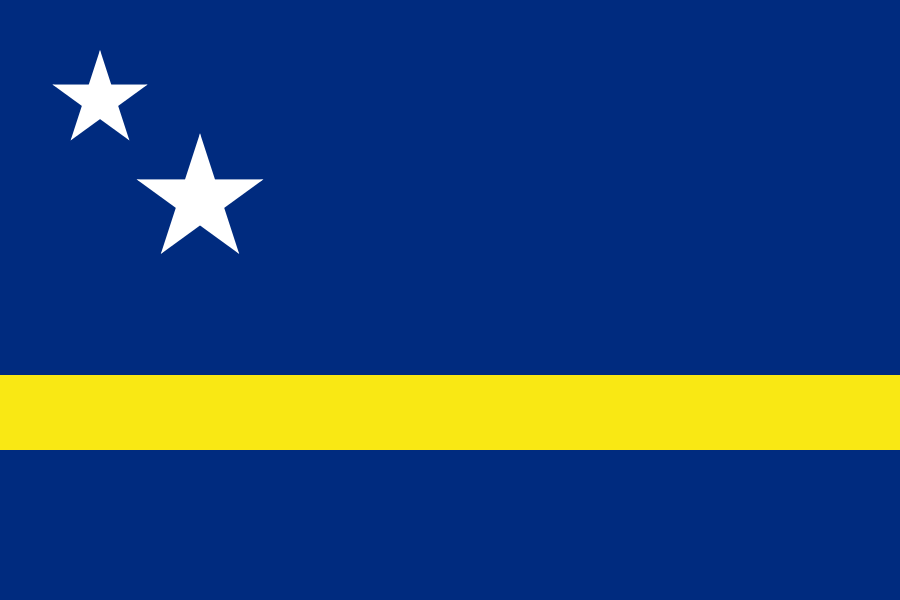
Curaçao is a constituent island country within the Kingdom of the Netherlands, situated in the southern Caribbean Sea, approximately 65 km north of Venezuela and 80 km southeast of Aruba. It consists of the main island of Curaçao and the smaller, uninhabited island of Klein Curaçao.
5 hours ago : Curaçao Tourism Booming: New Resort and Arrival Surge Expected in 2026
Curaçao is experiencing a tourism boom, with an 8% increase in stayover arrivals projected for January 2026. Fueling this growth is demand from key markets and the anticipation of the Pyrmont Curaçao Marriott's all-inclusive resort opening in 2026.


1905: First published work in Papiamentu
In 1905, the first published work in Papiamentu was a poem by Joseph Sickman Corsen entitled Atardi, published in the La Cruz newspaper.
1911: Rebuilt tramway line in Punda
In 1911, the Punda tramway line was rebuilt, regauged to metre gauge, and the horse-drawn trams were replaced by petrol engined ones.
1914: Discovery of Oil in Maracaibo Basin
In 1914, the discovery of oil in the Maracaibo Basin transformed Curaçao into a major refinery location.
1914: Oil Discovery Transforms Curaçao's Economy
In 1914, the discovery of oil in the Venezuelan Maracaibo Basin town of Mene Grande dramatically altered Curaçao's economy, leading to the establishment of refineries supplied by Shell and Exxon.
1920: Closure of Punda tramway line
In 1920, the tramway line in Punda closed.
1925: Curaçao divided into districts
In 1925, Curaçao was divided into the two outer districts of Bandabou and Bandariba and the city district of Willemstad.
1926: White-Tailed Deer Becomes Protected Species
Since 1926, the white-tailed deer has been a protected species on Curaçao, with an estimated 200 deer living on the island.
1929: Attack by Venezuelan Rebel Commander
In 1929, Curaçao was attacked by Venezuelan rebel commander Rafael Simón Urbina, who captured the fort, plundered weapons, and kidnapped the Governor, Leonardus Albertus Fruytier.
1936: Oil Fire in Schottegat
In 1936, a fire caused by a burning bale of cotton on the MS Colombia ignited oil floating on the water in Schottegat, leading to evacuations but no casualties.
1939: Current Queen Emma Bridge installed
The current Queen Emma Bridge was installed in 1939.
1940: British Occupation of Curaçao
In 1940, before the German invasion of the Netherlands, the British occupied Curaçao, alarming the Venezuelan government.
1941: US Troops Occupy Curaçao
In 1941, US troops occupied Curaçao and built the military airport "Hato" to counter potential Axis attacks.
August 1942: German Submarine Attacks
In August 1942, German submarines attacked a tanker near Curaçao, prompting the United States Navy to establish the Fourth Fleet and send aid to protect the island.
1954: Hurricane Hazel affects Curaçao
In 1954 Curaçao was affected by Hurricane Hazel.
1954: Curaçao Joins Netherlands Antilles
In 1954, Curaçao became part of the Netherlands Antilles, joining other Dutch Caribbean colonies.
1954: Formation of the Netherlands Antilles
In 1954, Curaçao joined other Dutch Caribbean colonies to form the Netherlands Antilles.
1957: Construction of Hotel Van der Valk Plaza Curaçao
In 1957, the hotel Van der Valk Plaza Curaçao was built on top of the Waterfort.
1961: Hurricane Anna affects Curaçao
In 1961 Curaçao was affected by Hurricane Anna.
1969: Hurricane Francelia affects Curaçao
In 1969 Curaçao was directly affected by pre-hurricane tropical storm Francelia.
1969: Curaçao Riots
In 1969, riots broke out in Curaçao due to discontent with the Netherlands, racial discrimination, and unemployment, leading to a state of emergency and reforms.
1971: Hurricane Edith affects Curaçao
In 1971 Curaçao was directly affected by pre-hurricane tropical storm Edith and Irene.
1972: Death of Leonardus Albertus Fruytier
In 1972, Leonardus Albertus Fruytier, the former governor of Curaçao who was kidnapped in 1929, died.
1974: Opening of the Queen Juliana Bridge
In 1974, the Queen Juliana Bridge was opened, allowing the Queen Emma Bridge to become a pedestrian-only bridge.
1975: Shell Refinery Losses
From 1975 to 1979, Shell's refinery on Curaçao experienced significant losses.
1978: Hurricane Cora affects Curaçao
In 1978 Curaçao was directly affected by pre-hurricane tropical storm Cora and Greta.
1979: Shell Refinery Losses
Shell's refinery on Curaçao operated with significant losses from 1975 to 1979, threatening its future.
1982: Shell Refinery Losses
From 1982 to 1985, Shell's refinery on Curaçao operated with significant losses again.
1985: Shell Ends Activities on Curaçao
In 1985, Royal Dutch Shell decided to end its activities on Curaçao after 70 years, impacting the island's fragile economy.
1988: Hurricane Joan affects Curaçao
In 1988 Curaçao was directly affected by pre-hurricane tropical storm Joan.
1992: New public education law
Since the introduction of a new public education law in 1992, compulsory primary education in Curaçao starts at age six and continues for six years, and secondary lasts for another four.
1993: Papiamentu in primary school education
In 1993, Papiamentu was introduced as a language of primary school education in Curaçao.
1996: Hurricane Cesar affects Curaçao
In 1996 Curaçao was directly affected by pre-hurricane tropical storm Cesar.
1997: End of Military Conscription
In 1997, military conscription ended in Curaçao and was replaced by civil conscription for underprivileged young Antilleans.
1999: USAF F-16 fighter aircraft discontinued
Until 1999, the USAF operated a small fleet of F-16 fighter aircraft from the Forward Operating Location (FOL).
2000: Jewish population on the island
As of the year 2000, there were approximately 300 Jewish people living on the island of Curaçao.
April 2002: Tax Information Exchange Agreement signed
In April 2002, the Tax Information Exchange Agreement was signed between the U.S. and the Kingdom of the Netherlands including Curaçao.
2004: Little League Baseball world title
In 2004, the Little League Baseball team from Willemstad, Curaçao, won the world title against the United States champion from Thousand Oaks, California.
November 2006: Delay of Country Status
On 28 November 2006, the change of Curaçao to a country was delayed when the island council rejected a clarification memorandum.
July 2007: Curaçao's Planned Country Status
On 1 July 2007, Curaçao was initially scheduled to become a country within the Kingdom of the Netherlands.
2007: Hurricane Felix affects Curaçao
In 2007 Curaçao was affected by Hurricane Felix.
2007: Royal Netherlands Navy Air Base Closure
Until 2007, a Royal Netherlands Navy air base operated at the west side of Curaçao International Airport. The site now houses the Dutch Caribbean Coast Guard.
December 2008: Rescheduled Country Status
On 15 December 2008, Curaçao was again scheduled to become a separate country within the Kingdom of the Netherlands.
2008: Hurricane Omar affects Curaçao
In 2008 Curaçao was affected by Hurricane Omar.
2008: Pabao Little League All-Stars winning championship
In 2008, Curaçao's Pabao Little League All-Stars won their country's eighth straight championship at the Little League World Series.
May 2009: Referendum on Country Status
On 15 May 2009, a non-binding referendum was held in Curaçao, with 52% of voters supporting becoming a country within the Kingdom.
2009: Opening of Renaissance Curaçao Resort and Casino
In 2009, the Renaissance Curaçao Resort and Casino opened next to the Rif Fort.
October 2010: Dissolution of the Netherlands Antilles
On 10 October 2010, the Netherlands Antilles was dissolved, and Curaçao became a country within the Kingdom of the Netherlands.
2010: Autonomy Achieved
In 2010, Curaçao achieved autonomy, becoming a country within the Kingdom of the Netherlands.
2010: Hurricane Tomas affects Curaçao
In 2010, Hurricane Tomas brushed past Curaçao as a tropical storm, causing significant rainfall, flooding, and damage.
2010: Dissolution of the Netherlands Antilles
In 2010, the Netherlands Antilles dissolved, and Curaçao became a country within the Kingdom of the Netherlands.
2010: Documentary film Boys of Summer released
In 2010, the documentary film Boys of Summer detailed Curaçao's Pabao Little League All-Stars winning their country's eighth straight championship at the 2008 Little League World Series.
2011: Religious breakdown of the population
In 2011 an estimate of religious breakdown of Curaçao was conducted.
December 2012: Daniel Hodge Becomes Prime Minister
On 31 December 2012, Daniel Hodge became the third prime minister of Curaçao.
2012: Opening of wind farms
In 2012, NuCuraçao opened wind farms in Tera Kora and Playa Kanoa.
June 2013: Ivar Asjes Becomes Prime Minister
On 7 June 2013, a new cabinet under the leadership of Ivar Asjes was sworn in as prime minister of Curaçao.
2013: Increase in cruise ship tourism
In 2013, Curaçao experienced a 41.4% increase in cruise ship tourism, with 610,186 cruise passengers. Hato International Airport also received 1,772,501 passengers.
2013: Curaçao participated in the CARIFTA Games
In 2013, Curaçao participated in the CARIFTA Games. Kevin Philbert won third place in the under-20 male Long Jump, and Vanessa Philbert won second place in the under-17 female 1,500 metres.
June 2014: Inter-Governmental Agreement with the U.S.
On June 30, 2014, Curaçao was deemed to have an Inter-Governmental Agreement (IGA) with the United States of America with respect to the "Foreign Account Tax Compliance Act" of the United States of America.
2015: Expansion of wind farms in Tera Kora
In 2015, NuCuraçao expanded wind farms in Tera Kora.
2016: Unemployment rate in Curaçao
In 2016, a Labour Force Survey (LFS) indicated that the unemployment rate in Curaçao was 13.3%, and the employment rate for residents ages 15–64 was 70.4%.
2016: Tax agreement takes effect
In 2016, the updated Tax Information Exchange Agreement between the U.S. and the Kingdom of the Netherlands with respect to Curaçao took effect.
2016: Economic stagnation due to decreased exports
Since 2016, Curaçao experienced economic stagnation due to reduced foreign demand for goods, stemming from unrest and political uncertainty in Venezuela. This led to decreased exports and increased domestic demand for goods and services.
June 2017: Top Cruise Destination in the Southern Caribbean
In June 2017, Curaçao was named the Top Cruise Destination in the Southern Caribbean by Cruise Critic, based on positive feedback from cruise passengers.
July 2017: Prime Minister Requests Cooperation from Netherlands
In July 2017, Curaçaoan Prime Minister Eugene Rhuggenaath requested more cooperation and assistance from the Netherlands, while seeking full responsibility over Curaçao's affairs.
2017: Curaçao won the Caribbean Cup
In 2017, the Curaçao national football team won the Caribbean Cup by defeating Jamaica in the final, qualifying for the 2017 CONCACAF Gold Cup.
2018: Airport transformation into a regional hub
By 2018, Hato International Airport aimed to transform into a regional hub, backed by capital investments totaling US$48 million.
2018: High Carbon Dioxide Emissions
In 2018, Curaçao had the second highest average carbon dioxide emissions per person in the world, at 52 tonnes.
January 2019: Curaçao Population Estimate
In January 2019, Curaçao had an estimated population of 158,675 and an area of 444 square kilometers.
2019: Curaçao won the King's Cup
In 2019, Curaçao won the King's Cup by beating Vietnam in the final.
2019: PDVSA's lease expired
In 2019, Venezuelan state oil company PDVSA's lease on the island's oil refinery expired. The facility employs 1,000 people and refines oil from Venezuela for export to the United States and Asia.
June 2020: Civil Servants Protest and Riot
On 24 June 2020, civil servants and waste collectors protested austerity measures, leading to a riot in Willemstad and subsequent lockdown and curfew.
2020: Closure of Campo Alegre brothel
In 2020, Campo Alegre, Curaçao's largest open-air brothel, closed after 71 years of operation.
2022: CIA data on gender distribution
According to 2022 data from the CIA, Curaçao has a total of only 92 men for every 100 women.
2023: Language spoken at home based on census
According to the 2023 census, 78% of the population reported that Papiamentu was the language they most spoke at home.
2023: Government purchased Campo Alegre property
In 2023, the Curaçao government purchased the Campo Alegre property after it was put up for auction.
2024: Government evaluating scenarios for Campo Alegre
As of 2024, the government is evaluating scenarios for the future use of the Campo Alegre property, aiming to benefit the local economy and social landscape.
July 2025: Curaçao discontinued Netherlands Antillean guilder
On July 1, 2025, Curaçao formally discontinued the Netherlands Antillean guilder as its currency.
2025: Curaçao qualified for the FIFA World Cup
In 2025, Curaçao qualified for the 2026 FIFA World Cup.
2026: FIFA World Cup
In 2026, Curaçao qualified for the FIFA World Cup, becoming the smallest nation in history to reach the World Cup finals.
Mentioned in this timeline
California is a U S state on the Pacific Coast...
Puerto Rico is a self-governing Caribbean archipelago and island that...
Venezuela officially the Bolivarian Republic of Venezuela is located on...
Colombia officially the Republic of Colombia is a country located...
The Dominican Republic is located on the eastern five-eighths of...
Football is a family of team sports primarily involving kicking...
Trending
54 seconds ago Kaitlan Collins' 'The Source' Podcast on CNN: In-depth Interviews and Current Affairs.
1 minute ago Mick Cronin Ejects Player in UCLA's Blowout Loss to Michigan State

1 hour ago Deandre Ayton Detained in Bahamas Airport for Marijuana Possession, Later Released.
1 hour ago iPhone 18: eSIM Expansion Expected in 2026; Key Feature Loss for Europe?

2 hours ago Kristi Yamaguchi and the Blade Angels aim to end US figure skating drought.
3 hours ago Shatner reflects on Judy Garland's fragility and his disappointment meeting her.
Popular
Jesse Jackson is an American civil rights activist politician and...
Randall Adam Fine is an American politician a Republican who...

Pam Bondi is an American attorney lobbyist and politician currently...
Barack Obama the th U S President - was the...
Kid Rock born Robert James Ritchie is an American musician...

XXXTentacion born Jahseh Dwayne Ricardo Onfroy was a controversial yet...