


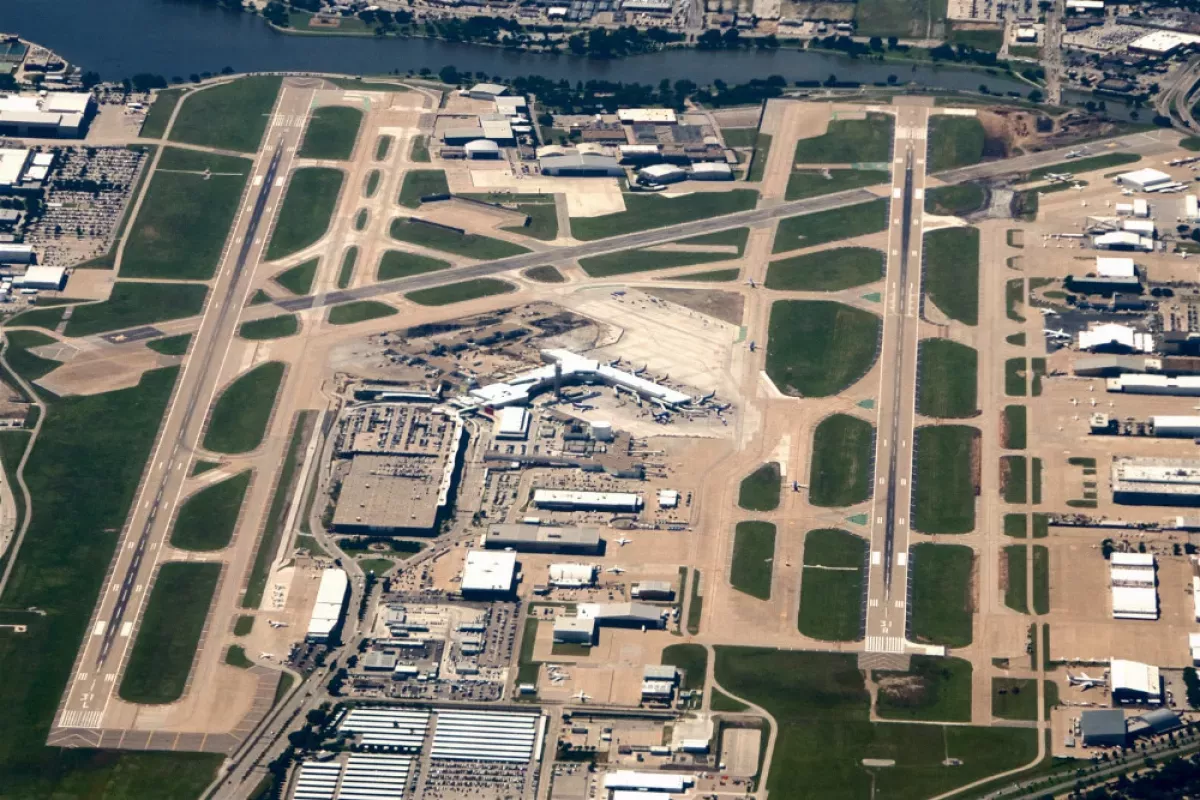
Dallas Love Field, a city-owned airport located six miles northwest of downtown Dallas, served as the city's primary airport until 1974 when Dallas/Fort Worth International Airport (DFW) opened. Covering 1,300 acres and situated at an elevation of 487 feet, Love Field features three runways.
September 4, 1913: Moss L. Love's Fatal Crash
On September 4, 1913, Moss L. Love, for whom Dallas Love Field is named, tragically died in an airplane crash near San Diego, California, during a practice flight for his Military Aviator Test.


October 19, 1917: Love Field Officially Named
The United States Army officially named the airfield Love Field in honor of Moss L. Love on October 19, 1917.
1917: Pilot Training at Love Field
During 1917, Love Field served as a training ground for pilots in the United States Army Air Service. The training program consisted of two phases: primary and advanced, with primary training conducted at Love Field.
1917: Love Field Established for WWI Pilot Training
In 1917, as the United States entered World War I, the Army established Love Field as one of 32 new Air Service fields for training pilots.
March 1918: 865th Aero Squadron Formed
The 865th Aero Squadron (Repair) was established at Love Field in March 1918 to provide support for the repair and maintenance of JN-4 aircraft.
November 11, 1918: Cadets Finish Training as War Ends
On November 11, 1918, as World War I came to an end, cadets in training at Love Field were permitted to complete their training. However, no new cadets were assigned to the base.
November 1918: Love Field's Future Uncertain
With the abrupt end of World War I in November 1918, the future operational status of Love Field became uncertain. Despite speculation that the U.S. government might keep it open due to its successful pilot training program and favorable weather conditions, the base's activities began to wind down.
March 1919: 865th Aero Squadron Demobilized
The 865th Aero Squadron was demobilized in March 1919 following the end of World War I.
December 1919: Love Field Deactivated
Love Field was deactivated as an active duty airfield in December 1919 and repurposed into a storage facility for surplus De Havilland and JN-4 aircraft.
January 1921: Coney's Transcontinental Flight Attempt
In January 1921, 1st Lt. William D. Coney made an ambitious attempt to fly from San Diego to Jacksonville with a single stop at Love Field.
1923: Love Field's Role in Air Route
In 1923, Dallas, with Love Field, served as a route point on the southern division of the model airway, connecting Muskogee and Kelly Field.
1928: Love Field Opens for Civilian Use
Dallas purchased Love Field in 1928, marking the beginning of its transformation into a civilian airport. The first passenger service was inaugurated by the National Air Transport company.
April 9, 1932: First Paved Runways Completed
A significant milestone was reached on April 9, 1932, with the completion of the first paved runways at Love Field, marking a step forward in the airfield's development.
March 1939: Love Field's Busy Flight Schedule
By March 1939, Love Field had a bustling flight schedule with 21 weekday airline departures, reflecting its growing importance as a transportation hub.
October 6, 1940: Lemmon Avenue Terminal Opens
On October 6, 1940, Love Field's Lemmon Avenue Terminal Building, situated on the east side of the airfield, was officially opened.
September 1942: Air Transport Command Moves to Love Field
The Air Transport Command's activity at Hensley Field was transferred to Love Field in September 1942, further expanding the airfield's role in military aviation.
1942: Fort Worth Airfield Receives Pilot School Approval
In 1942, a four-engine pilots' school was approved for Fort Worth Airfield–Tarrant Field, highlighting the expansion of aviation training facilities in the region.
April 15, 1943: 2d Ferrying Squadron Relocated
The Air Transport Command relocated the 2d Ferrying Squadron of the 5th Ferrying Group from Love Field to Fairfax Field in Kansas City on April 15, 1943.
September 1943: New Runways Constructed
September 1943 saw the completion of two new runways at Love Field: the north-south runway 18/36 and the northwest-southeast runway 13/31, enhancing the airfield's capacity and capabilities.
March 21, 1946: Radar Bomb Scoring Station Transferred
The Radar Bomb Scoring station at Love Field was transferred to Strategic Air Command on March 21, 1946.
November 29, 1949: American Airlines Flight 157 Crash
Tragedy struck on November 29, 1949, when American Airlines Flight 157, a Douglas DC-6, crashed at Love Field, resulting in the loss of 28 lives. The aircraft slid off Runway 36 during landing, hit buildings, and caught fire.
1950: Pioneer Airlines Relocates to Love Field
In 1950, Pioneer Airlines decided to relocate its base of operations from Houston to Love Field.
February 1953: Runway Configuration
In February 1953, Love Field had three runways: Runway 7 (4,301 feet), Runway 13 (6,201 feet), and Runway 18 (5,202 feet).
1953: Amon Carter Field Opens in Fort Worth
Fort Worth opened Amon Carter Field in 1953, later to become Greater Southwest International Airport, creating competition for Love Field.
June 1, 1954: Runway Closure
On June 1, 1954, Runway 7/25 at Love Field was closed to accommodate terminal expansion and was later removed.
April 1957: Airline Traffic
In April 1957, Love Field was a bustling hub with numerous daily departures from airlines like Braniff, American, Delta, Trans-Texas, Central, and Continental. The airport offered nonstop flights to major cities, including Washington DC, New York/Newark, Chicago, and even international destinations like California and Mexico City.
1957: Radar Bomb Scoring Station Redesignated
By 1957, the Radar Bomb Scoring station at Love Field was redesignated as the 10th RBSS Det 1.
January 20, 1958: New Terminal Opening
On January 20, 1958, Love Field inaugurated its third terminal, designed by Donald S. Nelson. The state-of-the-art facility featured three one-story concourses, 26 ramp-level gates, and the world's first airport moving walkways. Major airlines such as American Airlines, Braniff International Airways, Central Airlines, Continental Airlines, Delta Air Lines, and Trans-Texas Airways were already operating from the airport at that time.
April 1, 1959: Turbine-Powered Flights Begin
Continental Airlines marked the start of turbine-powered flights at Love Field on April 1, 1959, with the introduction of the Vickers Viscount turboprop aircraft.
July 12, 1959: Jet Airline Service Begins
On July 12, 1959, Love Field entered the jet age as American Airlines commenced Boeing 707 flights to New York.
1961: Statue Installation
In 1961, a bronze statue named "One Riot, One Ranger," created by Texas sculptor Waldine Tauch, was gifted to Love Field by Mr. and Mrs. Earle Wyatt and put on display in the new terminal.
November 22, 1963: Assassination of President Kennedy
On November 22, 1963, Love Field became the site of a tragic event in American history. President John F. Kennedy arrived at the airport on Air Force One but was assassinated less than an hour later in Dealey Plaza while en route to the Dallas Trade Mart. Texas Governor John Connally, also in the motorcade, was seriously injured. Following the assassination, Vice President Lyndon B. Johnson was sworn in as President on Air Force One before the plane departed Love Field for Washington, D.C.
1963: International Jet Service
By 1963, Love Field offered direct Boeing 707 jet service to London and Frankfurt through a joint operation by Braniff International and Pan American World Airways. The flights included an intermediate stop at Chicago O'Hare Airport as part of an interchange agreement between the two airlines.
1964: Planning for a Regional Airport
The Civil Aeronautics Board (CAB), seeking to streamline air travel in the Dallas-Fort Worth area, initiated a plan in 1964 for a new regional airport. They gave Dallas and Fort Worth six months to come up with a plan.
April 2, 1965: New Runway Opens
After facing legal challenges and safety concerns from nearby residents, the 8,800-foot parallel Runway 13R/31L at Love Field was officially opened on April 2, 1965. The existing Runway 13/31 was then redesignated as Runway 13L/31R.
1968: Agreement for DFW Airport
In 1968, Dallas and Fort Worth finalized an agreement to build the Dallas/Fort Worth Regional Airport (now Dallas/Fort Worth International Airport or DFW). This agreement included restrictions on air carrier operations at Love Field to support the new airport.
1968: Terminal Expansions
Responding to the surge in air travel during the 1960s, Love Field underwent several terminal expansion projects. American Airlines expanded its concourse in 1968, while Braniff International Airways unveiled its innovative "Terminal of the Future," featuring a rotunda concourse, jet bridges, and designs by Alexander Girard, Herman Miller, and Ray and Charles Eames.
1968: Legal Battles Over Southwest's Right to Operate
Southwest Airlines' decision to operate from Love Field, despite not signing the 1968 regional airport agreement, sparked legal challenges from the cities of Dallas and Fort Worth, along with the Dallas-Fort Worth Regional Airport Board. They argued that the agreement granted them the authority to compel Southwest to use DFW Airport. However, the courts ultimately ruled in favor of Southwest, asserting that the cities couldn't prevent the airline from utilizing Love Field as long as it remained operational as an airport.
1969: Texas International Concourse Expansion
Texas International Airways expanded its concourse at Love Field in 1969, further enhancing the airport's capacity.
1970: Braniff Jetrail Monorail and Delta Concourse Expansion
In 1970, Braniff International introduced the Jetrail monorail system at Love Field, connecting its new terminal to remote parking areas. Additionally, Delta Air Lines expanded its concourse during the same year.
1971: Southwest Airlines Begins Operations
In a significant development for Love Field, Southwest Airlines began operations in 1971. Arguing that the CAB's authority didn't extend to intrastate flights, Southwest obtained an air operator's certificate from Texas and initiated quick, no-frills flights between Love Field, Houston, and San Antonio.
January 12, 1972: Hijacking of Braniff Flight 38
On January 12, 1972, Love Field experienced an aircraft hijacking. Braniff Flight 38, a Boeing 727 en route from Houston to Dallas, was hijacked by Billy Gene Hurst Jr. Upon landing at Love Field, Hurst released the 94 passengers but held the seven crew members hostage. After a tense six-hour standoff, during which Hurst made various demands, police managed to secure the release of the hostages and apprehend Hurst without any serious injuries.
1972: Gate Distribution and Boeing 747 Service
By 1972, Love Field had a well-defined gate distribution among its major airlines. American Airlines utilized 14 gates on the west side, Delta Air Lines had 13 gates, Braniff International and Ozark shared 13 gates on the east side, and Texas International operated from seven gates. Notably, both Braniff International and Delta were operating Boeing 747-100 jumbo jet service from Love Field, with Braniff flying nonstop to Honolulu and Delta offering nonstop flights to Atlanta and Los Angeles.
1973: Love Field Reaches Peak Traffic
In 1973, Love Field experienced its highest passenger traffic, recording 6,668,398 enplanements, and ranking as the eighth busiest airport in the United States. The airport boasted over 70 gates and handled frequent Boeing 747 service.
January 13, 1974: DFW Airport Opens, Impacting Love Field
The opening of DFW Airport on January 13, 1974, marked a turning point for Love Field, leading to a significant decline in passenger service. The nearby Greater Southwest International Airport, situated in the flight path of DFW, was permanently closed and subsequently demolished.
1974: Airlines Move to DFW Airport
As part of the 1968 agreement, all airlines operating at Love Field at that time, including American, Braniff, Continental, Delta, Eastern, Frontier, Ozark, and Texas International, agreed to relocate their commercial flights to DFW Airport when it opened in early 1974.
1974: Limited Service at Love Field
By 1974, only two airlines were operating out of Love Field due to the restrictions imposed by the Wright Amendment.
1974: Dallas/Fort Worth International Airport Opens
In 1974, Dallas/Fort Worth International Airport (DFW) opened, replacing Love Field as Dallas' main airport.
1974: Long-Haul Service Returns to Love Field
Legend Airlines commenced the first long-haul service from Love Field since 1974, marking a significant development in the airport's history.
November 1975: Llove Entertainment Complex Opens
In November 1975, Wesley Goyer opened the Llove Entertainment Complex in a former terminal lobby at Dallas Love Field. The complex featured movie theaters, ice and roller rinks, video arcades, restaurants, and a bowling alley.
1975: Concourse Decommissioning
Following the opening of DFW Airport and the resulting reduction in flights, Love Field's passenger traffic plummeted to 467,212 enplanements in 1975. As a result, the airport decommissioned several of its concourses.
May 1978: Llove Entertainment Complex Closes
Despite initial success, attendance at the Llove Entertainment Complex drastically dropped, leading to its closure in May 1978.
1978: Deregulation and the Wright Amendment
Following the deregulation of the U.S. airline industry in 1978, Southwest Airlines announced plans for interstate service from Love Field. Concerns arose about potential competition with DFW Airport, leading to the enactment of the Wright Amendment, restricting air service at Love Field to destinations within Texas and four neighboring states.
1979: Southwest Airlines' Interstate Service Plans
In 1979, Southwest Airlines announced plans to commence interstate service from Love Field, a move that was supported by federal regulators but faced opposition from local officials concerned about the potential impact on DFW Airport.
1982: Muse Air Enters the Market
Lamar Muse, co-founder of Southwest, launched Muse Air, a short-haul competitor operating out of Love Field. Muse Air faced challenges competing with Southwest and was eventually acquired by Southwest in 1985.
1985: Southwest Acquires Muse Air and Continental's Interest in Love Field
In 1985, Southwest Airlines acquired its competitor, Muse Air, renaming it TranStar Airlines before shutting it down in 1987. Also in 1985, Continental Airlines expressed interest in operating from Love Field, leading to legal battles over the interpretation of the Wright Amendment.
1987: TranStar Airlines Ceases Operations
After acquiring Muse Air and renaming it TranStar Airlines, Southwest Airlines ceased the subsidiary's operations in 1987.
1990: Last Runway Repavement
The previous repavement of runway 13R/31L at Love Field, using concrete designed for the lighter traffic volume under the Wright Amendment, was done in 1990.
September 1996: Legend Airlines and the 56-Seat Rule
In September 1996, Dalfort Aviation's Legend Airlines announced plans for long-haul flights using modified McDonnell Douglas DC-9-30 jets in an all-business class configuration. However, the USDOT ruled that the 56-seat restriction on long-haul flights from Love Field applied to the "designed capacity" of an aircraft, not the number of seats installed, prompting Legend to seek a change in the law.
July 1997: Shelby Amendment Passes
By July 1997, Legend Airlines garnered support from Senator Richard Shelby, leading to the passage of the Shelby Amendment, which allowed Love Field flights to three more states (Kansas, Mississippi, and Alabama) and modified the definition of 56-passenger jets eligible for long-haul flights.
1998: Continental Express Returns to Love Field
In 1998, after years of legal battles, Continental Express became the third airline to operate out of Love Field since 1974, offering service to George Bush Intercontinental Airport in Houston. However, proposed interstate service was blocked by federal courts.
February 10, 2000: Injunction Lifted on Continental Express' Interstate Service
On February 10, 2000, a federal judge lifted the injunction against Continental Express' proposed interstate service from Love Field, paving the way for the airline to begin flights to Cleveland on June 1.
April 5, 2000: Legend Airlines Commences Long-Haul Service
On April 5, 2000, Legend Airlines launched the first long-haul service from Love Field since 1974 with a flight to Washington Dulles International Airport (IAD) using a refurbished 56-seat McDonnell Douglas DC-9-30.
2000: Legal Battles Conclude, Delta Expands at Love Field
In 2000, federal appeals court decisions struck down lawsuits against the Shelby Amendment, leading to increased long-haul flights from Love Field. Delta Air Lines, through its regional affiliate Atlantic Southeast Airlines, began service to Atlanta in July. Despite the legal victories, Legend Airlines struggled to operate profitably and suspended operations in December.
November 2004: Southwest Opposes Wright Amendment
Southwest Airlines publicly declared its opposition to the Wright Amendment in November 2004, arguing that the law hindered competition and was no longer relevant.
November 2005: Senator Bond's Amendment Passes
Senator Kit Bond successfully added an amendment to a transportation bill in November 2005, exempting Missouri from the Wright Amendment's restrictions.
December 13, 2005: Southwest Begins Nonstop Flights
After the Wright Amendment was challenged, Southwest Airlines started operating nonstop flights from Love Field to St. Louis and Kansas City on December 13, 2005.
March 2, 2006: American Airlines Joins Competition
On March 2, 2006, American Airlines entered the competition and launched its service from Love Field to Missouri airports, San Antonio, and Austin.
June 15, 2006: Compromise Reached to Repeal Wright Amendment
A compromise to repeal the Wright Amendment was reached on June 15, 2006, involving American Airlines, Southwest Airlines, Dallas/Fort Worth Airport, and the cities of Dallas and Fort Worth. Key conditions included a delayed ban lift on nonstop flights, immediate allowance of through-ticketing, gate capacity reduction, and domestic-only flights from Love Field.
October 13, 2006: Wright Amendment Repeal Signed into Law
President George W. Bush signed the bill repealing the Wright Amendment on October 13, 2006, after a bipartisan effort led by Senator Kay Bailey Hutchison and Rep. Kay Granger. The repeal restricted Love Field to 20 gates, prohibited international commercial flights, and added a condition for Southwest Airlines regarding gate usage.
October 17, 2006: Southwest Announces Connecting Service
Southwest Airlines announced on October 17, 2006, that it would launch connecting flights between Love Field and 25 destinations outside the Wright Amendment zone, commencing on October 19, 2006.
October 18, 2006: American Airlines Offers Travel Beyond Wright Zone
A day before Southwest, on October 18, 2006, American Airlines started providing travel options between Love Field and destinations outside the Wright zone.
October 19, 2006: Southwest Starts Connecting Flights
On October 19, 2006, Southwest Airlines commenced its one-stop or connecting service between Love Field and destinations beyond the Wright zone.
2009: Love Field Modernization Plan Unveiled
In 2009, a modernization plan for Love Field was announced. The plan, budgeted at US$519,000,000, aimed to replace existing terminals with a new 20-gate concourse and upgraded baggage handling facilities. The initial proposal for a US$250,000,000 people mover system to connect with Dallas Area Rapid Transit was dropped in favor of a more cost-effective bus link to Inwood Station.
2010: First Perimeter Security Breach
In 2010, a man driving a pickup truck, pursued by Dallas police, crashed through the airport's perimeter fence. The chase ended when a police car collided with the truck, leading to the driver's arrest.
2013: Second Perimeter Security Breach
In a separate incident in 2013, a man drove an SUV at high speed along a taxiway after an employee unknowingly opened a gate for him. He was later found in a hangar and subsequently arrested.
October 13, 2014: Southwest Expands Service After Wright Amendment Repeal
On October 13, 2014, as the Wright Amendment repeal came into effect, Southwest Airlines expanded its service from Love Field to include Baltimore, Denver, Las Vegas, Orlando, Washington–Reagan, and Chicago–Midway. The inaugural flight, symbolically numbered 1013 after the repeal date, flew to Denver.
November 2, 2014: Southwest Further Expands Destinations
Southwest Airlines further expanded its reach from Love Field on November 2, 2014, by adding flights to Atlanta, Nashville, Fort Lauderdale, Los Angeles, New York–LaGuardia, Phoenix, San Diego, Orange County (California), and Tampa.
2014: Ban on Nonstop Flights Lifted
As per the agreement to repeal the Wright Amendment, the ban on nonstop flights outside the designated zone was lifted in 2014.
2014: Delta Threatens Legal Action
When Delta Air Lines was informed that it would lose its operating space at Love Field, the airline threatened legal action against the city of Dallas.
January 2015: Delta's Sublease Agreement Expires
Delta Air Lines' agreement with Southwest to sublease gate space at Love Field came to an end in January 2015.
June 2015: City of Dallas Files Lawsuit
In June 2015, the city of Dallas initiated a lawsuit against Delta, Southwest, and United to find a legal resolution to the gate allocation dispute at Love Field.
July 2015: Delta's Gate Use Agreement with United Ends
Delta's subsequent agreement with United Airlines to use one of their gates at Love Field also expired in July 2015.
January 2016: Delta Granted Preliminary Injunction
Delta Air Lines secured a preliminary injunction in January 2016, allowing them to continue operating from Love Field using Southwest's gate rights.
June 10, 2016: Shooting Incident at Love Field
On June 10, 2016, a police officer shot and wounded a suspect involved in a domestic altercation at Love Field. The suspect, armed with a stone, charged at the officer, leading to the shooting. The incident caused panic and a temporary evacuation of the terminal, resulting in numerous flight cancellations. This event is believed to be the first shooting to occur at the airport.
2017: Runway Converted to Taxiway
Due to its proximity to residential areas and low usage, runway 18/36 at Love Field was converted into a taxiway in 2017.
2018: Virgin America Gates Transferred to Alaska Airlines
Following Virgin America's merger with Alaska Airlines in 2018, the two gates assigned to Virgin America at Love Field were transferred to Alaska Airlines.
2019: Alaska Airlines Reduces Flights
Alaska Airlines significantly downsized its flight schedule at Love Field from 13 daily flights in 2019 to only two by 2022.
June 2020: Statue Removal
In June 2020, the "One Riot, One Ranger" statue was removed from Love Field due to its controversial background. The statue's inscription referenced a Texas Ranger's role in quelling a riot, but it was later revealed that the ranger who modeled for the statue had been involved in supporting white supremacist protesters during the desegregation of Dallas schools in 1956.
November 2020: JSX Commences Passenger Service
In November 2020, JSX began offering passenger flights from Love Field to Houston Hobby. JSX utilizes a separate, private terminal on the airport's north side, adding to the competition on the route previously dominated by Southwest Airlines.
April 22, 2021: Runway Reconstruction Begins
On April 22, 2021, a $141 million project to demolish and rebuild runway 13R/31L commenced at Love Field, leaving the airport temporarily operating with only one usable runway.
August 2021: Southwest Airlines Dominates Love Field
By August 2021, Southwest Airlines held a commanding 95% market share at Love Field, solidifying its position as the airport's primary carrier.
June 28, 2022: Runway Reconstruction Completed
The extensive project to rebuild runway 13R/31L at Love Field was completed on June 28, 2022.
July 25, 2022: Shooting Incident at Love Field
On July 25, 2022, around 11 a.m., a woman brandished a firearm near the ticket counters outside the security checkpoint at Love Field. After being ordered to drop her weapon by a Dallas police officer, she fired two shots into the air. In the ensuing exchange of fire, the officer shot her in the "lower extremities," disabling and apprehending her. The incident led to the terminal's evacuation, a ground stop, and over 105 flight cancellations. While the woman's motive remains unclear, she has a known history of mental health issues and arrests. She is facing charges of aggravated assault against a public servant.
2022: Airport Settles Gate Dispute
The long-standing gate dispute at Love Field was settled in 2022 when the airport leased back one of the gates controlled by Alaska Airlines. This gate was then subleased to Delta Air Lines, allowing them to maintain a presence at the airport.
2025: Southwest Airlines Gate Condition
The repeal agreement included a clause that if Southwest Airlines started flights from another North Texas airport before 2025, it would have to relinquish one gate at Love Field.
September 2028: Delta's Gate Lease Agreement
The lawsuit regarding gate allocation at Love Field was settled, with Delta securing a gate lease agreement until September 2028.
Mentioned in this timeline
John F Kennedy JFK was the th U S President...
George W Bush the rd U S President - is...
California is a U S state on the Pacific Coast...
Southwest Airlines is a major U S airline headquartered in...
Radar Radio Detection and Ranging is a detection system that...
Texas is the second-largest U S state by area and...
Trending

3 hours ago Mark Ruffalo and Robert De Niro Rally Against Voter Suppression
3 hours ago Gulf Shipping Attacks Heighten Fears Amid G7 Oil Strategy Response
3 hours ago Jo Adell and Guardians Reset Following Disappointing ALDS Game 1 Loss

3 hours ago Miles Bridges Prepares to Strengthen Phoenix Suns Roster for New NBA Season

3 hours ago David Berson Succeeds Luis Silberwasser as Head of Merged TNT Sports Group

3 hours ago Ivar Stenberg Impresses as NHL-Ready Forward for San Jose Sharks
Popular

Ken Paxton is an American politician and lawyer serving as...

Shakira Isabel Mebarak Ripoll the Queen of Latin Music is...

Jameis Winston is an American football quarterback currently playing for...

Elon Musk is a visionary entrepreneur and engineer known for...

Bernie Sanders is a prominent American politician and the senior...
Cesar Chavez was a prominent American labor leader and civil...