


Earthquake engineering is an interdisciplinary field focused on designing and analyzing structures to withstand seismic activity. The primary objective is to construct buildings and infrastructure capable of resisting minor tremors without damage and preventing collapse during major earthquakes. This involves designing structures to withstand seismic forces while sustaining acceptable damage levels, which doesn't necessarily require immense strength or cost but rather a focus on proper design and understanding of seismic effects.
1933: Long Beach earthquake leads to masonry reinforcement requirements
In 1933, the Long Beach earthquake revealed masonry's vulnerability to earthquake damage. As a result, the California State Code mandated masonry reinforcement across California.


1964: Soil liquefaction in Niigata, Japan
In 1964, an earthquake in Niigata, Japan, caused major damage to thousands of buildings due to soil liquefaction of loose granular deposited materials.
1987: Sliding off foundations effect during 1987 Whittier Narrows earthquake
During the 1987 Whittier Narrows earthquake, a relatively rigid residential building structure slid off its foundations. The magnitude 5.9 earthquake shifted the Garvey West Apartment building in Monterey Park, California, about 10 inches to the east on its foundation.
1994: Springs-with-damper base isolator installed
In 1994, a springs-with-damper base isolator, conceptually similar to a Lead Rubber Bearing, was installed under a three-story town-house in Santa Monica, California, before exposure to the Northridge earthquake.
1994: Brittle behavior of steel buildings in the 1994 Northridge earthquake
In 1994, the Northridge earthquake caused brittle behavior and damage to welded steel moment-resisting frame buildings, which were considered earthquake-proof. Following this, FEMA initiated the development of repair techniques and new design approaches.
1999: ASTM E2026 'Standard Guide for the Estimation of Building Damageability in Earthquakes' produced
In 1999, ASTM E2026 'Standard Guide for the Estimation of Building Damageability in Earthquakes' was produced to standardize the nomenclature for seismic loss estimation and establish guidelines for the review process.
December 26, 2004: Indian Ocean earthquake and tsunami
On December 26, 2004, the Indian Ocean earthquake, with its epicenter off the west coast of Sumatra, Indonesia, triggered devastating tsunamis. These tsunamis killed over 230,000 people in eleven countries, inundating coastal communities with waves up to 30 meters high.
2011: Fukushima I nuclear accidents
In 2011, the Fukushima I nuclear accidents and damage to other nuclear facilities following the Tōhoku earthquake and tsunami raised concerns over Japanese nuclear seismic design standards, prompting governments to re-evaluate their nuclear programs.
Mentioned in this timeline

California is a U S state on the Pacific Coast...

China officially the People's Republic of China PRC is located...
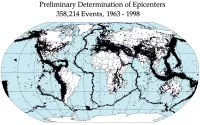
An earthquake is a sudden intense shaking of the Earth's...

A bank is a regulated financial institution licensed to accept...

Japan is an East Asian island country located in the...
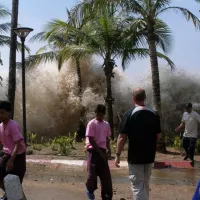
A tsunami is a series of powerful waves caused by...
Trending

3 hours ago Kevin Bacon Seeks Fan Assistance Following Recent Heartbreaking Personal Loss
3 hours ago Tacoma Grocery Owner Extradited from India Over $600K Food Stamp Fraud Scheme

4 hours ago Elizabeth Hurley and Billy Ray Cyrus Announce Their Engagement

4 hours ago Fabio Wardley Praises Anthony Joshua's Aura Ahead of Daniel Dubois Boxing Match

4 hours ago Ariel Winter Reveals Modern Family Connection to New Boyfriend Introduced by Nolan Gould
4 hours ago Jessica Tarlov's Role as a Prominent Political Commentator and The Five Host
Popular

Ilhan Omar is a prominent American politician currently serving as...

Ken Paxton is an American politician and lawyer serving as...

Elon Musk is a visionary entrepreneur and engineer known for...

Michael Joseph Jackson the King of Pop was a highly...

Jameis Winston is an American football quarterback currently playing for...

Cristiano Ronaldo widely considered one of the greatest footballers captains...