History of El Niño–Southern Oscillation in Timeline


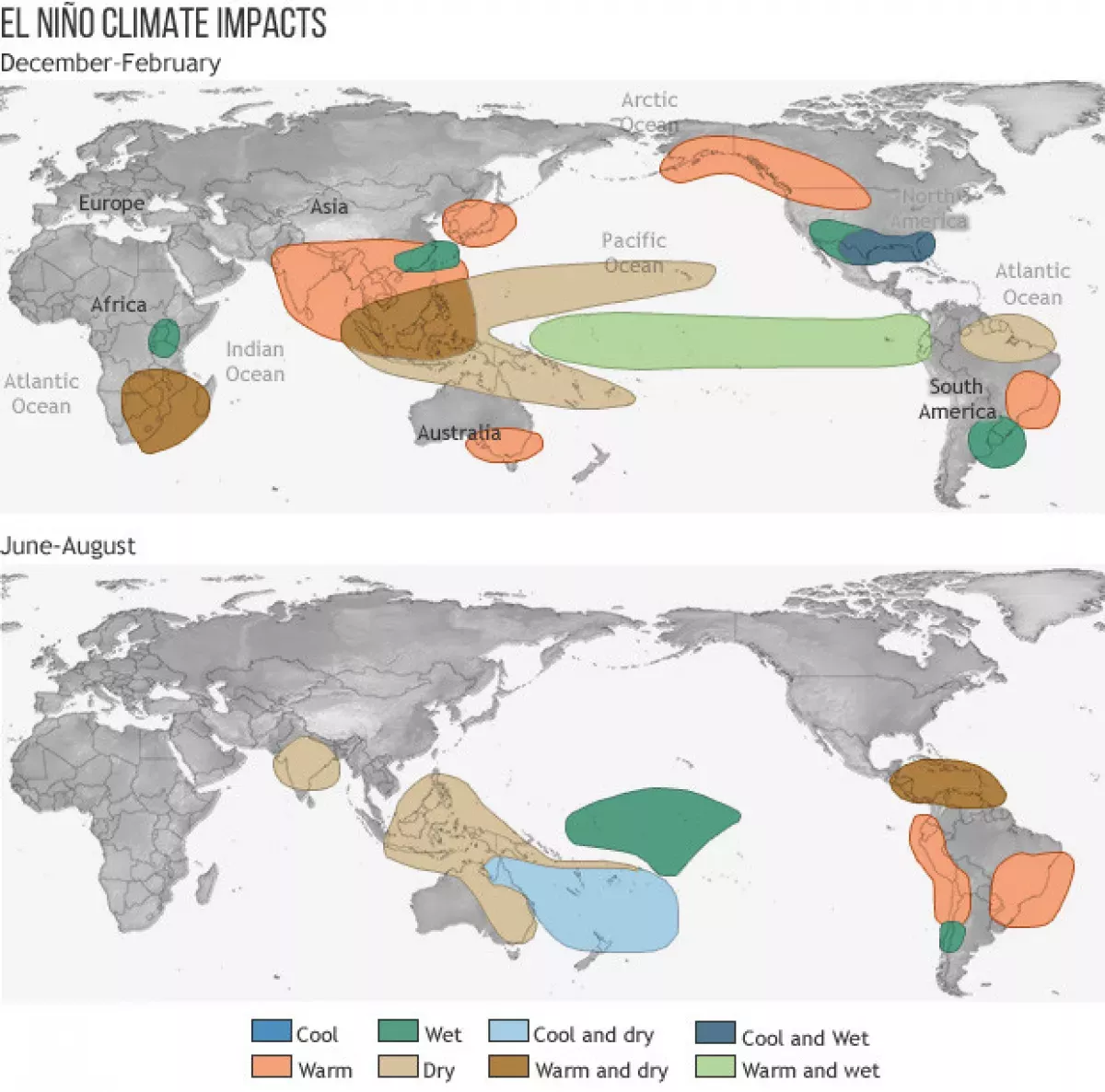
The El Niño–Southern Oscillation (ENSO) is a recurring climate pattern involving changes in the temperature of waters in the central and eastern tropical Pacific Ocean. It consists of three phases: El Niño, La Niña, and a neutral state. During El Niño, unusually warm ocean temperatures disrupt global atmospheric circulation, often leading to increased rainfall in some regions and severe droughts in others. Conversely, La Niña is characterized by cooler ocean temperatures, which typically result in opposite climatic impacts. The 'Southern Oscillation' refers to the accompanying shifts in air pressure patterns between the western and eastern Pacific. These oscillations have profound effects on global weather, marine ecosystems, and agriculture. By altering wind patterns and ocean currents, ENSO influences storm tracks, temperature extremes, and precipitation levels worldwide. Monitoring these cycles is critical for long-term climate forecasting and disaster preparedness, as the phenomena can trigger significant humanitarian and economic impacts across various continents.
1900: Beginning of Recorded El Niño Count
Starting in 1900, researchers began tracking a series of at least 30 significant El Niño events that occurred through 2024.


1901: Baseline for ENSO Climate Modeling
In 1901, the start of a period defined by greenhouse-gas increases began, serving as the initial benchmark for climate model ensemble experiments evaluating shifts in ENSO amplitude.
1925: Major ENSO Event of 1925-26
During 1925, a major El Niño–Southern Oscillation (ENSO) event commenced, which continued into 1926 as part of a recorded series of historical climate phenomena.
1949: Introduction of the Equatorial Southern Oscillation Index (EQSOI)
In 1949, the Equatorial Southern Oscillation Index (EQSOI) was established to improve upon the reliability of the traditional Southern Oscillation Index, which was limited by the non-equatorial locations of Darwin and Tahiti. By defining new regions centered on the Equator—one over Indonesia and one over the eastern equatorial Pacific—this index provided a more direct measurement of ENSO effects starting from 1949.
1950: La Niña Costera Event
A La Niña Costera event took place in 1950, as categorized by the Coastal Niño Index (ICEN).
1950: Commencement of ENSO Conflict Data Analysis
In 1950, researchers began the data collection period that would later be used to study the correlation between El Niño–Southern Oscillation (ENSO) and global civil conflicts, a period that continued through 2004.
1954: La Niña Costera Event
A La Niña Costera event occurred during the 1954–1956 period, noted in 1954 per the Coastal Niño Index (ICEN).
1957: 1957-59 Modoki Event
A "Modoki" El Niño event was observed starting in 1957 and continuing through 1959.
1957: Strong El Niño Costero Event
In 1957, a strong El Niño Costero event was recorded according to the Coastal Niño Index (ICEN).
1960: End of Initial Climate Observation Period
The year 1960 marked the conclusion of the first sixty-year observational period used to measure changes in eastern Pacific ENSO amplitude relative to subsequent greenhouse-gas-influenced periods.
1961: Commencement of Accelerated GHG Observation
Beginning in 1961, a new observational period started that showed an approximately 10% increase in eastern Pacific ENSO amplitude compared to previous decades due to rising greenhouse-gas concentrations.
1962: La Niña Costera Event
The Coastal Niño Index (ICEN) identified a La Niña Costera event occurring in 1962.
1963: 1963-64 Modoki Event
A "Modoki" climate event took place between 1963 and 1964, starting in 1963.
1964: La Niña Costera Event
A La Niña Costera event was recorded in 1964 according to the Coastal Niño Index (ICEN).
1965: 1965-66 Modoki Event
During 1965, a "Modoki" event began, which persisted until 1966.
1966: La Niña Costera Event
In 1966, a La Niña Costera event took place, as recognized by the Coastal Niño Index (ICEN).
1967: La Niña Costera Event
A La Niña Costera event spanned from 1967 to 1968, with the onset in 1967 being noted by the Coastal Niño Index (ICEN).
1968: 1968-70 Modoki Event
A "Modoki" event spanned from 1968 through 1970, originating in 1968.
1969: Discovery of the Bjerknes feedback
In 1969, Jacob Bjerknes identified a key mechanism of ENSO known as the Bjerknes feedback, which describes a positive feedback loop where changes in atmospheric winds and sea surface temperatures reinforce one another, contributing to the phenomena of El Niño.
1969: Identification of Ocean-Atmosphere Coupling in ENSO
In 1969, Jacob Bjerknes identified the critical relationship between ocean temperatures and trade wind strength, proposing that the El Niño–Southern Oscillation (ENSO) operates as a positive feedback loop. This theory, now known as Bjerknes feedback, suggests that changes in the ocean and atmosphere reinforce each other, such as when reduced Pacific temperature contrasts weaken trade winds to further accelerate the development of an El Niño event.
1970: La Niña Costera Event
The Coastal Niño Index (ICEN) listed a La Niña Costera event occurring from 1970 to 1971, beginning in 1970.
1972: Major ENSO Event of 1972-73
A significant El Niño–Southern Oscillation event occurred spanning 1972 and 1973, marking a notable climatic period in the 20th century.
1972: Peruvian and Chilean Fishery Crisis
Starting in 1972, the ENSO event caused a substantial collapse in the anchovy populations of Peru and Chile, leading to a profound and long-lasting fishery crisis in the region.
1973: 1973-74 La Niña Modoki
A La Niña Modoki event occurred spanning 1973 to 1974.
1974: 1973-74 La Niña Modoki Conclusion
The La Niña Modoki event that began in 1973 reached its conclusion in 1974.
1975: La Niña Costera Event
A La Niña Costera event occurred between 1975 and 1976, noted in 1975 by the Coastal Niño Index (ICEN).
1975: 1975-76 La Niña Modoki
The 1975-76 period featured a La Niña Modoki event, starting in 1975.
1976: 1975-76 La Niña Modoki Conclusion
The La Niña Modoki event initiated in 1975 concluded during 1976.
1977: 1977-78 Modoki Event
The 1977-78 period included a "Modoki" event that began in 1977.
1979: 1979-80 Modoki Event
A "Modoki" climate event was recorded starting in 1979 and ending in 1980.
1979: Commencement of Comprehensive Satellite ENSO Data
In 1979, the scientific community began gathering comprehensive satellite data regarding the El Niño–Southern Oscillation (ENSO), which serves as a vital but limited baseline for modern climate research.
1982: Extinction of Hydrocoral Species and Kelp Bed Mortality
During the 1982 ENSO event, rising surface seawater temperatures led to the likely extinction of two species of hydrocoral in Panama and caused massive mortality to 600 kilometers of kelp beds along the Chilean coast.
1982: 1982–83 ENSO forest impact
During the 1982 ENSO event, tropical forests in the Amazon and Borneo suffered from a prolonged dry period, leading to extensive wildfires and significant alterations to forest structure and species composition.
1982: Strong El Niño Costero Event
During the period spanning 1982 to 1983, a significant El Niño Costero event occurred, identified by the Coastal Niño Index (ICEN) in 1982.
1982: 1982–83 Strong El Niño Event
In 1982, one of the strongest El Niño events on record began, lasting through 1983.
1982: Major ENSO Event of 1982-83
Starting in 1982 and lasting through 1983, a major El Niño–Southern Oscillation episode impacted global weather patterns.
1983: 1983-84 La Niña Modoki
In 1983, a La Niña Modoki event began, extending into 1984.
1984: 1983-84 La Niña Modoki Conclusion
The La Niña Modoki event that started in 1983 finished in 1984.
1986: First Central Pacific El Niño
In 1986, the first recorded El Niño that originated in the central Pacific and moved toward the east occurred.
1988: 1988-89 La Niña Modoki
A La Niña Modoki event was documented starting in 1988 and ending in 1989.
1989: 1988-89 La Niña Modoki Conclusion
The La Niña Modoki event that began in 1988 came to an end in 1989.
1991: 1991-92 Central Pacific El Niño
A Central Pacific El Niño event took place during the 1991-92 period, beginning in 1991.
1994: 1994-95 Central Pacific El Niño
The year 1994 marked the beginning of a documented Central Pacific El Niño event that spanned into 1995.
1997: Onset of Major Global Coral Bleaching
Beginning in 1997, the Pacific Marine Environmental Laboratory identified the start of a significant, large-scale coral bleaching event linked to rising ocean temperatures caused by a major El Niño phenomenon.
1997: Global Coral Bleaching and Fishery Crisis
During 1997, a significant ENSO event triggered a global mass bleaching event, resulting in a loss of 75–99% of live coral worldwide, while simultaneously contributing to a severe fishery crisis due to the collapse of Peruvian and Chilean anchovy populations.
1997: Severe Rift Valley fever outbreak in East Africa
During the 1997-98 El Niño event, extreme rainfall triggered a severe outbreak of Rift Valley fever across north-eastern Kenya and southern Somalia, demonstrating the correlation between El Niño cycles and the transmission of mosquito-borne diseases.
1997: 1997–98 ENSO forest impact
The 1997 ENSO event triggered a severe drought in tropical regions, resulting in widespread forest fires and long-term damage to the vegetation and ecosystems of the Amazonian and Bornean forests throughout 1997 and 1998.
1997: Strong El Niño Costero Event
The year 1997 marked the beginning of a strong El Niño Costero event that lasted through 1998, as classified by the Coastal Niño Index (ICEN).
1997: 1997–98 Strong El Niño Event
The year 1997 marked the onset of an exceptionally strong El Niño event that persisted into 1998.
1997: Major ENSO Event of 1997-98
The year 1997 saw the onset of a major El Niño–Southern Oscillation event that persisted through 1998, categorized as one of the significant historical climate occurrences.
1998: Peak of 1997-1998 Coral Bleaching Event
By 1998, the large-scale coral bleaching event reached its peak as a result of the ongoing El Niño warming and potential influences from anthropogenic climate change.
1998: 1998-99 La Niña Modoki
The 1998-99 interval included a La Niña Modoki event, beginning in 1998.
1999: 1998-99 La Niña Modoki Conclusion
The La Niña Modoki event initiated in 1998 concluded in 1999.
2000: 2000-01 La Niña Modoki
A La Niña Modoki event occurred starting in 2000 and lasting through 2001.
2000: Post-2000 El Niño Observations
From 2000 onwards, a series of distinct El Niño events were systematically documented and observed.
2001: 2000-01 La Niña Modoki Conclusion
The La Niña Modoki event that commenced in 2000 ended in 2001.
2002: 2002-03 Central Pacific El Niño
A Central Pacific El Niño event occurred between 2002 and 2003, starting in 2002.
2002: 2002–03 El Niño Event
An El Niño event was observed and recorded during the 2002–2003 period.
2004: 2004–05 El Niño Event
An El Niño event was observed and recorded during the 2004–2005 period.
2004: Study Linking ENSO to Civil Conflict Risk
As of 2004, scientists from The Earth Institute of Columbia University concluded that ENSO conditions may have contributed to 21% of civil conflicts occurring since 1950, noting that the risk of conflict doubles during El Niño years compared to La Niña years.
2004: 2004-05 Central Pacific El Niño
The 2004-05 period saw the occurrence of a Central Pacific El Niño event, which commenced in 2004.
2006: 2006–07 El Niño Event
An El Niño event was observed and recorded during the 2006–2007 period.
2006: 2006-07 Central Pacific El Niño
Some meteorological sources classify the 2006-07 climate event, which began in 2006, as a Central Pacific El Niño.
2008: 2008-09 La Niña Modoki
During 2008, a La Niña Modoki event began, continuing into 2009.
2009: 2009–10 El Niño Event
An El Niño event was observed and recorded during the 2009–2010 period.
2009: 2009-10 Central Pacific El Niño
In 2009, a Central Pacific El Niño event began, lasting into 2010.
2010: 2010-11 La Niña Modoki
A La Niña Modoki event was observed starting in 2010 and ending in 2011.
2011: 2010-11 La Niña Modoki Conclusion
The La Niña Modoki event that began in 2010 concluded in 2011.
2013: La Niña Costera Event
In 2013, a La Niña Costera event was documented according to the metrics of the Coastal Niño Index (ICEN).
2014: Major ENSO Event of 2014-16
A major El Niño–Southern Oscillation event began in 2014 and continued to influence global climate conditions until 2016.
2014: 2014–16 Strong El Niño Event
A major, record-strength El Niño event occurred between 2014 and 2016.
2014: University of Cambridge Working Paper on El Niño Economic Impact
In 2014, a University of Cambridge working paper analyzed the economic consequences of El Niño, finding that while many nations like Australia and Indonesia face temporary economic declines, others such as Argentina and the United States may experience benefits. Additionally, the 2014 study highlighted that El Niño events typically trigger global inflationary pressures and an increase in commodity prices.
2014: 2014-16 Central Pacific El Niño
Starting in 2014, a climate event occurred that some sources identify as a Central Pacific El Niño, lasting until 2016.
2015: 2015-2016 El Niño Induced Food Shortages
Beginning in 2015, a significant El Niño event altered global wind patterns, leading to widespread environmental impacts and food shortages that affected over 60 million people globally.
2015: Global Mass Coral Bleaching and Anchovy Population Collapse
In 2015, another major ENSO event caused widespread coral mortality, with losses between 75–99% recorded globally, and spurred a major economic and ecological crisis for the Peruvian and Chilean anchovy fishing industries.
2015: Strong El Niño Costero Event
Starting in 2015 and continuing into 2016, a major El Niño Costero event was documented based on the Coastal Niño Index (ICEN).
2015: 2015–16 ENSO ecological crisis
Starting in 2015, the El Niño event caused intense droughts and fires that devastated tropical forests, leading to major declines in insect populations, habitat loss for bird species, and the temporary disappearance of over 100 lowland butterfly species in Borneo.
2016: Continuation of 2015-2016 Global Food Crisis
The impacts of the intense El Niño event continued into 2016, with severe climate-driven disruptions resulting in food insecurity for more than 60 million individuals throughout that year.
2016: 2016-17 La Niña Modoki
The year 2016 marked the beginning of a La Niña Modoki event that persisted into 2017.
2017: 2016-17 La Niña Modoki Conclusion
The La Niña Modoki event that started in 2016 came to a conclusion in 2017.
2018: 2018–19 El Niño Event
An El Niño event was observed and recorded during the 2018–2019 period.
2019: Increased Frequency of Extreme El Niño Events due to Climate Change
Starting around 2019, scholarly research began to establish a clearer link between global climate change and the frequency of extreme El Niño events, moving away from previous academic uncertainty regarding how long-term climatic shifts affect the intensity and duration of these weather phenomena.
2020: Conclusion of Modern ENSO Modeling Study
By 2020, climate model simulations concluded that the post-1961 period exhibited a significantly higher likelihood of extreme El Niño and La Niña events compared to pre-industrial conditions.
2021: IPCC Sixth Assessment Report on ENSO
In 2021, the IPCC Sixth Assessment Report provided a comprehensive summary of the current state of scientific research regarding the projected future behavior and impacts of the El Niño–Southern Oscillation (ENSO).
October 2022: El Niño Impact on Seedling Mortality in Thai Dry Forests
Published in October 2022, a seven-year study conducted in a Chiang Mai, Thailand national park revealed that El Niño-induced drought conditions significantly increased seedling mortality rates in seasonally dry tropical forests, suggesting long-term implications for forest health.
2023: 2023–24 El Niño Event
An El Niño event was observed and recorded during the 2023–2024 period.
2023: Global Weather Disruptions from 2023 El Niño
In 2023, the El Niño event caused severe global weather disturbances, most notably leading to extreme drought conditions in Zimbabwe, Zambia, and Malawi that slashed maize production by as much as 70%. These agricultural losses in 2023 forced these nations to declare states of disaster and seek international aid to mitigate hunger. Concurrently, the same phenomenon triggered excessive rainfall and catastrophic flooding in East Africa throughout 2023, damaging infrastructure and crops in regions already struggling with long-term drought.
2023: Major ENSO Event of 2023-24
The period beginning in 2023 and extending into 2024 featured a major El Niño–Southern Oscillation event, documented as part of long-term climate records.
2024: End of 1900-2024 El Niño Tracking Period
By 2024, the historical record confirmed that at least 30 El Niño events had taken place since the beginning of the century in 1900.
June 2026: UN Warning on El Niño Severity
In June 2026, the United Nations issued an official warning indicating that the ongoing El Niño phenomenon was projected to become one of the most powerful instances in several decades. This climate event was predicted to trigger severe global weather patterns, specifically increasing the risks of intense droughts, widespread flooding, major storms, and a higher frequency of wildfires.
2026: 2026 El Niño Event
An El Niño event was observed and documented as occurring in 2026.
Mentioned in this timeline
California is a U S state on the Pacific Coast...
India officially the Republic of India is a South Asian...

Australia officially the Commonwealth of Australia is a country encompassing...
Kenya officially the Republic of Kenya is an East African...
Canada is a North American country spanning from the Atlantic...
Bolivia officially the Plurinational State of Bolivia is a landlocked...
Trending

4 hours ago Packers Defensive Lineman Javon Hargrave Out for Season With Torn Achilles

5 hours ago Supreme Court Reassesses Religious Rights and LGBTIQ Protections in Forthcoming Legal Battles

5 hours ago Danny Trejo defends Daily Wire movie role amid production suspension in Montana

6 hours ago Bubba Wallace Involved in Major Multi-Car Racing Wreck at Charlotte Motor Speedway

5 hours ago Democrats Demand Apology From Chuck Grassley Regarding Jack Smith Basketball Remarks
6 hours ago IBM Market Outlook: Quantum Milestones and SAP Partnership Shape Earnings Expectations
Popular

Ken Paxton is an American politician and lawyer serving as...

Jameis Winston is an American football quarterback currently playing for...

Cristiano Ronaldo widely considered one of the greatest footballers captains...
Michael Joseph Jackson the King of Pop was a highly...

Elon Musk is a visionary entrepreneur and engineer known for...

Marco Rubio is a prominent American politician serving as the...