History of Fiji in Timeline


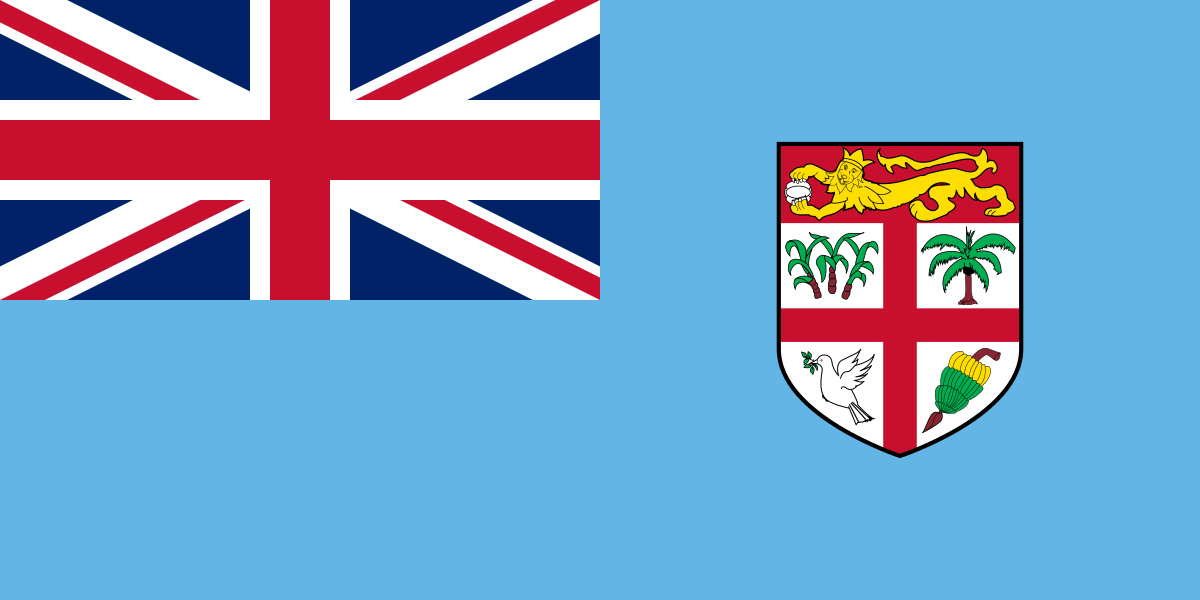
Fiji is an island nation in Melanesia, Oceania, consisting of over 330 islands, with roughly 110 inhabited. The archipelago sits in the South Pacific Ocean, about 1,100 nautical miles northeast of New Zealand. The two major islands, Viti Levu and Vanua Levu, are home to approximately 87% of Fiji's population. Most Fijians reside on Viti Levu's coasts, in cities like Suva, Nadi, or Lautoka, while the interior remains sparsely populated due to its terrain. Fiji's total land area is about 18,300 square kilometers.
9 hours ago : Fiji Faces Alarming Surge in HIV Cases: A Public Health Crisis Unfolds
Fiji is currently grappling with a significant increase in HIV cases, described as 'spreading like wildfire.' The nation faces a serious public health challenge needing immediate attention and intervention to control the outbreak.


1914: Apolosi Nawai founds Viti Kabani
In 1914, Apolosi Nawai founded Viti Kabani, a co-operative company to monopolise the agricultural sector and boycott European planters.
1915: Arrest of Apolosi Nawai
In 1915, Apolosi Nawai and his followers were arrested, leading to the collapse of Viti Kabani.
1916: End of Indian indentured labour scheme and repatriation
In 1916, the scheme to bring Indian workers to Fiji as indentured labourers ended, and repatriated Indians boarded ships for their return voyage.
1916: End of Indian indentured labour scheme
In 1916, the scheme to import indentured labourers from India to work on the sugarcane fields ended.
September 1917: Count Felix von Luckner surrenders at Wakaya Island
In September 1917, Count Felix von Luckner arrived at Wakaya Island after his raider, SMS Seeadler, ran aground. On 21 September, he surrendered to the district police inspector and Fijians, unaware they were unarmed.
1917: Collapse of Viti Kabani
In 1917, the company Viti Kabani collapsed after the arrest of Apolosi Nawai and his followers.
1921: Ratu Sir Lala Sukuna returns to Fiji
In 1921, a chief returned to Fiji as a war hero and the country's first-ever university graduate, after completing a law degree at Oxford University. He later became known as Ratu Sir Lala Sukuna and became the most powerful chief in Fiji.
1932: Mr Robinson Crusoe Film Location
In 1932, Fiji served as a location for the Hollywood movie Mr Robinson Crusoe.
1946: Death of Apolosi Nawai
Apolosi Nawai died in 1946, with the British viewing him as a threat right up to his death.
July 1965: Constitutional conference held in London
In July 1965, a constitutional conference was held in London to discuss constitutional changes with a view to introducing responsible government.
1967: Establishment of cabinet system of government
In 1967, a series of compromises led to the establishment of a cabinet system of government, with Ratu Kamisese Mara as the first Chief Minister.
1969: Sidiq Koya took over leadership of NFP
In 1969, Sidiq Koya took over the leadership of the mainly Indo-Fijian National Federation Party on Patel's death.
April 1970: Second constitutional conference in London
In April 1970, a second constitutional conference took place in London, where Fiji's Legislative Council agreed on a compromise electoral formula and a timetable for independence as a fully sovereign and independent nation within the Commonwealth.
October 1970: Fiji gains independence
In October 1970, specifically on the 10th, Fiji officially became independent. The British flag was lowered on 9 October 1970 and the Fijian flag was raised after dawn on 10 October 1970.
1970: Independence gained and Dominion of Fiji created
In 1970, Fiji gained independence and became known as the Dominion of Fiji after operating as a Crown colony until this time.
1970: Constitution of Fiji
In 1970, Fiji's constitution came into effect.
1970: Britain grants Fiji independence
In 1970, the British granted Fiji independence.
1976: Hong Kong Sevens Inception
Since its inception in 1976, Fiji has won the Hong Kong Sevens a record eighteen times.
1980: The Blue Lagoon Film Location
In 1980, Fiji served as a location for the Hollywood movie The Blue Lagoon starring Brooke Shields.
1986: World Exposition in Vancouver
In 1986, Fiji's culture was showcased at the World Exposition held in Vancouver, Canada.
1987: Military coups due to Indo-Fijian community dominance
In 1987, democratic rule was interrupted by two military coups precipitated by a growing perception that the government was dominated by the Indo-Fijian (Indian) community. The Fijian monarchy and the Governor General were replaced by a non-executive president, and the country's name was changed.
1987: Military government declared Fiji a republic after coups
In 1987, following a series of coups d'état, the military government that had taken power declared Fiji a republic.
1987: Rugby World Cup Quarter-Finals
In 1987, the Fiji national rugby union team reached the quarter-finals of the Rugby World Cup.
1987: Coups Cause Economic Contraction
The coups of 1987 in Fiji caused further contraction in the economy.
1990: New constitution institutionalises ethnic Fijian domination
In 1990, the new constitution institutionalised ethnic Fijian domination of the political system.
1991: Return to the Blue Lagoon Film Location
In 1991, Fiji served as a location for the Hollywood movie Return to the Blue Lagoon starring Milla Jovovich.
1991: Pacific Games Football Tournament Win
In 1991, Fiji won the Pacific Games football tournament.
1992: Sitiveni Rabuka becomes Prime Minister
In 1992, Sitiveni Rabuka, who had carried out the 1987 coup, became Prime Minister following elections held under the new constitution.
1992: Participating in International competition
Since 1992, The Fiji national rugby league team has been participating in international competition.
1996: Indo-Fijian Christians
In the 1996 census, Christians comprised 6.1% of the Indo-Fijian population.
1997: Country name changed to Republic of the Fiji Islands
In 1997 the country's name changed from Republic of Fiji to Republic of the Fiji Islands.
1997: Rugby World Cup Sevens
In 1997, Fiji won the Rugby World Cup Sevens.
1997: Official Languages
In 1997, Fiji's constitution recognized three official languages: English, Fijian (iTaukei), and Hindustani.
1997: Mahendra Chaudhry becomes Prime Minister
In 1997, Mahendra Chaudhry became the country's first Indo-Fijian Prime Minister.
1997: New constitution written
In 1997, a new constitution was written by the Constitutional Review Commission, supported by most leaders of the indigenous Fijian and Indo-Fijian communities, and Fiji was re-admitted to the Commonwealth of Nations.
1997: Abrogation of constitution and reappointment of Bainimarama
In 1997, the Fijian High Court ruled that the military leadership was unlawful.
1997: English as an official language
Until 1997, English was the sole official language of Fiji and remained widely used in government, business, and education.
1999: Netball World Cup
In 1999, the Fiji national netball team reached 6th position at the Netball World Cup competitions, its highest level to date.
2000: Cast Away Film Location
In 2000, Fiji served as a location for the Hollywood movie Cast Away.
2000: Reprisals against Indo-Fijians
In 2000, Indo-Fijians suffered reprisals following a coup.
2000: Pardons to participants in the 2000 coup attempt
In 2000, Pardons were to be given to participants in the 2000 coup attempt.
2000: Coup instigated by George Speight
In 2000, a coup was instigated by George Speight, toppling the government of Mahendra Chaudhry. Commodore Frank Bainimarama assumed executive power. Later in 2000, Fiji was rocked by two mutinies at Suva's Queen Elizabeth Barracks.
2000: Issue with previously pending legislation to pardon those involved in the 2000 coup
In 2000, there was a previously pending legislation to pardon those involved in the 2000 coup.
September 2001: General election won by Laisenia Qarase's party
In September 2001, a general election was held to restore democracy, which was won by interim Prime Minister Laisenia Qarase's Soqosoqo Duavata ni Lewenivanua party.
2003: Former Military Personnel in Iraq Security Sector
Following the 2003 U.S.-led invasion of Iraq, a significant number of former Fijian military personnel served in the lucrative security sector in Iraq.
2003: Pacific Games Football Tournament Win
In 2003, Fiji won the Pacific Games football tournament.
2003: Tourism Numbers in Fiji
In 2003, the number of tourists in Fiji reached 430,800, marking a major source of foreign exchange for the country.
2004: Anacondas: The Hunt for the Blood Orchid Film Location
In 2004, Fiji served as a location for the Hollywood movie Anacondas: The Hunt for the Blood Orchid.
2005: Rugby World Cup Sevens
In 2005, Fiji won the Rugby World Cup Sevens.
2005: Controversy over Reconciliation and Unity Commission proposal
In 2005, the Qarase government proposed a Reconciliation and Unity Commission with the power to recommend compensation for victims of the 2000 coup and amnesty for its perpetrators, which was met with much controversy.
December 2006: Bainimarama handed down demands to Qarase; Qarase refused
In late November and early December 2006, Bainimarama was instrumental in the 2006 Fijian coup d'état. Bainimarama handed down a list of demands to Qarase after a bill was put forward to parliament, part of which would have offered pardons to participants in the 2000 coup attempt. He gave Qarase an ultimatum date of 4 December to accede to these demands or to resign from his post. Qarase adamantly refused either to concede or resign, and on 5 December President Ratu Josefa Iloilo signed a legal order dissolving the parliament after meeting with Bainimarama.
December 2006: Military takeover by Bainimarama
On 5 December 2006, citing corruption, Bainimarama staged a military takeover against the prime minister that he had installed after a 2000 coup. The commodore took over the powers of the presidency and dissolved the parliament, paving the way for the military to continue the takeover.
2006: Commodore Frank Bainimarama seized power in a coup
In 2006, Commodore Frank Bainimarama seized power in a coup d'état.
2006: Coup in Fiji
In 2006, there was a coup in Fiji which led to the Commonwealth of Nations demanding elections by 2010.
January 2007: Iloilo restores power to Bainimarama
On 4 January 2007, the military announced that it was restoring executive power to Iloilo, who endorsed the military's actions. On 5 January 2007, Iloilo named Bainimarama as the interim prime minister.
2007: Population Census Results
According to the 2007 census the population of Fiji was 837,271 and the population density was 45.8 inhabitants per square kilometre.
2007: Christian Denominations
As of 2007, among Christians, 54% were counted as Methodist, followed by 14.2% Catholic, 8.9% Assemblies of God, 6.0% Seventh-day Adventist, 1.2% Anglican with the remaining 16.1% belonging to other denominations.
2007: Government Expenditure on R&D
In 2007, agriculture and primary production accounted for just under half of government expenditure on R&D, according to the Fijian National Bureau of Statistics.
2007: Pacific Games Gold Medal
In 2007, the Fiji national netball team won gold medals at the Pacific Games.
2007: Rugby World Cup Quarter-Finals
In 2007, the Fiji national rugby union team qualified for the Rugby World Cup, upsetting Wales 38–34, and progressing to the quarter-finals where they lost to South Africa.
2007: Great Council of Chiefs suspended
In 2007, the Great Council of Chiefs was suspended by the military-backed interim government.
August 2008: Proposal to change the name of Fiji's citizens
In August 2008, a proposal was announced recommending that all citizens of Fiji, regardless of ethnicity, be called "Fijians". This proposal aimed to change the English name of indigenous Fijians from "Fijians" to itaukei.
2008: Rugby League World Cup Semi-Finals
In 2008, Fiji made a semi-final appearance in the Rugby League World Cup.
2008: OFC Nations Cup
In 2008, the Fiji national football team defeated New Zealand 2–0 in the OFC Nations Cup, leading to a joint-record third-place finish.
April 2009: Voreqe Bainimarama addresses the nation
During the constitutional crisis of April 2009, military leader Voreqe Bainimarama addressed the nation about changing the definition of "Fijian".
April 2009: Fiji Court of Appeal Overturns High Court Decision
In April 2009, the Fiji Court of Appeal overturned the High Court decision, declaring Bainimarama's takeover of Qarase's government unlawful and the interim government illegal. Bainimarama agreed to step down as interim prime minister, but President Iloilo abrogated the constitution, appointed himself Head of State, reappointed Bainimarama, and imposed a "Public Emergency Regulation".
April 2009: Public Emergency Regulations Put in Place
In April 2009, the Public Emergency Regulations were put in place when the former constitution was abrogated, allowing restrictions on speech, public gatherings, and censorship of news media, and giving security forces added powers.
May 2009: Fiji Suspended from Pacific Islands Forum
On 2 May 2009, Fiji became the first nation ever to be suspended from participation in the Pacific Islands Forum due to its failure to hold democratic elections as promised.
September 2009: Fiji Suspended from Commonwealth of Nations
In September 2009, Fiji was suspended from the Commonwealth of Nations because Bainimarama failed to hold elections by 2010 as demanded after the 2006 coup. Bainimarama cited the need for more time to reform the voting system.
2009: Samoa leaves the Pacific Islands Rugby Alliance
In 2009, Samoa announced their departure from the Pacific Islands Rugby Alliance, leaving just Fiji and Tonga in the union.
2009: Military leadership unlawful, President re-appointed Bainimarama
In 2009, the Fijian High Court ruled that the military leadership was unlawful. At that point, President Ratu Josefa Iloilo formally abrogated the 1997 Constitution and re-appointed Bainimarama as interim prime minister. Later in 2009, Ratu Epeli Nailatikau succeeded Iloilo as president.
May 2010: Attorney-General reiterates the definition of Fijian
In May 2010, Attorney-General Aiyaz Sayed-Khaiyum stated that the term "Fijian" should apply to all Fiji nationals, which was met with protest.
2010: Bainimarama Announces Lifting of Public Emergency Regulations
In 2010, Bainimarama announced the lifting of the Public Emergency Regulations (PER) in his New Year's address. He also announced a nationwide consultation process leading to a new constitution for the 2014 elections.
2010: Shanghai World Expo
In 2010, Fiji's culture was showcased at the Shanghai World Expo, along with other Pacific countries in the Pacific Pavilion.
2010: Commonwealth of Nations Demands Elections
In 2010, the Commonwealth of Nations demanded that Bainimarama hold elections, following the 2006 coup.
February 2011: Country Name Reverted to Republic of Fiji
In February 2011, the official name of the country was reverted to Republic of Fiji.
January 2012: Public Emergency Regulations Rescinded
In January 2012, the Public Emergency Regulations were rescinded, and the Suva Philosophy Club was the first organisation to reorganise and convene public meetings.
2012: GERD/GDP Ratio
In 2012, Fiji's National Bureau of Statistics cited a GERD/GDP ratio of 0.15%.
2012: Fiji Journal of Public Health Launched
In 2012, the Fijian Ministry of Health launched the Fiji Journal of Public Health to develop endogenous research capacity.
2012: Great Council of Chiefs abolished
In 2012, the Great Council of Chiefs was abolished.
2012: Tourism Statistics
Official statistics from 2012 indicate that 75% of visitors to Fiji stated that they came for a holiday/vacation. Honeymoons and romantic getaways are very popular.
2013: European Union Funds EPIC Programme
From 2013 to 2017, the European Union funded the EPIC programme which developed two master's programmes in renewable energy management.
2013: Rugby League World Cup Semi-Finals
In 2013, Fiji made a semi-final appearance in the Rugby League World Cup.
2013: Fiji Constitution
The 2013 Constitution did not revoke the three official languages of Fiji: English, Fijian (iTaukei), and Hindustani.
2013: Compulsory language subjects in primary schools
The 2013 Constitution mandates that Conversational and contemporary iTaukei and Fiji Hindi languages shall be taught as compulsory subjects in all primary schools.
March 2014: Fiji's Commonwealth Suspension Changed
On 14 March 2014, the Commonwealth Ministerial Action Group changed Fiji's full suspension from the Commonwealth of Nations to a suspension from the councils of the Commonwealth, allowing participation in some activities including the 2014 Commonwealth Games.
September 2014: General Election Held
A general election took place on 17 September 2014. Bainimarama's FijiFirst party won with 59.2% of the vote, and the election was deemed credible by international observers.
September 2014: Fiji's Commonwealth Suspension Lifted
In September 2014, Fiji's suspension from the councils of the Commonwealth was lifted.
September 2014: Democratic election and victory for FijiFirst party
On 17 September 2014, a democratic election took place. Bainimarama's FijiFirst party won 59.2% of the vote, and international observers deemed the election credible.
2014: Elections Under New Constitution
In 2014, elections were held under a new constitution.
2014: Centre of Renewable Energy Becomes Operational
In 2014, the Centre of Renewable Energy became operational at the University of Fiji, with assistance from the EPIC programme funded by the European Union.
2014: FijiFirst Party Wins Election
In the 2014 election, the FijiFirst party, led by Prime Minister Frank Bainimarama, won an outright majority in the country's 51-seat parliament.
December 2015: IRB Ranking
As of December 28 2015, Fiji is ranked eleventh in the world by the IRB.
2015: Pacific Games Gold Medal
In 2015, the Fiji national netball team won gold medals at the Pacific Games.
2015: Potential to Expand Renewable Energy
In 2015, the Secretariat of the Pacific Community noted the enormous potential to expand the deployment of renewable energy options such as solar, wind, geothermal and ocean-based energy sources in Fiji.
2016: Summer Olympics Qualification
In 2016, Fiji qualified for the Summer Olympics men's tournament for the first time in history.
2016: Master's Programs Accredited
In 2016, two master's programmes in renewable energy management, one at the University of Papua New Guinea and the other at the University of Fiji, were accredited.
2016: Survivor Filmed in Mamanuca Islands
Since its 33rd season in 2016, the U.S. version of the reality television show Survivor has filmed all of its semiannual seasons in the Mamanuca Islands.
2017: 2017 Census
According to the 2017 census, 69.2% of the population was Christian, while 24.0% was Hindu, 5.8% Muslim, and 1.04% belonged to other religions including Sikhism.
2017: European Union Funds EPIC Programme Until 2017
From 2013 to 2017, the European Union funded the EPIC programme which developed two master's programmes in renewable energy management.
2017: Population Census Results
The 2017 census found that the population of Fiji was 884,887, compared to the population of 837,271 in the 2007 census.
2018: Forest Landscape Integrity Index Score
In 2018, Fiji had a Forest Landscape Integrity Index mean score of 8.35/10, ranking it 24th globally out of 172 countries.
2018: FijiFirst Wins 2018 Election
In the 2018 election, FijiFirst won with 50.02 per cent of the total votes cast, holding its outright majority in parliament with 27 of the 51 seats. The Social Democratic Liberal Party (SODELPA) came in second with 39.85 per cent of the vote.
2018: FijiFirst Party Wins Election Narrowly
In the 2018 election, the FijiFirst party, led by Prime Minister Frank Bainimarama, won an outright majority narrowly in the country's 51-seat parliament.
2019: Rugby League World Cup Semi-Finals
In 2019, Fiji made a semi-final appearance in the Rugby League World Cup.
2019: Related Diploma Programme Introduced
In 2019, a related diploma programme was introduced, in Fiji.
2020: Regional Pacific Nationally Determined Contributions Hub Office Launched
In 2020, the Regional Pacific Nationally Determined Contributions Hub Office in Fiji was launched to support climate change mitigation and adaptation.
October 2021: Ratu Wiliame Katonivere Elected President
In October 2021, Tui Macuata Ratu Wiliame Katonivere was elected the new President of Fiji by the parliament.
December 2022: Sitiveni Rabuka Becomes Prime Minister
On 24 December 2022, Sitiveni Rabuka, the head of the People's Alliance (PAP), became Fiji's 12th prime minister, succeeding Bainimarama, following the December 2022 general election.
2022: FijiFirst Loses Majority in Parliament
In the 2022 election FijiFirst lost its parliamentary majority. Sitiveni Rabuka of People's Alliance party, with the backing of the Social Liberal Democratic party (Sodelpa), became Fiji's new Prime Minister to succeed Frank Bainimarama.
2024: Global Hunger Index Score
Fiji's score on the 2024 Global Hunger Index (GHI) is 10.2, which indicates a moderate level of hunger.
2050: Fiji's Net-Zero Emissions Target
As a party to the Kyoto Protocol and the Paris Climate Agreement, Fiji hopes to achieve net-zero emissions by 2050 which, along with national policies, will help to mitigate the impacts of climate change.
Mentioned in this timeline

Brooke Shields is an American actress and current president of...
India officially the Republic of India is a South Asian...
New Zealand is an island country in the southwestern Pacific...
Hong Kong is a densely populated special administrative region of...
Iraq officially the Republic of Iraq is a country in...
News encompasses current events communicated through various media including word...
Trending
27 minutes ago Fatal Shooting at Duluth Marriott: Gwinnett County Police Investigate Homicide Case
27 minutes ago Cubs Eye Trade Deadline Heists: Aroldis Chapman Potential Target Amid World Series Push
1 hour ago Gerard Butler to Star as Sniper Saving World Cup in 'The Nest'

1 hour ago Mariners Update: Luke Raley, Spencer Jones, and Matthew Boyd in the News

1 hour ago Urban Meyer questions OSU tradition after Kyle Whittingham's Michigan move.

2 hours ago Josh Hart probable for Game 3 despite thumb sprain, playing through pain.
Popular
Ted Turner is an American entrepreneur and media mogul best...
Michael Joseph Jackson the King of Pop was a highly...
Graham Cunningham Platner is an American oyster farmer and Marine...
Rudy Giuliani is an American politician and disbarred lawyer best...
William Franklin Graham III known as Franklin Graham is an...
Elizabeth Warren is a prominent American politician currently serving as...