


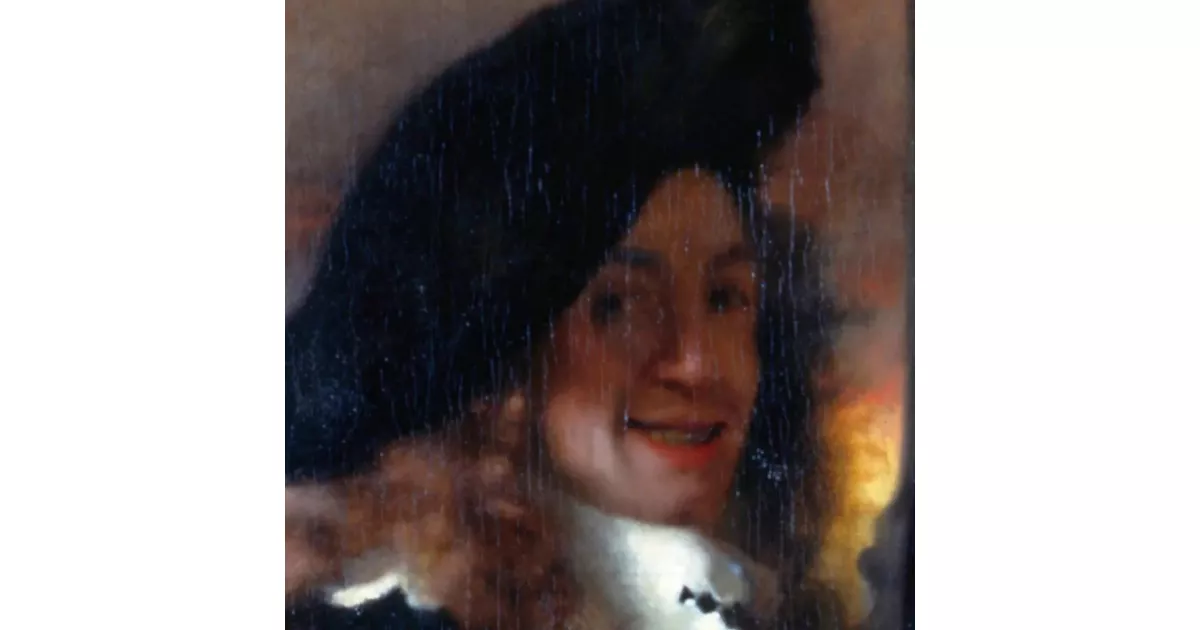
Johannes Vermeer was a Dutch Baroque Period painter known for his domestic interior scenes of middle-class life. Although recognized in Delft and The Hague, he was a moderately successful genre painter during his lifetime. Vermeer's output was relatively small, and he primarily made a living as an art dealer. He struggled financially, leaving his wife in debt upon his death. Despite this, he is now considered one of the greatest painters of the Dutch Golden Age.
1934: Salvador Dalí's Homage to Vermeer
Surrealist artist Salvador Dalí, an admirer of Vermeer, paid homage to the Dutch master in 1934 with his painting "The Ghost of Vermeer of Delft Which Can Be Used As a Table." This work exemplifies Dalí's fascination with Vermeer's artistry.


September 1971: Theft of "Love Letter"
On the evening of September 23, 1971, Vermeer's painting "Love Letter" was stolen from the Fine Arts Palace in Brussels, where it was on loan from the Rijksmuseum for the exhibition "Rembrandt and his Age." The perpetrator was 21-year-old Mario Pierre Roymans, a hotel waiter.
1982: Publication of "Artists and Artisans in Delft"
In 1982, John Michael Montias published his book "Artists and Artisans in Delft: A Socio-Economic Study of the Seventeenth Century," which revealed new details about Vermeer's family from the Delft city archives.
1999: Publication of "Girl with a Pearl Earring"
Tracy Chevalier's novel "Girl with a Pearl Earring," published in 1999, offers a fictionalized narrative of Vermeer's creation of his iconic painting and his connection with the fictional model portrayed in the artwork.
2001: Publication of "Secret Knowledge: Rediscovering the Lost Techniques of the Old Masters"
In 2001, British artist David Hockney published his book "Secret Knowledge: Rediscovering the Lost Techniques of the Old Masters." In the book, Hockney argued that Vermeer, along with other Renaissance and Baroque artists, utilized optics, potentially including curved mirrors, camera obscura, and camera lucida, to attain precise positioning in their compositions. This theory became known as the Hockney–Falco thesis.
2001: Publication of "Vermeer's Camera: Uncovering the Truth behind the Masterpieces"
Philip Steadman published "Vermeer's Camera: Uncovering the Truth behind the Masterpieces" in 2001, in which he posited that Vermeer employed a camera obscura in the creation of his paintings. Steadman observed that numerous paintings by Vermeer were created in the same room. He identified six paintings with dimensions that would align precisely with being painted from within a camera obscura positioned against the room's back wall.
2003: Film Adaptation of "Girl with a Pearl Earring"
The 2003 film "Girl with a Pearl Earring," adapted from Tracy Chevalier's novel, presents a cinematic interpretation of the fictionalized account of Vermeer's creation of the renowned painting and his relationship with the imagined model.
2008: Tim Jenison's Theory on Vermeer's Techniques
American entrepreneur and inventor Tim Jenison developed a theory in 2008 suggesting Vermeer utilized a camera obscura and a "comparator mirror," conceptually akin to a camera lucida but simpler in design, to facilitate the matching of color values. He would later refine the theory to involve only a concave mirror and a comparator mirror.
2013: Release of the Documentary "Tim's Vermeer"
The 2013 documentary film "Tim's Vermeer" documented Tim Jenison's five-year endeavor to test his theory about Vermeer's techniques. The film captures Jenison's process of attempting to recreate Vermeer's "The Music Lesson" using a camera obscura and comparator mirror.
November 2021: Google Doodle Honors Vermeer
On November 12, 2021, Google commemorated the 26th anniversary of the opening of a Vermeer exhibition at the National Gallery of Art in Washington, DC, with a Google Doodle honoring the Dutch painter.
2023: Identification of Maria de Knuijt as Vermeer's Main Patron
During a 2023 exhibition of Vermeer's works at the Rijksmuseum in Amsterdam, curators identified Maria de Knuijt, Vermeer's wife, as his primary patron due to her unwavering and significant support for his artistic career.
2023: Record-Breaking Vermeer Exhibition at Rijksmuseum
In 2023, the Rijksmuseum in Amsterdam hosted an exhibition showcasing 28 of Vermeer's works, marking the largest assembly of his paintings to date. The exhibition drew over 650,000 visitors, establishing a new attendance record for the museum.
Mentioned in this timeline

Google LLC is a multinational technology corporation specializing in a...
Music involves arranging sounds to create form harmony melody rhythm...

Books are a means of storing information as text or...
A camera is an instrument for capturing and storing images...

A hotel is a commercial establishment that provides short-term lodging...
September is the ninth month of the year in the...
Trending
5 months ago Dylan Raiola cleared by Oregon, reveals Nebraska regrets, gives health update.
11 days ago Junior Caminero Featured in Tampa Bay Rays vs Oakland Athletics MLB Matchup

5 hours ago LeBron James Reveals Factors Behind Choosing the Philadelphia 76ers

7 hours ago Josiah Harrell Faces Elves Brener at UFC Vegas 121

6 months ago Rob Dillingham's NBA Journey: From Wolves Question to Bulls' Rising Star

8 hours ago Deadly Russian Drone Barrage Strikes Kyiv and Ukrainian Attacks Leave Ten Dead
Popular

Jameis Winston is an American football quarterback currently playing for...

Shakira Isabel Mebarak Ripoll the Queen of Latin Music is...

Ken Paxton is an American politician and lawyer serving as...

Michael Joseph Jackson the King of Pop was a highly...

Sylvester Stallone is an iconic American actor screenwriter and filmmaker...

Cristiano Ronaldo widely considered one of the greatest footballers captains...