


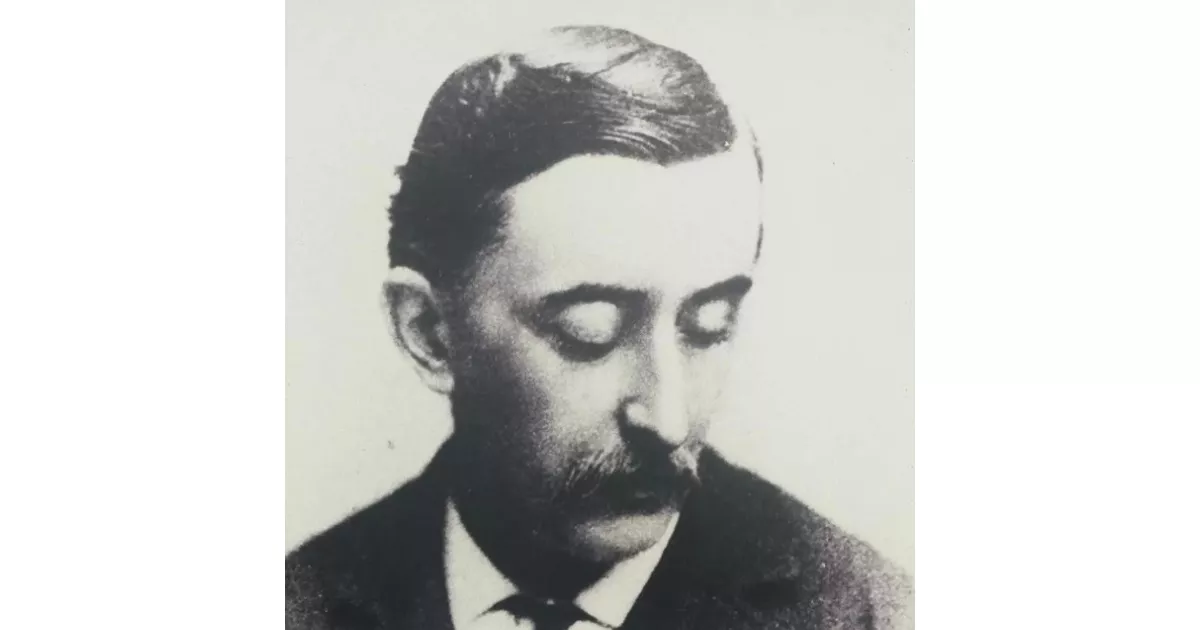
Lafcadio Hearn, also known as Koizumi Yakumo, was a writer and teacher of Greek and Irish descent, best known for introducing Japanese culture and literature to the West. He is particularly noted for his collections of Japanese legends and ghost stories, most famously Kwaidan. Prior to his time in Japan, where he became a citizen, Hearn worked as a journalist in the United States, particularly in Cincinnati and New Orleans, documenting life in New Orleans during his ten years residing there. A home associated with him in Orleans Parish is historically recognized.
1900: Japanese Styles Became Fashionable after the Paris Exposition Universelle
In 1900, with the introduction of Japanese aesthetics, particularly at the Paris Exposition Universelle, Japanese styles became fashionable in Western countries. Hearn became known to the world by his writings concerning Japan.


1903: Hearn's position at Tokyo Imperial University ends
In 1903, Lafcadio Hearn's position teaching English literature at Tokyo Imperial University ended.
September 1904: Lafcadio Hearn's Death
In September 1904, Lafcadio Hearn, also known as Yakumo Koizumi, passed away. He was a writer, translator, and teacher known for introducing Japanese culture to the Western world.
1904: Hearn became lecturer at Waseda University
In 1904, Lafcadio Hearn became a lecturer at Waseda University.
1924: Publication of 'Creole Sketches'
In 1924, selections of Lafcadio Hearn's New Orleans writings were collected and published in 'Creole Sketches'.

1926: Julius Daniels recorded song similar to Hearn's stanza
In 1926, Julius Daniels recorded a song with similar stanzas to those Hearn had printed in the Commercial after overhearing roustabouts on Cincinnati's levee waterfront.
1939: Tommy McClennan recorded song similar to Hearn's stanza
In 1939, Tommy McClennan recorded his version of "Bottle Up and Go" with stanzas similar to those Lafcadio Hearn had printed in the Commercial after overhearing roustabouts on Cincinnati's levee waterfront.
1964: Release of 'Kwaidan' film
In 1964, Japanese director Masaki Kobayashi adapted four Hearn tales into his film, 'Kwaidan'.
1983: Reprint of 'Ye Giglampz'
In 1983, the Cincinnati Public Library reprinted a facsimile of all nine issues of 'Ye Giglampz', an 8-page weekly journal of art, literature and satire that Lafcadio Hearn and Henry Farny wrote, illustrated, and published in 1874.
1984: 'Nihon no omokage' TV series broadcast
In 1984, the Japanese TV series 'Nihon no omokage' (Remnants of Japan), depicting Hearn's departure from the United States and later life in Japan, was broadcast.
1989: Lefkada and Shinjuku Became Sister Cities
In 1989, Lefkada and Shinjuku became sister cities, connecting the two ends of Hearn's life journey.
1994: New Orleans and Matsue Became Sister Cities
In 1994, New Orleans and Matsue, two other cities where Hearn lived, became sister cities.
1999: Ping Chong adapted 'Kwaidan' into puppet theatre
In 1999, Ping Chong adapted Hearn's tales into his puppet theatre, including 'Kwaidan'.
2002: Ping Chong adapted 'OBON: Tales of Moonlight and Rain' into puppet theatre
In 2002, Ping Chong adapted Hearn's tales into his puppet theatre, including 'OBON: Tales of Moonlight and Rain'.
2007: Opening of Lafcadio Hearn Museum in Yaizu, Shizuoka
In 2007, another small museum dedicated to Hearn opened in Yaizu, Shizuoka, Japan.
2008: Hearn's Murder Account Included in American True Crime Retrospective
In 2008, The Library of America selected Lafcadio Hearn's murder account, "Gibbeted," for inclusion in its two-century retrospective of American True Crime.
2011: Fujita published "The Shadow of James Joyce"
In 2011, Motoko Fujita, a photographer, published "The Shadow of James Joyce".
2012: Koizumi's visit to Dublin
In 2012, Professor Bon Koizumi (Hearn's great-grandson) and his wife Shoko were introduced to Dublin-based Motoko Fujita.
2013: Koizumi visited Ireland
In autumn 2013, Fujita coordinated a trip for Bon and Shoko Koizumi to Ireland, during which relationships to more Lafcadio supporters in Ireland were forged.
July 2014: Inauguration of the Lafcadio Hearn Historical Center in Lefkada
On 4 July 2014, the first museum in Europe dedicated to Hearn, the Lafcadio Hearn Historical Center, was inaugurated in Lefkada, Greece.
October 2015: Opening of 'Coming Home: The Open Mind of Patrick Lafcadio Hearn' Exhibition
On 15 October 2015, the exhibition 'Coming Home: The Open Mind of Patrick Lafcadio Hearn' opened at the Little Museum of Dublin, marking the first time Hearn was honored in the city.
2015: Publication of 'The Faceless Ghost'
In 2015, Sean Michael Wilson and Michiru Morikawa created a manga book version of Hearn’s Japanese stories titled 'The Faceless Ghost'.
January 2016: Closing of the 'Coming Home' exhibition
On 3 January 2016, the exhibition 'Coming Home: The Open Mind of Patrick Lafcadio Hearn' closed at the Little Museum of Dublin.
2018: Publication of 'Sayonara' in Irish
In 2018, Pádraig Mac Cearáin published 'Sayonara', a collection of Japanese folk tales translated from English to Irish.
2020: Publication of 'Manga Yokai Stories'
In 2020, Sean Michael Wilson and Ai Takita created a manga book version of Hearn’s Japanese stories titled 'Manga Yokai Stories'.
2022: Lafcadio Hearn and the Global Imagination Conference at Durham University
In 2022, Durham University held a conference titled 'Lafcadio Hearn and the Global Imagination at the Fin de Siècle' at the cultural centre named after Hearn.
Mentioned in this timeline
The United States of America is a federal republic primarily...

Japan is an East Asian island country located in the...

New Orleans is the most populous city in Louisiana and...

Books are a means of storing information as text or...

Tokyo is the capital and most populous city of Japan...
Greece officially the Hellenic Republic is a country in Southeast...
Trending
3 hours ago Catherine Breed Makes History Swimming Entire 900-Mile California Coastline

3 hours ago League of Legends Patch 26.21 Introduces ARAM Mayhem and New Augments
3 hours ago U.S. and Israel Coordinate Potential Renewed Strike Plans Against Iran

3 hours ago England and Sri Lanka Battle for First Points in Rawalpindi Tri-Series Cricket Match
4 hours ago Al Pacino Vacates Iconic Former Jackie Collins Beverly Hills Home After 18 Years
4 hours ago Daniil Medvedev Faces Sho Shimabukuro at the 2026 ATP Almaty Open
Popular

Ken Paxton is an American politician and lawyer serving as...

Ilhan Omar is a prominent American politician currently serving as...

Michael Joseph Jackson the King of Pop was a highly...

Elon Musk is a visionary entrepreneur and engineer known for...

Cristiano Ronaldo widely considered one of the greatest footballers captains...
Linda Ronstadt is a versatile American singer renowned for her...