History of Medal of Honor in Timeline


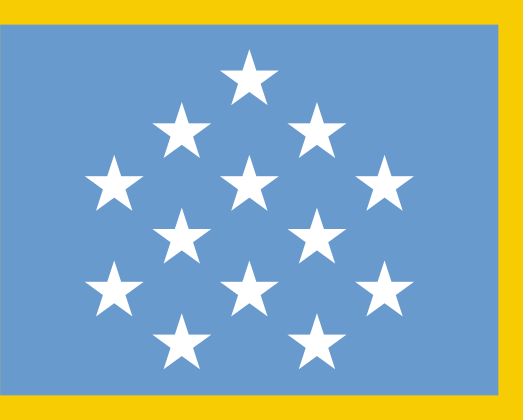
The Medal of Honor (MOH) is the highest U.S. military decoration, awarded to members of the Armed Forces for valor. Presented by the President "in the name of Congress," it recognizes extraordinary acts of courage and self-sacrifice. Often called the Congressional Medal of Honor, its official designation is simply "Medal of Honor."
3 hours ago : Kootenai County Deputies and Firefighter Honored with Medals of Honor for Bravery
Kootenai County deputies and a Coeur d’Alene firefighter received Medals of Honor for their response to the Canfield Mountain shooting. The Attorney General recognized their bravery.


1901: Medal of Honor Awarded to John Henry Helms
In 1901, John Henry Helms aboard USS Chicago was awarded the Medal of Honor for saving the ship's cook from drowning.
January 25, 1904: Medals of Honor Awarded to Six Sailors Aboard USS Iowa
On January 25, 1904, six sailors aboard USS Iowa were awarded the Medal of Honor after the ship's boiler exploded.
November 22, 1904: General Gillespie Receives Patent for Medal of Honor Design
On November 22, 1904, Brigadier General George Gillespie, Jr. received a patent for the new Medal of Honor design and later transferred it to the Secretary of War, William Howard Taft.
1904: Army "Gillespie" Version Introduced
In 1904, the Army "Gillespie" version of the Medal of Honor introduced a smaller redesigned star and the ribbon was changed to the light blue pattern with white stars seen today. The 1904 Army version also introduced a bar with the word "Valor" above the star.
1904: Army Medal Redesign
In 1904, the Army's Medal of Honor planchet was redesigned by General George Lewis Gillespie to distinguish it from other medals.
1913: Naval Version Adopts Ribbon Pattern
In 1913, the Naval version of the Medal of Honor adopted the same light blue ribbon pattern with white stars as the Army version.
1914: Smedley Butler Medal of Honor
In 1914, Smedley Butler received one of his Medals of Honor. He would later receive another.
1915: Smedley Butler Medal of Honor
In 1915, Smedley Butler received one of his Medals of Honor. He had previously received another in 1914.
1916: Congress Authorizes Review to Revoke Medals
In 1916, Congress authorized a review to revoke Medals of Honor after the Judge Advocate General of the Army deemed it unlawful to unilaterally revoke them absent specific circumstances, leading to the revocation of 911 medals.
1916: Congress establishes Medal of Honor Review Board
In 1916, Congress established the Medal of Honor Review Board.
1916: Army Generals Convene to Review Medals of Honor
In 1916, a board of Army generals convened to review every Army Medal of Honor awarded.
February 1917: Army Medal of Honor Review Board Strikes Medals
In February 1917, the Army Medal of Honor Review Board removed 911 medals from the Medal of Honor list due to a lack of basic prerequisites.
1917: Army Medals Revoked
In 1917, Congress authorized a review that resulted in the revocation of 911 Army Medals of Honor.
1917: Medals of Honor Revoked
In 1917, based on the report of the Medal of Honor Review Board established by Congress in 1916, 911 recipients were removed from the Army's Medal of Honor list due to inappropriate awarding of the medal. Among those were William Frederick "Buffalo Bill" Cody and Mary Edwards Walker.
1917: Restoration of Medals
In 1917, five recipients whose names were included on the Army's medal revocations had their awards restored.
1917: Medal of Honor Board Revoked Awards
In 1917, the Medal of Honor Board revoked 911 awards from the Army's Medal of Honor list, impacting 910 names, including Mary Edwards Walker and William F. "Buffalo Bill" Cody. Recipients were not ordered to return their medals.
1917: Report Issued by Medal of Honor Review Board
In 1917, the report issued by the Medal of Honor review board was reviewed by the Judge Advocate General.
July 9, 1918: Act of Congress Tightens Medal of Honor Criteria
On July 9, 1918, an Act of Congress established stricter criteria for the War Department's version of the Medal of Honor, requiring gallantry and intrepidity in action involving actual conflict with an enemy.
October 3, 1918: John J. Kelly Awarded Two Medals of Honor
On October 3, 1918, John J. Kelly was the last living individual to be awarded two Medals of Honor.
1918: Laws Passed for the Army
In 1918, laws were passed for the Army stipulating that "no more than one medal of honor . . . shall be issued to any one person,"
1918: Governing Statute for Army's Medal of Honor
In 1918, the governing statute for the Army's Medal of Honor (10 U.S.C. § 6241) explicitly stated that a recipient must be "an officer or enlisted man of the Army", "distinguish himself conspicuously by gallantry and intrepidity at the risk of his life above and beyond the call of duty", and perform an act of valor "in action involving actual conflict with an enemy".
1919: Issuance of Separate Versions of Medal of Honor
Between 1919, the Department of the Navy issued two separate versions of the Medal of Honor, one for acts related to combat and one for non-combat bravery.
1919: Laws Passed for the Navy
In 1919, laws were passed for the Navy stipulating that "no more than one medal of honor . . . shall be issued to any one person,"
1919: Medal of Honor Separated into Combat and Non-Combat Versions
In 1919, the Department of the Navy decided to separate the Medal of Honor into two versions, one for combat and one for non-combat. The original upside-down star was designated as the non-combat version and a new pattern of the medal pendant, in cross form, was designed by the Tiffany Company in 1919.
1919: First Award of the Tiffany Cross Medal of Honor
In 1919, the Tiffany Cross Medal of Honor was first awarded, but it proved unpopular due to its design and lower gratuity.
1923: Medal of Honor Awarded to Ensign Thomas J. Ryan
In 1923, Ensign Thomas J. Ryan was awarded the Medal of Honor for saving a woman from the burning Grand Hotel in Yokohama, Japan, following the Great Kantō earthquake.
1926: Medal of Honor Awarded to Richard Byrd and Floyd Bennett
In 1926, Richard Byrd and Floyd Bennett were awarded the Medal of Honor for their flight claiming to have reached the North Pole.
1926: Tiffany Cross Awarded for North Pole Flight
In 1926, despite "actual conflict" guidelines, the Tiffany Cross was awarded to Navy CDR Richard E. Byrd and Floyd Bennett for their flight to the North Pole, which proved to be controversial.
1926: Air Corps Authorized
In 1926, on Jul. 2, the Air Corps was authorized by statute, giving the Air Force retroactive jurisdiction over military awards to that date.
1927: Executive Order by President Coolidge
In 1927, President Coolidge issued an executive order that forbade issuing more than one federal decoration for the same action.
1930: Byrd Requests Alternate Medal Version
In 1930, Richard E. Byrd, who was awarded the Tiffany Cross, requested the alternate version of the medal from President Herbert Hoover.
1941: Posthumous Medals Increase
Since 1941, more than half of the Medals of Honor have been awarded posthumously.
1942: Issuance of Separate Versions of Medal of Honor
Between 1942, the Department of the Navy issued two separate versions of the Medal of Honor, one for acts related to combat and one for non-combat bravery.
1942: Department of the Navy returns to the original 1862 design and retires Tiffany Cross
In 1942, the Department of the Navy returned to using only the original 1862 inverted 5-point star design and retired the Tiffany Cross.
1942: Reversion to Single Medal of Honor by the Navy
In 1942, the Department of the Navy reverted to a single Medal of Honor, although the statute still contained a loophole for awards for both combat and non-combat actions.
1944: Suspension Ribbons Replaced with Neck Ribbon
In 1944, the suspension ribbons for both versions of the Medal of Honor were replaced with the now-familiar neck ribbon.
1944: Neck Ribbon Introduced for Medal of Honor
Since 1944, the Medal of Honor has been attached to a light blue colored moiré silk neck ribbon that is 1+3⁄16 in (30 mm) in width and 21+3⁄4 in (550 mm) in length. The center of the ribbon displays thirteen white stars in the form of three chevrons.
1945: Last Non-Combat Navy Medal of Honor Awarded
In 1945, the last non-combat Navy Medal of Honor was awarded.
September 19, 1947: Air Force Date
September 19, 1947, marks a date after which Air Force recipients are counted, excluding those from pre-existing Army-related organizations.
1956: Air Force Medal of Honor Authorized
In 1956, a separate design for a version of the medal for the Department of the Air Force was authorized.
1961: Army Authorizes Revocation of Service Medals Due to Misconduct
In 1961, the Army authorized the revocation of service medals due to misconduct.
July 25, 1963: Standardization of Medal of Honor Requirements
On July 25, 1963, Public Law 88–77 standardized the requirements for the Medal of Honor across all services, requiring gallantry and intrepidity at the risk of life above and beyond the call of duty. The act removed the loophole allowing non-combat awards to Navy personnel.
1963: Coast Guard Medal of Honor Authorized
In 1963, a separate Coast Guard Medal of Honor was authorized, but it was never designed or awarded.
1963: Navy Version Retained Non-Combat Provision
Until 1963, the Navy version of the Medal of Honor retained a non-combat provision.
April 14, 1965: Air Force Medal of Honor Design
On April 14, 1965, the design for the Department of the Air Force's version of the Medal of Honor was finalized.
1965: Air Force Receives Distinctive Medal of Honor
In 1965, the Air Force received its own distinctive version of the Medal of Honor, before that they used the Army's version.
January 1967: First Air Force Medal of Honor Awarded
In January 1967, the Department of the Air Force's version of the Medal of Honor was first awarded.
1969: Air Force Adopts Unilateral Revocation of Valor Decorations
In 1969, the Air Force adopted unilateral revocation of valor decorations.
1974: Army Expands Revocation Authority to Include Valor Decorations
In 1974, the Army expanded its revocation authority to include valor decorations, including the Medal of Honor, stating that awards could be revoked if later-determined facts would have prevented the original approval.
1976: Navy Adopts Regulations Permitting Revocation of Valor Decorations
In 1976, the Navy adopted regulations permitting the revocation of valor decorations.
1977: Mary Edwards Walker's Medal Restored
In 1977, Mary Edwards Walker's medal was restored by the Army Board for Correction of Military Records.
1977: Medal of Honor Restoration
In 1977, the Army's Board for Correction of Military Records restored Mary Edwards Walker's Medal of Honor. This action is often mistakenly attributed to President Jimmy Carter.
1977: Walker's Medal Restored
In 1977, the Army's board for correction of military records unilaterally restored Mary Edwards Walker's medal at the request of a relative, even though the board lacked the authority to overturn the original statute that had revoked it.
1977: Restoration of Mary Edwards Walker's Medal of Honor
In 1977, the Medal of Honor awarded to Dr. Mary Edwards Walker was posthumously restored.
1980: Presidential Decoration Standardized
Since 1980, nearly all Medal of Honor recipients have been personally decorated by the president.
June 12, 1989: Medals Reinstated for Cody and Civilian Scouts
On June 12, 1989, the Army's board for correction reinstated the Medals of Honor for William Frederick "Buffalo Bill" Cody and four other civilian scouts, following a request prompted by the restoration of Mary Edwards Walker's medal.
1989: Restoration of Buffalo Bill Cody's Medal of Honor
In 1989, Buffalo Bill Cody's Medal of Honor was restored along with four other scouts.
1989: Medals Restored to Civilians
In 1989, Cody and four other civilian scouts had their medals restored by the Army Board for Correction of Military Records.
1989: Medals of Honor Restored
In 1989, the Army Board for Correction of Military Records restored the Medals of Honor of Buffalo Bill and four other civilian scouts.
1990: Medal of Honor Day Designated
In 1990, Congress designated March 25 as Medal of Honor Day.
1993: Study Commissioned by U.S. Army
In 1993, a study was commissioned by the U.S. Army to investigate "racial disparity" in the awarding of medals.
1994: Statute Amended to Permit Enhanced Penalty for Offenses Involving Medal of Honor
In 1994, Congress amended the statute to permit an enhanced penalty if the offense involved the Medal of Honor.
January 13, 1997: Medal of Honor Presented to World War II Veterans
On January 13, 1997, President Bill Clinton presented the Medal of Honor to seven World War II veterans, six posthumously, including former Second Lieutenant Vernon Baker, following a 1993 study on racial disparity in medal awarding.
1998: Study of Asian Americans
In 1998, a study of Asian Americans was conducted, leading to Medal of Honor presentations in 2000.
2000: Medals of Honor Presented
In 2000, following a 1998 study, President Clinton presented 22 Medals of Honor to Asian Americans. Twenty of these went to soldiers of Japanese descent of the 442nd Regimental Combat Team.
2001: Flag Concept Design
In 2001, Bill Kendall designed a flag to honor Medal of Honor recipient Army Air Forces Captain Darrell Lindsey.
2001: Theodore Roosevelt, Jr. Awarded Medal of Honor
In 2001, Theodore Roosevelt, Jr. was awarded the Medal of Honor. This made Arthur MacArthur, Jr. and Douglas MacArthur and Theodore Roosevelt III and Theodore Roosevelt, Jr. the only father and son pairings to be awarded the Medal of Honor.
October 23, 2002: Medal of Honor Flag Authorized
On October 23, 2002, Pub. L. 107–248 was enacted, modifying 36 U.S.C. § 903, authorizing a Medal of Honor Flag to be presented to each person to whom a Medal of Honor is awarded.
2004: Bill to require 90% gold in Medal of Honor
In 2004, the United States Congress considered a bill which would require the Medal of Honor to be made with 90% gold, but the bill did not pass Congress.
April 4, 2005: First Medal of Honor Flag Presented
On April 4, 2005, President George W. Bush presented the Medal of Honor and Flag to the family of U.S. Army Sergeant First Class Paul R. Smith during the award ceremony for him in the White House. Smith was the first Medal of Honor Flag recipient.
2005: Medal of Honor Presented to Tibor Rubin
In 2005, President George W. Bush presented the Medal of Honor to Tibor Rubin, a Hungarian-born American Jew and Holocaust survivor.
2005: Enactment of the Stolen Valor Act
In 2005, the Stolen Valor Act was enacted, amending 18 U.S.C. § 704 to make it a federal criminal offense for a person to deliberately state falsely that he or she had been awarded a military decoration, service medal, or badge, and permitted an enhanced penalty for someone who falsely claimed to have been awarded the Medal of Honor.
September 2006: Special Medal of Honor Flag Ceremony
In September 2006, a special Medal of Honor Flag presentation ceremony was held for over 60 living Medal of Honor recipients on board the USS Constitution.
2010: Congress Directs DOD to Survey Military Leaders
In 2010, Congress directed the Department of Defense to survey military leaders to determine if there was a trend of downgrading awards.
2011: DOD Instructions Amended Regarding Medal of Honor
In 2011, Department of Defense (DOD) instructions were amended regarding the Medal of Honor authorizing an additional ribbon and/or a "V" Device for each succeeding act that would justify award of the Medal of Honor.
April 11, 2013: Medal of Honor Presented to Emil Kapaun
On April 11, 2013, President Obama posthumously presented the Medal of Honor to Army chaplain Captain Emil Kapaun for his actions during the Korean War.
2013: President Obama Signs Stolen Valor Act of 2013
In 2013, President Barack Obama signed into law the Stolen Valor Act of 2013, making it a federal offense to falsely represent oneself as an awardee of medals for valor in order to receive "money, property, or other tangible benefit."
March 18, 2014: Valor 24 Medal of Honor Upgrades
On March 18, 2014, President Obama upgraded Distinguished Service Crosses to Medals of Honor for 24 Hispanic, Jewish, and black individuals, known as the "Valor 24," for their actions in past wars.
2014: Congress Directs DOD to Survey Military Leaders (Again)
In 2014, Congress again directed the Department of Defense to survey military leaders to determine if there was a trend of downgrading awards and review the Medal of Honor process.
2015: Litigation over Garlin Conner's award
In 2015, subsequent litigation over the Garlin Conner award established that the correction boards lack the authority to unilaterally award Medals of Honor.
December 2016: DOD Manual Updated
In December 2016, the relevant DOD manual regarding the Medal of Honor was updated.
2017: State Legislation to Criminalize Stolen Valor
As of 2017, at least 22 states had enacted their own legislation to criminalize stolen valor amid claims that the federal law was virtually unenforced.
December 2019: Congress Expands Honorable Service Requirement
In December 2019, Congress passed a law expanding the statutory requirement for honorable service after award qualification to include all military decorations.
January 1, 2021: Statutory Sections Authorizing the Medal Last Amended
On January 1, 2021, the four specific statutory sections authorizing the medal were last amended.
July 2024: Secretary of Defense Announces DoD/DoI Review of Wounded Knee Medals of Honor
In July 2024, the Secretary of Defense announced a joint DoD/DoI review to consider revoking the Medals of Honor awarded for conduct during the Wounded Knee Massacre of 1890.
October 2024: DoD Review Recommends No Revocation of Wounded Knee Medals of Honor
In October 2024, the DoD review reportedly concluded, recommending that no Medals of Honor be revoked for conduct during the Wounded Knee Massacre.
Mentioned in this timeline

Jupiter is the fifth and largest planet from the Sun...
Bill Clinton the nd U S President - served as...
George W Bush the rd U S President - is...
The United States of America is a federal republic located...
The White House located at Pennsylvania Avenue NW in Washington...
Jimmy Carter the th U S President - was a...
Trending

2 minutes ago Rosamund Pike recalls Judi Dench's 'naughty' side, calling her a 'mischief maker'.

1 hour ago Declan Rice's behavior scrutinized after derby win; Scholes deems him too emotional.

1 hour ago Donovan Clingan shines for Trail Blazers: Draft prospect improves shooting and raises questions.
3 minutes ago James Cook and Dion Dawkins to appear at Dick’s House of Sport opening.

1 hour ago Shakira's Mexico City Concert: Security, Tickets, and Traffic Updates

1 hour ago Courteney Cox wears 90s jeans, stays overnight with on-screen husband Greg Kinnear.
Popular

Jesse Jackson is an American civil rights activist politician and...

Susan Rice is an American diplomat and public official prominent...
Barack Obama the th U S President - was the...

Michael Joseph Jackson the King of Pop was a highly...

Bernie Sanders is a prominent American politician currently serving as...

XXXTentacion born Jahseh Dwayne Ricardo Onfroy was a controversial yet...