


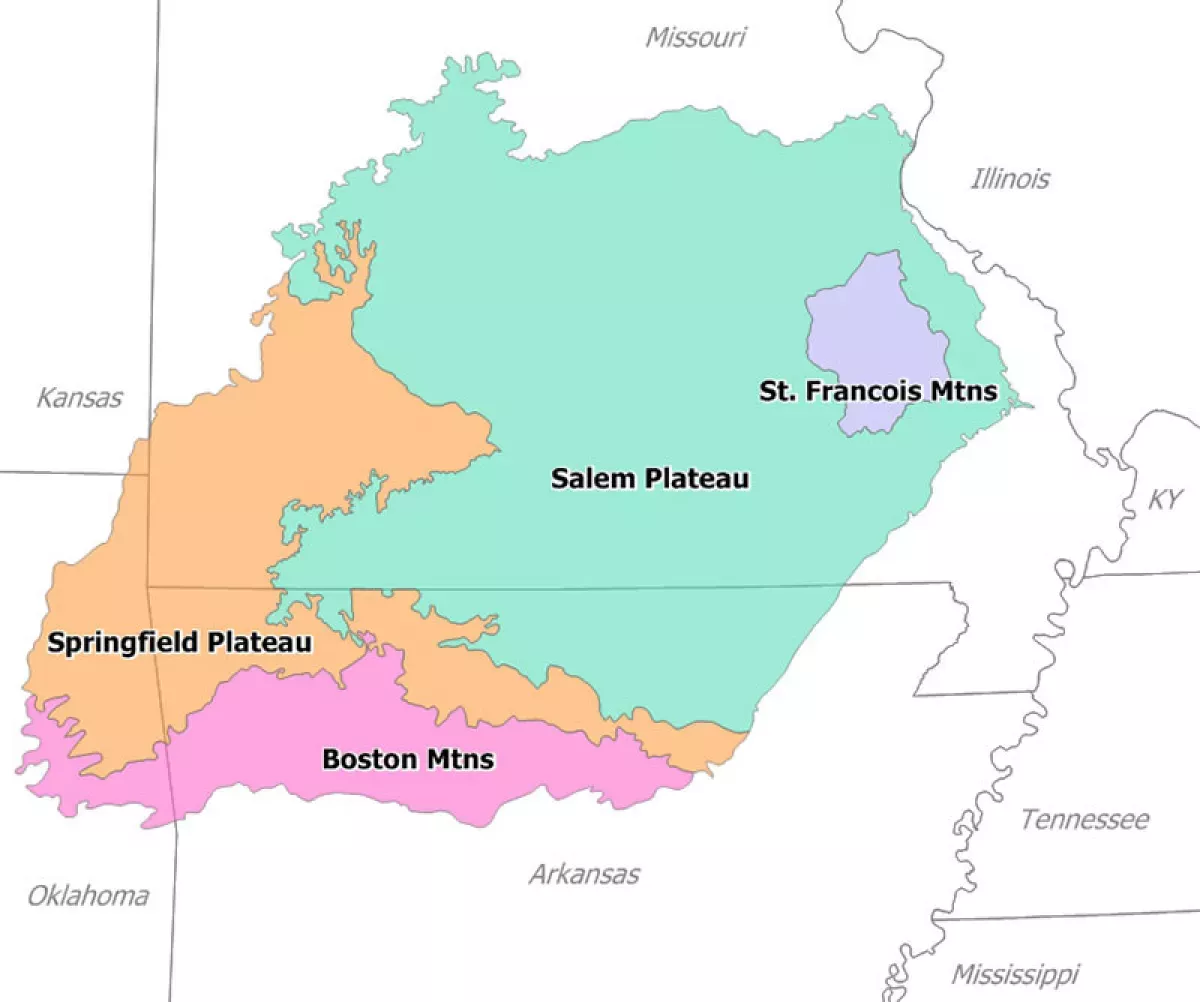
The Ozarks, also known as the Ozark Mountains, Ozark Highlands, or Ozark Plateau, is a physiographic region primarily located in Missouri, Arkansas, and Oklahoma, with a small portion extending into Kansas. This region covers a large portion of northern Arkansas and the southern half of Missouri, spanning from central Arkansas to central Missouri. The Ozarks are defined by their unique geography.
1908: Ozark National Forest Creation
In 1908, President Theodore Roosevelt formally established conservation in the region by creating the Ozark National Forest, preserving 917,944 acres across five Arkansas counties.


1911: Creation of smaller lakes by dams in the White River basin
From 1911 through 1960, multiple smaller lakes were created by dams in the White River basin for recreational and water management purposes.
1911: Construction of Powersite Dam
In 1911, construction began on the Powersite Dam on the White River near Branson, Missouri, leading to the impoundment of Lake Taneycomo. This marked the beginning of harnessing Ozarks rivers for electrical power, recreation, and flood control.
1931: Formation of Lake of the Ozarks
In 1931, the Lake of the Ozarks was formed by impounding the Osage River.
1938: Flood Control Act
President Franklin D. Roosevelt signed the Flood Control Act of 1938, which led to the construction of six large flood control dams on the White River and its tributaries.
1939: Establishment of Mark Twain National Forest
In 1939, Congress established the Mark Twain National Forest at nine sites in Missouri.
1940: Creation of Grand Lake o' the Cherokee
In 1940, Grand Lake o' the Cherokee in northeast Oklahoma was created by damming the Grand River.
1941: Formation of Norfork Lake
In 1941, Norfork Lake was formed by damming the North Fork River, a tributary of the White River.
1941: Randolph Recorded Ozark Songs
In 1941–42, Vance Randolph, commissioned by Alan Lomax of the Archive of Folk Culture, returned to the Ozarks with a portable recording machine from the Library of Congress and captured over 800 songs, ballads and instrumentals.
1952: Completion of Bull Shoals Lake
In 1952, Bull Shoals Lake was completed. It is the furthest downstream lake on the White River proper.
1958: Formation of Table Rock Lake
In 1958, Table Rock Lake was formed in Missouri and feeds directly into Lake Taneycomo.
1960: Formation of Beaver Lake
In 1960, Beaver Lake was formed northeast of Fayetteville, Arkansas.
1961: Formation of Lake Sequoyah
In 1961, Lake Sequoyah, a small recreational fishing lake east of Fayetteville, Arkansas, was formed as the uppermost impoundment on the White River.
1961: Formation of Pomme de Terre Lake
In 1961, the Pomme de Terre Lake was formed by impounding the Pomme de Terre River.
1964: Publication of "Ozark Magic and Folklore"
In 1964, Vance Randolph's "Ozark Magic and Folklore" (Courier Dover Publications) was published, documenting Ozark traditions and beliefs.

1964: Establishment of Ozark National Scenic Riverways
In 1964, the Ozark National Scenic Riverways was established along the Current and Jacks Fork rivers as the first US national park based on a river system.
1964: The Wilderness Act of 1964
The Wilderness Act of 1964 designated wilderness areas, including second growth public forests like the Mark Twain National Forest.
1968: Establishment of Eleven Point River in the National Wild and Scenic Rivers System
In 1968, the Eleven Point River was included in the National Wild and Scenic Rivers System.
1969: Formation of Stockton Lake
In 1969, Stockton Lake was formed by damming the Sac River near Stockton, Missouri, to supplement Springfield's water supply.
1972: Creation of the Buffalo National River
In 1972, the Buffalo National River was created by an Act of Congress as the nation's first National River, administered by the National Park Service, following a decade-long battle against a proposed dam.
1973: Start of Bittersweet Project
In 1973, the Bittersweet project began as an English class at Lebanon High School in Missouri, aimed at documenting traditional Ozark culture.
1976: Establishment of Hercules Glades Wilderness
In 1976, Congress established the Hercules Glades Wilderness, marking it as the first of 13 designated wilderness areas in the Ozarks.
1976: Publication of "Pissing in the Snow and Other Ozark Folktales"
In 1976, Vance Randolph's collection of Ozark folklore, "Pissing in the Snow and Other Ozark Folktales" (University of Illinois Press), was published and became a national bestseller.

1979: Formation of Truman Lake
In 1979, Truman Lake was formed by impounding the Osage River's tributary, the Pomme de Terre River.
1980: Publication of "Ozark Folksongs"
In 1980, Vance Randolph's "Ozark Folksongs" (University of Missouri Press), a four-volume anthology of regional songs and ballads collected in the 1920s and 1930s, was published.

1983: End of Bittersweet Project
By 1983, the Bittersweet project had collected 476 taped and transcribed interviews, published 482 stories, and taken over 50,000 photographs documenting traditional Ozark culture.
1986: Establishment of the Ozark Plateau National Wildlife Refuge
In 1986, Congress established the Ozark Plateau National Wildlife Refuge in northeast Oklahoma, ensuring the recovery of endangered and threatened species of animals and plants.
1999: Release of the film "Ride with the Devil"
In 1999, the film "Ride with the Devil", based on the book Woe to Live On, was released, depicting conflict in southwest Missouri during the Civil War.
2001: Release of "Ozark Folksongs" Compilation Album
In 2001, 35 tracks selected from Randolph's field recordings were released on Various Artists: "Ozark Folksongs" (Rounder Records).
2007: Donation of Gordon McCann Collection to Missouri State University
In 2007, Gordon McCann, a chronicler of Ozarks folklife and fiddle music, donated a collection of audio recordings, fieldnotes, and photographs to Missouri State University in Springfield.
2007: Fire lookouts listed as endangered
In 2007, a report by the National Trust for Historic Preservation deemed Ozark fire lookouts and related structures as one of "America's 11 Most Endangered Historic Places".
2008: Publication of "Ozarks Fiddle Music"
In 2008, Drew Beisswenger and Gordon McCann's book/CD set "Mel Bay Presents Ozarks Fiddle Music: 308 Tunes Featuring 30 Legendary Fiddlers With Selections from 50 Other Great Ozarks Fiddlers" was published, featuring selected audio recordings, biographical sketches, photographs and tune histories.
2010: Release of "Winter's Bone" film
In 2010, the feature film "Winter's Bone", based on the novel by Daniel Woodrell, was released, receiving the Grand Jury Prize at the Sundance Film Festival, as well as other awards.
July 21, 2017: Premiere of "Ozark" on Netflix
On July 21, 2017, the Netflix drama series "Ozark" premiered. The series revolves around the Byrde family who move from Chicago to the Ozarks after a money laundering scheme goes wrong.
Mentioned in this timeline
Oklahoma is a U S state located in the South...
Music involves arranging sounds to create form harmony melody rhythm...

Lebanon is a small sovereign nation located on the eastern...
Illinois is a Midwestern state in the United States bordered...
War is defined as an armed conflict involving the armed...
Books are a means of storing information as text or...
Trending

3 hours ago Breaking Bad Named Greatest Television Show of the 21st Century

3 hours ago Learner Tien Faces Casper Ruud at Rolex Shanghai Masters

3 hours ago Sonay Kartal Faces Anhelina Kalinina in WTA Wuhan Open First Round Match

3 hours ago Nicolas Cage Refuses Amazon AI Waiver and Teases True Detective Season 5 Role

3 hours ago Casper Ruud Competes at the 2026 ATP Shanghai Masters Tournament
3 hours ago Alex Eala Prepares for Wuhan Open First Round Match Against Shi Han
Popular

Ken Paxton is an American politician and lawyer serving as...

Jameis Winston is an American football quarterback currently playing for...

Cristiano Ronaldo widely considered one of the greatest footballers captains...

Michael Joseph Jackson the King of Pop was a highly...

Elon Musk is a visionary entrepreneur and engineer known for...

Bernie Sanders is a prominent American politician and the senior...