


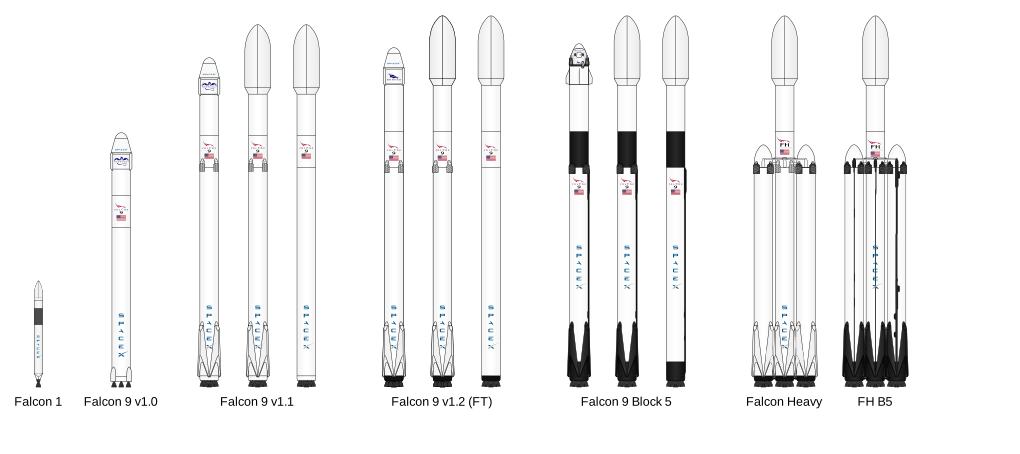
SpaceX designs, manufactures, and operates launch vehicles. Currently, the workhorses are the Falcon 9 Block 5 (medium-lift) and Falcon Heavy (heavy-lift), both utilizing reusable first stages powered by Merlin engines. SpaceX is also developing the Starship, a fully reusable launch system intended to replace the Falcon series and Dragon spacecraft. Starship is their next-generation vehicle aiming to reduce the cost of space travel and enable missions beyond Earth orbit.


December 2011: Stratolaunch Systems to contract with SpaceX for Falcon 9 Air development
In December 2011, Stratolaunch Systems announced a contract with SpaceX to develop the Falcon 9 Air, an air-launched, multi-stage launch vehicle based on Falcon 9 technology, for the Stratolaunch project. The Falcon 9 Air was intended to place satellites up to 6,100 kg into low Earth orbit and potentially be developed into a human-rated version.
November 27, 2012: Stratolaunch partners with Orbital Sciences Corporation
On November 27, 2012, Stratolaunch announced a partnership with Orbital Sciences Corporation for an air-launched vehicle study contract, effectively ending the development of the Falcon 9 Air.
2012: SpaceX and Stratolaunch end contractual relationship
In the fourth quarter of 2012, SpaceX and Stratolaunch amicably agreed to end their contractual relationship. This was because the Stratolaunch launch vehicle design had significantly departed from the Falcon derivative envisioned by SpaceX and did not fit well with SpaceX's long-term strategic business model.
May 2013: Falcon 9 Air replaced by Orbital Sciences Pegasus II
In May 2013, the Falcon 9 Air was replaced in the development plan by the Orbital Sciences Pegasus II air-launched rocket.
December 2013: SpaceX launches its first satellite to geostationary orbit (SES-8)
In December 2013, SpaceX launched its first satellite to geostationary orbit, SES-8, and followed up with Thaicom 6 a month later. This began offering competition to European and Russian launch providers in the commercial communications satellite market.
2013: SpaceX builds large launch manifest
By late 2013, SpaceX had built a large manifest of over 50 launches due to competitive pricing, with two-thirds of them being for commercial customers excluding US government flights.
2013: ULA maintains need for large annual subsidy
In early 2013, United Launch Alliance (ULA), SpaceX's primary US competitor, maintained that it required a large annual subsidy to remain financially viable, despite SpaceX's competitive pricing and lack of subsidy. ULA cited a lack of market opportunity as the reason, conflicting with the market's perceived state.
2015: First test flight of carrier aircraft expected
In 2015, the first test flight of the carrier aircraft, part of the Stratolaunch Systems mobile launch system, was originally expected from Scaled Composites' facilities in Mojave, California.
2016: First test launch of rocket expected
In 2016, the first test launch of the rocket, part of the Stratolaunch Systems mobile launch system, was not expected before this time when the project was getting underway.
January 10, 2023: SpaceX had four rockets on four launch pads and two Dragon 2s on orbit
On January 10, 2023, SpaceX had a rare coincidence of four rockets (all types of operational and under-development rockets) on all four of its orbital launch pads and two Dragon 2s (both types of Dragon 2s) on orbit.
Mentioned in this timeline

Elon Musk is a visionary entrepreneur and engineer known for...

SpaceX founded by Elon Musk in is a private aerospace...

California is a U S state on the Pacific Coast...

NASA the National Aeronautics and Space Administration is the U...
Texas is the second-largest U S state by area and...

Canada is a North American country spanning from the Atlantic...
Trending
4 hours ago Steve Kerr Provides Positive Update on Kristaps Porzingis' Return to Warriors Facility
4 hours ago Bank of America Prepares for Q3 Earnings Report Reveal

4 hours ago Ashlyn Krueger Faces Shuai Zhang at WTA Wuhan Open

4 hours ago Johnson & Johnson Beats Q3 Earnings Estimates and Raises Full-Year Outlook

4 hours ago Winnipeg Jets Fans Create Website Tracking Connor Hellebuyck's Forfeited Salary

4 hours ago Taiwan Stock Market Experiences Volatility While TAIEX Reaches New Record Highs
Popular

Ken Paxton is an American politician and lawyer serving as...

Cristiano Ronaldo widely considered one of the greatest footballers captains...

Michael Joseph Jackson the King of Pop was a highly...

Jameis Winston is an American football quarterback currently playing for...
Elon Musk is a visionary entrepreneur and engineer known for...

Ilhan Omar is a prominent American politician currently serving as...