


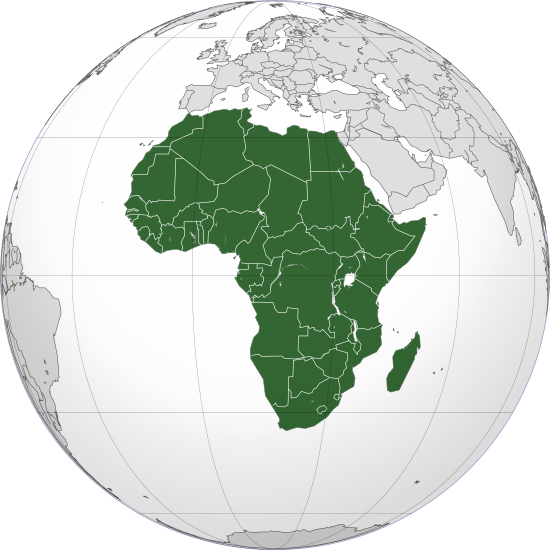
Africa is the second-largest and second-most populous continent, home to approximately 1.4 billion people as of 2021, representing roughly 18% of the global population. Characterized by a young population with a median age of 19.7 in 2012, Africa's population is projected to exceed 3.8 billion by 2100. While it is the least wealthy inhabited continent per capita, various factors like geography, climate, historical events (colonialism, Cold War), and modern economic systems contribute to this. Despite its relative poverty, Africa's significant natural resources, recent economic growth, and substantial youth population position it as a crucial economic market on the world stage.
6 hours ago : Nine Women Found Dead Near Johannesburg Sparks Femicide Outrage in South Africa
Police discovered the ninth body of a woman in South Africa's Dawn Park, fueling widespread public anger and protests regarding systemic femicide and the safety of women across the country.


December 1905: First Indigenous African Cinema
In December 1905, Albert Samama Chikly screened his own short documentaries in the casino of Tunis, and is often cited as the first producer of indigenous African cinema.
1914: European Control in Africa
By 1914, European control in Africa had risen to almost 90%, with only Liberia, Ethiopia, Egba, Aussa, Mbunda, the Dervish State, the Darfur Sultanate, and the Ovambo kingdoms retaining sovereignty.
1922: Highest Recorded Temperature
In 1922, the record for the highest-ever recorded temperature, in Libya (58 °C (136 °F)), was recorded.
1950: Population in Africa
In 1950, the total number of people in Africa was 229 million.
1951: Libya's Independence
In 1951, Libya, a former Italian colony, gained independence.
1955: First Sudanese Civil War
The First Sudanese Civil War began in 1955 and lasted until 1972.
1956: Apartheid in South Africa
From 1956, South Africa instated a system of racial segregation known as apartheid.
March 1957: Ghana's Independence
In March 1957, Ghana became the first sub-Saharan colony to be granted independence.
1960: Year of Africa
1960 is referred to as the Year of Africa, marking a period of decolonization.
1963: Establishment of the Organisation of African Unity
In 1963, newly independent African states established the Organisation of African Unity (OAU), the predecessor to the African Union. The countries decided to maintain their colonial borders and utilized traditional power structures in governance.
1964: Organisation of African Unity conference
In 1964, at the Organisation of African Unity conference, newly independent African colonies decided to keep their colonial borders due to fears of civil wars and regional instability, placing emphasis on pan-Africanism.
1965: Rhodesia's Unilateral Declaration of Independence
In 1965, Rhodesia unilaterally declared independence from the United Kingdom under the white minority government of Ian Smith.
1967: Che Guevara's assessment of African Revolution
In 1967, Che Guevara opined that Africa was not ready for revolution.
1972: End of the First Sudanese Civil War
The First Sudanese Civil War ended in 1972.
1973: Poverty in Sub-Saharan Africa
In 2003, the average poor person in sub-Saharan Africa was poorer than in 1973, indicating increasing poverty in some areas.
1975: Emigration of white settlers
Between 1975 and 1977, over a million colonials returned to Portugal alone.
1975: End of Portugal's Overseas Presence
Portugal's overseas presence in sub-Saharan Africa ended in 1975, after the Estado Novo regime was overthrown in a military coup in Lisbon.
1977: Emigration of white settlers
Between 1975 and 1977, over a million colonials returned to Portugal alone.
1980: Zimbabwe's Independence
In 1980, Rhodesia was internationally recognized as an independent state (Zimbabwe) after black nationalists gained power after a guerrilla war.
1981: Berber word origin hypothesis
In 1981, a hypothesis asserted that the name Africa stems from the Berber word ifri (plural ifran) meaning "cave", in reference to cave dwellers.
1981: Poverty in Sub-Saharan Africa
In 1981, approximately 50% of the population in Sub-Saharan Africa was living in poverty ($1.25 per day), totaling around 200 million people.
1983: Ethiopian Famine
Between 1983 and 1985, there was a major famine in Ethiopia that killed up to 1.2 million people, attributed to the forced relocation of farmworkers and seizure of grain by the communist Derg government, exacerbated by the civil war.
1983: Second Sudanese Civil War
The Second Sudanese Civil War began in 1983 and lasted until 2005.
1985: Ethiopian Famine
Between 1983 and 1985, there was a major famine in Ethiopia that killed up to 1.2 million people, attributed to the forced relocation of farmworkers and seizure of grain by the communist Derg government, exacerbated by the civil war.
1990: Trend Towards Democratic Governance
Between 1990 and 2018, the continent as a whole has trended towards more democratic governance.
1990: Military Marxism
Even after 1990, there are some examples of Military Marxism, such as a militia established by Ernest Wamba-dia-Wamba in Eastern Congo in the 1990s.
1990: Population in Africa
In 1990, the total number of people in Africa was 630 million.
1994: Rwandan Genocide
In 1994, a genocide in Rwanda resulted in up to 800,000 deaths, added to a severe refugee crisis and fueled the rise of militia groups in neighbouring countries.
1994: End of Apartheid in South Africa
In 1994, apartheid ended in South Africa.
1995: Economic Growth
From 1995 to 2005, Africa's rate of economic growth increased, averaging 5% in 2005.
1995: South Africa wins Rugby World Cup
In 1995, South Africa won the Rugby World Cup.
1996: Increased Poverty in Sub-Saharan Africa
The proportion of people living in poverty in Sub-Saharan Africa increased to 58% in 1996.
October 1997: Kenya Gains ODI Status
Kenya obtained One-Day International cricket (ODI) status on 10 October 1997.
2000: Deforestation in Madagascar
Around 2000 years ago, approximately 90% of Madagascar's original forests had been destroyed since the arrival of humans.
2000: Africa's Population
Around the year 2000, Africa's population surpassed that of the Americas.
2000: GDP Growth
Between 2000 and 2014, annual GDP growth in sub-Saharan Africa averaged 5.02%.
June 2001: Formation of the African Union
On June 26, 2001, the African Union (AU) was formed in Addis Ababa, Ethiopia, as its headquarters. The AU is a continental union consisting of 55 member states.
2001: Climate Change and Public Health Incidents
In 2001, climate change started to be connected to a number of public health incidents in Africa.
July 2002: Official Establishment of the African Union
On July 9, 2002, the African Union was officially established as a successor to the Organisation of African Unity (OAU).
2002: African Union replaces OAU
In 2002, the African Union replaced the Organization of African Unity (OAU).
2002: End of Civil Wars
In 2002, the civil wars in Angola, Sierra Leone, and Algeria ended.
2003: UN Human Development Report
According to the United Nations' Human Development Report in 2003, the bottom 24 ranked nations (151st to 175th) were all African.
2003: 2003 Cricket World Cup
In 2003, South Africa, Zimbabwe and Kenya jointly hosted the 2003 Cricket World Cup.
2003: Increased Poverty in Sub-Saharan Africa
In 2003, the average poor person in sub-Saharan Africa was estimated to live on only 70 cents per day, and was poorer than in 1973.
2003: End of Civil Wars
In 2003, the civil war in Liberia and the Second Congo War, which involved 9 countries and several insurgent groups, ended.
2003: Start of the Darfur Conflict
In 2003, the conflict in Darfur, Sudan began.
July 2004: Relocation of the Pan-African Parliament
In July 2004, the African Union's Pan-African Parliament (PAP) was relocated to Midrand, South Africa, while the African Commission on Human and Peoples' Rights remained in Addis Ababa.
2005: Economic Growth
From 1995 to 2005, Africa's rate of economic growth increased, averaging 5% in 2005.
2005: Poverty in Sub-Saharan Africa
In 2005, eighty-one percent of the sub-Saharan African population was living on less than $2.50 (PPP) per day, compared with 86% for India.
2005: End of Civil Wars
In 2005, the civil wars in Sudan and Burundi ended.
2005: End of the Second Sudanese Civil War
The Second Sudanese Civil War ended in 2005.
2005: Peak Intensity of the Darfur Conflict
The conflict in Darfur peaked in intensity from 2003 to 2005.
2005: Resolution of the Debt Crisis
The last debt crisis in Africa was resolved in 2005 with help from the heavily indebted poor countries scheme (HIPC).
2007: Chinese Investment in Africa
In 2007, Chinese companies invested a total of US$1 billion in Africa.
2007: South Africa wins Rugby World Cup
In 2007, South Africa won the Rugby World Cup.
2007: Spike in Violence in Darfur
In 2007, there was a notable spike in violence in the Darfur conflict.
August 2008: World Bank's Revised Poverty Estimates
In August 2008, the World Bank announced revised global poverty estimates based on a new international poverty line of $1.25 per day.
2008: Food Security Crisis
In 2008, the food security crisis, which took place on the heels of the global financial crisis, pushed 100 million people into food insecurity.
2009: Boko Haram Insurgency
Since 2009, the Boko Haram Insurgency has primarily been within Nigeria, with considerable fighting in Niger, Chad, and Cameroon as well.
2010: South Africa Hosts the World Cup
In 2010, South Africa hosted the World Cup tournament, becoming the first African country to do so.
2011: Zambia Fell Back Into Debt
About ten years after the 2005 debt crisis in sub-Saharan Africa was resolved, Zambia fell back into debt in 2011 due to the fall in copper prices and mismanagement of borrowed funds.
2011: AIDS deaths in Sub-Saharan Africa
In 2011, Sub-Saharan Africa accounted for an estimated 69 percent of all people living with HIV and 70 percent of all AIDS deaths.
2012: Africa Median Age
In 2012, the median age in Africa was 19.7, while the worldwide median age was 30.4, indicating that Africa's population is the youngest among all the continents.
2013: Spike in Violence in Darfur
From 2013 to 2015, there was a notable spike in violence in the Darfur conflict.
2013: Discrediting of Temperature Record
In 2013, the record for the highest-ever recorded temperature, in Libya in 1922, was discredited.
January 2014: Kenya Loses ODI Status
On 30 January 2014, Kenya lost its One-Day International cricket (ODI) status.
2014: Slowed Overall Growth
Since 2014, overall economic growth in Africa has considerably slowed, primarily as a result of falling commodity prices, continued lack of industrialisation, and epidemics of Ebola and COVID-19.
2015: Doubled Total GDP
Between 2000 and 2014, Sub-Saharan Africa doubling its total GDP from $811 billion to $1.63 trillion constant 2015 USD.
2018: Fertility Rate
As of 2018, the total fertility rate (children per woman) for Sub-Saharan Africa is 4.7, the highest in the world.
2018: Van de Loosdrecht Study
In reference to the van de Loosdrecht et al. 2018 study on the epipalaeolithic Taforalt remains from Morocco, which identified the EM35 (primarily EM78) common in north-eastern Africa but characterised the mtDNA (female lineage haplogroups) of U6 and M1 as 'Eurasian', the authors questioned the classification of these maternal haplogroups despite their localized and long-established presence in ancient African populations.
2018: Democratic African States
Per the criteria laid out by Lührmann et al. (2018), only Botswana and Mauritius have been consistently democratic for the entirety of their post-colonial history.
2019: South Africa wins Rugby World Cup
In 2019, South Africa won the Rugby World Cup.
2019: Fertility Rate
In 2019, all countries in sub-Saharan Africa had TFRs (average number of children) above replacement level and accounted for 27.1% of global livebirths.
2021: Africa Population
As of 2021, Africa's population was nearly 1.4 billion people, accounting for about 18% of the world's human population.
2021: Population in Africa
As of 2021, the population of Africa is estimated at 1.4 billion.
2021: Climate Change and Public Health Incidents
By 2021, over half (56%) of the over 2,000 recorded public health incidents in Africa between 2001 and 2021 were connected to climate change.
2021: Global Births in Sub-Saharan Africa
In 2021, sub-Saharan Africa accounted for 29% of global births.
2022: African Conflicts Reduced
As of 2022, most African conflicts have been reduced to low-intensity conflicts.
March 2023: UNESCO World Heritage Sites in Africa
As of March 2023, UNESCO listed 98 African properties as World Heritage Sites, consisting of 54 cultural, 39 natural, and 5 mixed sites. The List of World Heritage in Danger includes 15 African sites.
2023: Africa's Energy Consumption
As of 2023, Africa accounted for just 5.5% of global total final energy consumption, with per-capita energy use more than three times lower than the global average.
2023: South Africa wins Rugby World Cup
In 2023, South Africa won the Rugby World Cup.
2024: Africa Projected Population
Based on 2024 projections, Africa's population will exceed 3.8 billion people by 2100.
2025: African Sovereign Countries
As of 2025, Africa contains 54 sovereign countries.
2025: Highlight of the problematic categorization of Genetic Haplogroups
In 2025, David Schoenbrun, Christopher Ehret, Steven A. Brandt and Shomarka Keita have highlighted the problematic categorization of genetic haplogroups characterised as ‘African’ and ‘Eurasian' in North African genome studies.
2025: Projected GDP
The table shows the projected nominal GDP and GDP per capita (at purchasing power parity) in 2025 by the IMF.
2050: Projected Number of Births in Africa
The increase in the number of babies born in Africa compared to the rest of the world is expected to reach approximately 37% in the year 2050.
2055: Formation of the Middle Kingdom of Egypt
Around 2055 BC, the 11th dynasty, based in Thebes, conquered the others to form the Middle Kingdom of Egypt, and the 12th dynasty expanded into Lower Nubia at the expense of Kerma.
Mentioned in this timeline
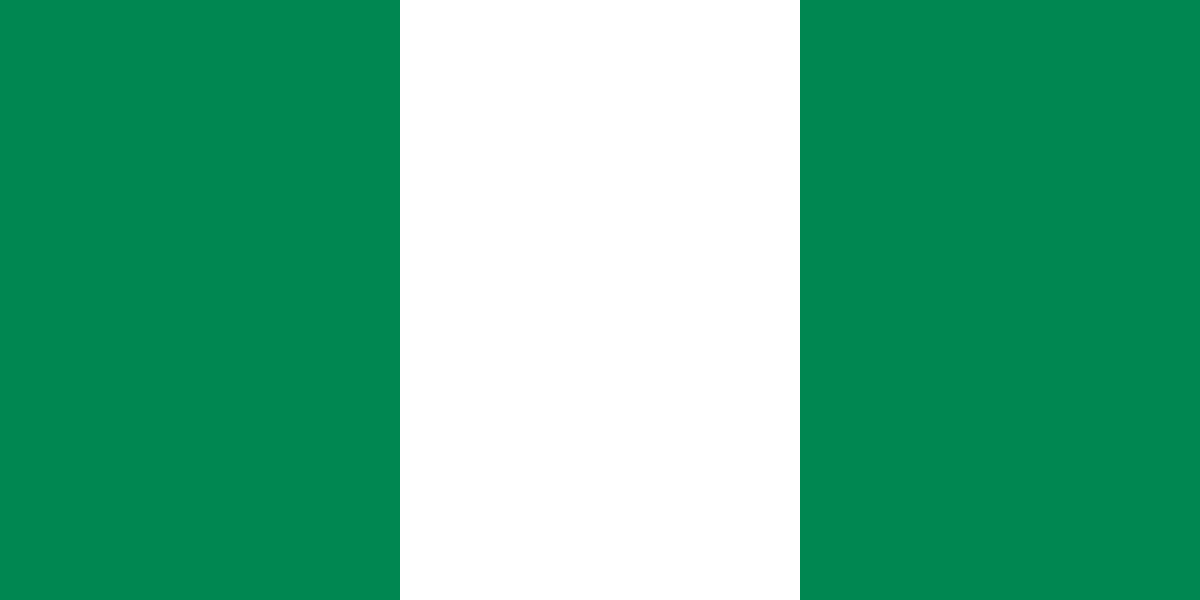
Nigeria located in West Africa is the continent's most populous...

Qatar is a country located on the Qatar Peninsula in...
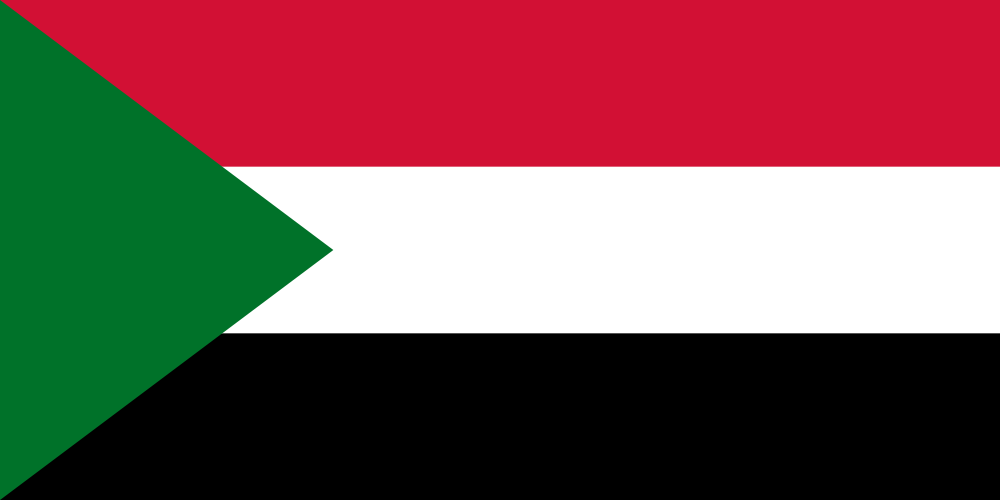
Sudan officially the Republic of the Sudan is a country...
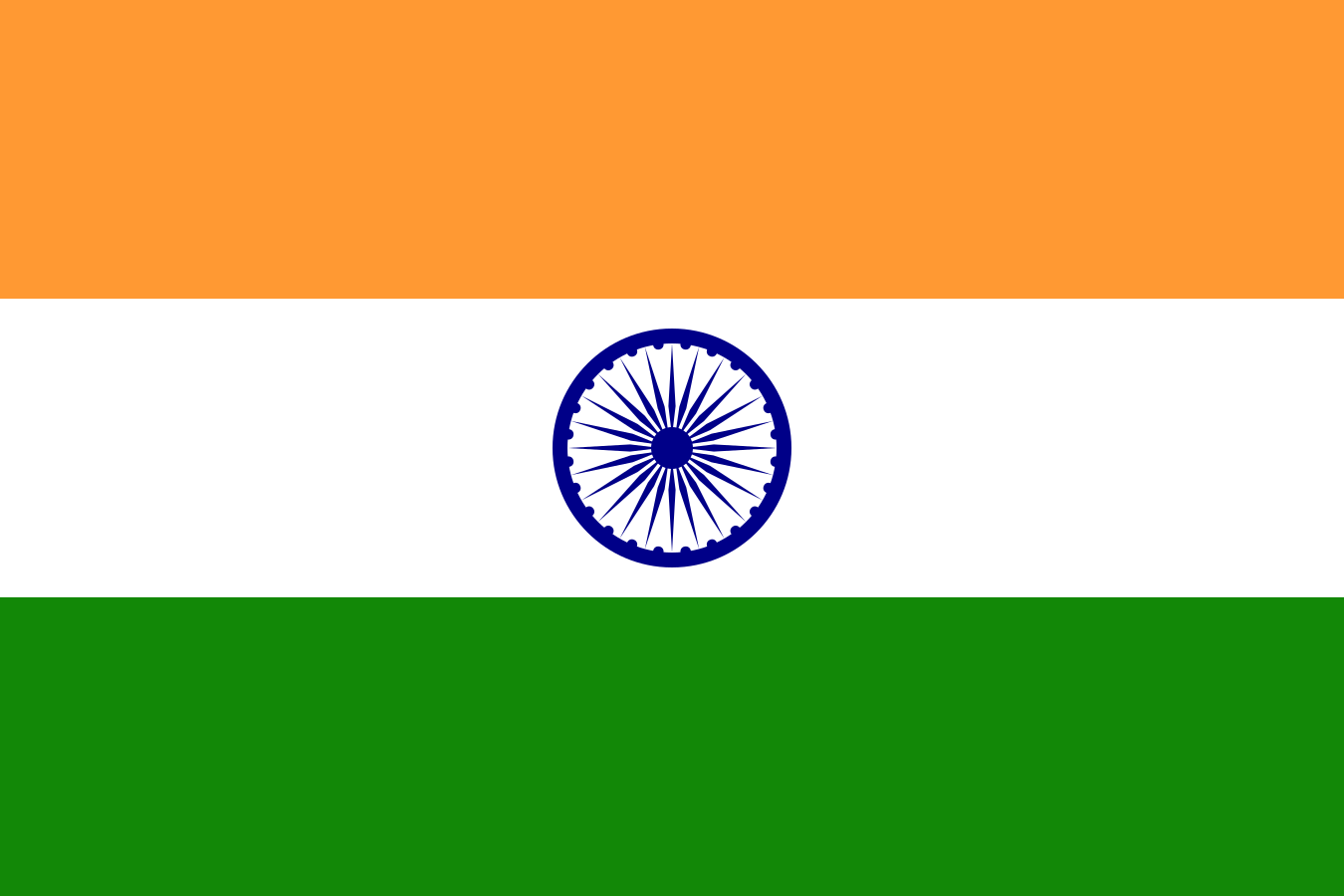
India officially the Republic of India is a South Asian...
Morocco a North African country in the Maghreb region boasts...
A bank is a regulated financial institution licensed to accept...
Trending

4 hours ago Kyle Harrison Scheduled to Start Series Finale for Milwaukee Brewers Against Pittsburgh Pirates

4 hours ago Kyle Tucker Secures Dodgers Playoff Roster Spot Amidst High Expectations
4 hours ago Severe Drought Devastates Crops Across Guatemala Prompting Emergency Government Response Strategy

5 hours ago Morgan Freeman Named College GameDay Guest Picker for Ole Miss-LSU Showdown

5 hours ago Rolling Loud Florida Announces Highly Anticipated 2027 Return to Orlando at Camping World Stadium
5 hours ago Honduras Faces Political Turmoil, Severe Climate Challenges, and Migration Struggles
Popular

Stan Lee - was a pivotal figure in the comic...

Ken Paxton is an American politician and lawyer serving as...

Michael Joseph Jackson the King of Pop was a highly...

Charlie Kirk was a prominent American right-wing political activist entrepreneur...

JD Vance is an American politician author and venture capitalist...

Kash Patel is an American lawyer who currently serves as...