


Alexandria is a major Egyptian city located on the Mediterranean coast, extending 40 km along the Nile Delta's western edge. Founded in 331 BC by Alexander the Great, it was a significant city in antiquity, known as a hub for science, culture, and scholarship. It is Egypt's main seaport, the second-largest city in the country, and the largest on the Mediterranean.
1900: Rediscovery of Kom El Shoqafa
In 1900, the catacombs of Kom El Shoqafa were accidentally rediscovered by citizens after being long forgotten.


1918: Construction of Teatro Mohamed Ali
Construction started on Teatro Mohamed Ali in 1918, designed by Georges Parcq.
1926: Construction on Al-Saad Bassili Pasha Palace
In 1926, initial construction began on the site of what would become the Alexandria National Museum, within the Al-Saad Bassili Pasha Palace, owned by a wealthy wood merchant.
1929: Construction of Alexandria Stadium
In 1929, Alexandria Stadium, the oldest stadium in Egypt, was built.
1933: Construction of Naval Memorial
In 1933, the Alexandria Naval Unknown Soldier Memorial was built in the Manshaya district to honor Khedive Ismail, with a statue of him erected at the top.
1938: Setting of "The Alexandria Quartet"
In 1938, Lawrence Durrell's "The Alexandria Quartet" was set in the city.
1948: Decline of Jewish community
Following the 1948 Arab-Israeli War, the Jewish community in Alexandria began to decline rapidly due to negative reactions towards Zionism.
July 1954: Israeli Bombing Campaign
In July 1954, Alexandria was targeted in an Israeli bombing campaign known as the Lavon Affair.
October 1954: Assassination Attempt on Gamal Abdel Nasser
On October 26, 1954, an assassination attempt on Gamal Abdel Nasser took place in Alexandria's Mansheya Square.
1956: Europeans Leave Alexandria Following Suez Crisis
Following the 1956 Suez Crisis, many Europeans began leaving Alexandria due to rising Arab nationalism.
May 1961: Highest Recorded Temperature
On May 30, 1961, the highest temperature ever recorded in Alexandria was 45 °C (113 °F).
1961: Nationalization of Property
In 1961, the nationalization of property by Nasser reached its peak, driving out nearly all remaining Europeans from Alexandria.
1965: Transformation to Unknown Soldier Monument
In 1965, the Alexandria Naval Unknown Soldier Memorial was transformed into the Monument to the Unknown Soldier, and the statue of Khedive Ismail was removed.
1967: Release of "The Sailor from Gibraltar"
In 1967, the British film "The Sailor from Gibraltar" was released, which is also set in the city of Alexandria.
1969: Release of 'Justine' Film
In 1969, the film "Justine", based on Lawrence Durrell's "The Alexandria Quartet", which is set in the city in 1938, was released.
1970: Alexandria Hosts AfroBasket Tournament
In 1970, Alexandria hosted the AfroBasket, the continent's most prestigious basketball tournament.
1975: Alexandria Hosts AfroBasket Tournament
In 1975, Alexandria hosted the AfroBasket, the continent's most prestigious basketball tournament.
1983: Alexandria Hosts AfroBasket Tournament
In 1983, Alexandria hosted the AfroBasket, the continent's most prestigious basketball tournament.
1992: Exploration of Underwater Section
In 1992, the underwater section of Alexandria, containing Cleopatra VII's royal quarters, was explored by French underwater archaeologist Franck Goddio and his team. The head of Caesarion was recovered.
January 1994: Coldest Recorded Temperature
On January 31, 1994, the coldest temperature ever recorded in Alexandria was 0 °C (32 °F).
1996: Existence of 12 Kisms
In 1996, Alexandria had the same area with 12 kisms, which are considered 'fully urbanised'.
1999: Obelisk Erecting Experiment
In 1999, Roger Hopkins and Mark Lehrner conducted a successful experiment to erect a 25-ton obelisk, potentially demonstrating the methods used to erect Pompey's Pillar.
2001: Total Fish Production
In 2001, Alexandria's total fish production was estimated at approximately 11,627 tons, with fishing activities in the Mediterranean Sea and Lake Mariout.
2002: Bibliotheca Alexandrina Inauguration
In 2002, the Bibliotheca Alexandrina was inaugurated near the site of the old Library of Alexandria.
2002: Cultivated Area in Alexandria
In 2002, the cultivated area in Alexandria reached approximately 87,403 feddans, divided among various villages and areas, relying on irrigation from canals and rainwater. Major crops included wheat, cotton, maize, barley, and rice.
2002: Livestock Numbers
In 2002, the number of cattle in Alexandria reached approximately 117,767 head, divided among different areas within the city.
December 2003: Alexandria National Museum Inauguration
On December 31, 2003, the Alexandria National Museum was inaugurated in a restored Italian-style palace on Tariq El Horreya Street, housing approximately 1,800 artifacts about Alexandria and Egypt.
2003: Alexandria Hosts AfroBasket Tournament
In 2003, Alexandria hosted the AfroBasket, the continent's most prestigious basketball tournament.
2005: Graeco-Roman Museum Closed for Renovations
In 2005, the Graeco-Roman Museum was closed for extensive renovations and expansion.
January 2006: Alexandria Hosts African Cup of Nations
In January 2006, Alexandria was one of the host cities for the African Cup of Nations, which Egypt won.
2006: CAPMAS Report on Alexandria
In 2006, CAPMAS reported the 14 kisms as simply 'Alexandria city', but explosive growth definitions, likely informal, may have changed or may be set to change.
2006: Tourist Visits to Alexandria
In 2006, approximately 534,235 non-Egyptian tourists visited Alexandria, representing 2% of the total inbound tourism to Egypt. Cultural tourism programs are also considered a major contributor to the city's tourism sector.
2009: Montessori system introduced
In 2009, the Montessori educational system was introduced in Alexandria for the first time at Alexandria Montessori.
February 2010: Alexandria International Airport Terminal 1 Opening
In February 2010, Terminal 1, the old terminal, of Alexandria International Airport was opened.
2011: Al-Nour Party wins Salafi votes
In 2011, Al-Nour Party, based in Alexandria, overwhelmingly won most of the Salafi votes in the parliamentary election.
2017: Revised Census Figures
In 2017, revised census figures were used for projections, but these may differ from preliminary tabulations.
2018: Hotel Capacity in Alexandria
In 2018, the city of Alexandria had 40 hotels of varying ratings, supporting the significant role of tourism in the city's economy.
2019: Climate Change Study Published in PLOS One
In 2019, a paper published in PLOS One estimated that under a moderate climate change scenario, Alexandria's climate in 2050 would resemble Gaza City's current climate.
2020: CAPMAS Projection
In 2020, a CAPMAS projection based on revised 2017 census figures was released, though it may differ significantly from preliminary tabulations.
2020: Fishing and Veterinary Services
In 2020, nearly ten thousand fishermen worked in Lake Mariout, producing about 20,000 tons of fish annually. Also in 2020, the city had 20 veterinary units and four slaughterhouses.
2020: Alexandria Metro Construction
In 2020, the construction of the Alexandria Metro was scheduled to begin at a cost of $1.05 billion.
2022: IPCC Sixth Assessment Report
The 2022 IPCC Sixth Assessment Report estimated that by 2050, Alexandria would sustain significant cumulative damages due to climate change, with Alexandria bearing around half of the costs among 12 major African cities.
July 2023: Alexandria Bus Routes
In July 2023, the Alexandria Passenger Transport Authority operated 103 bus routes, including medium, large, regular, and air-conditioned buses divided into four areas, in addition to microbus routes and taxis in yellow and black.
September 2023: Greek University of Patras Opens Branch
In September 2023, The Greek University of Patras announced that it is opening a branch in Alexandria, in a first-of-its-kind move by a Greek higher education institution. The branch will operate two departments, one Greek-speaking and one English-speaking, in subjects of Greek culture, language, and philosophy.
October 2023: Graeco-Roman Museum Re-opens
In October 2023, the Graeco-Roman Museum re-opened to the public after extensive renovations and expansion.
2023: Alexandria's Population and Area in 2023
In 2023, Alexandria had a population of 5,362,527 and an area of 1,661 square kilometers. The city is an industrial hub, a major tourist destination, and home to the Alexandria Shipyard and the Alexandria Mediterranean Countries Film Festival.
2025: Buildings at Risk of Collapse
A study predicts that in 2025, more than 7000 buildings in Alexandria will be at risk of collapse due to groundwater processes caused by rising sea levels.
2025: Alexandria's Petroleum Industry
As of late 2025, Alexandria continues to serve as a primary center for refining crude oil and manufacturing specialized petroleum derivatives, maintaining its status as a hub for Egypt's petroleum industry.
2025: Alexandria International Airport Terminal 2 Inauguration
In 2025, the brand new Terminal 2 of Alexandria International Airport was inaugurated.
2025: Centenary of Art Deco Architecture
In late 2025, Alexandria celebrated the centenary of its Art Deco architecture, recognized as a Mediterranean model of the style, focusing on preserving historic cinemas such as the Rio Cinema.
2030: Egypt Vision 2030
Alexandria is considered a major contributor to the Egypt Vision 2030. The city's economy is primarily based on its role as a major industrial hub, accounting for approximately 40% of Egypt's total industrial output.
2030: Potential Relocation Due to Sea Level Rise
By 2030, hundreds of thousands of people in Alexandria's low-lying areas may need to be relocated due to sea level rise.
2050: Projected Damages from Climate Change
By 2050, Alexandria is projected to incur significant damages from climate change, as estimated in the 2022 IPCC Sixth Assessment Report. Alexandria alone is projected to bear around half of the costs among 12 major African cities
Mentioned in this timeline

Basketball is a team sport played on a rectangular court...
Japan is an East Asian island country located in the...
War is defined as an armed conflict involving the armed...
Egypt officially the Arab Republic of Egypt is a transcontinental...
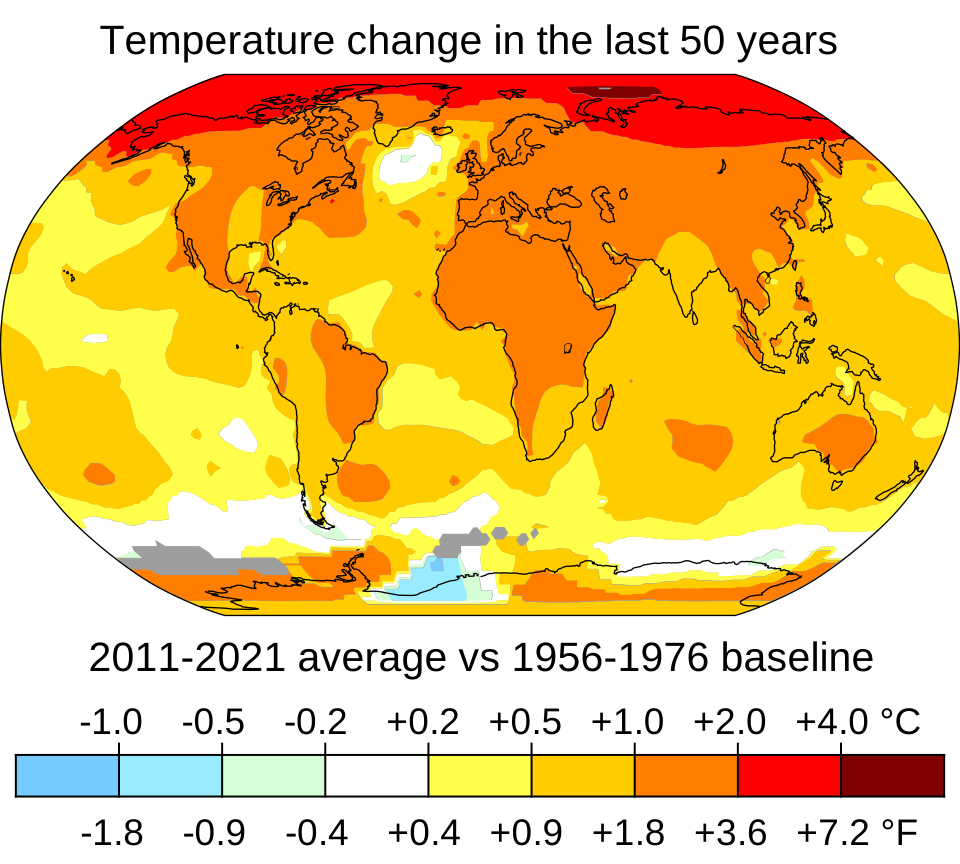
Climate change refers to long-term shifts in global temperatures and...
Bear is a popular award-winning writing and note-taking application designed...
Trending
3 hours ago North Korea Conducts Submarine Missile Tests and AI Torpedo Trials

3 hours ago Mads Mikkelsen Announced as Villain Lead for Call of Duty: Modern Warfare 4

4 hours ago Victor Wembanyama Pursues Defensive Excellence and Championship Glory for San Antonio Spurs

4 hours ago Anthony Davis Prepares for NBA Season With Strong Preseason Performance

4 hours ago Sidney Crosby and Longtime Penguins Teammates Celebrate Two Decades of Professional Partnership

5 hours ago Healthy Joel Embiid Expected to Transform Philadelphia 76ers Performance This NBA Season
Popular

Ilhan Omar is a prominent American politician currently serving as...

Ken Paxton is an American politician and lawyer serving as...

Elon Musk is a visionary entrepreneur and engineer known for...

Michael Joseph Jackson the King of Pop was a highly...

Jameis Winston is an American football quarterback currently playing for...

Cristiano Ronaldo widely considered one of the greatest footballers captains...