


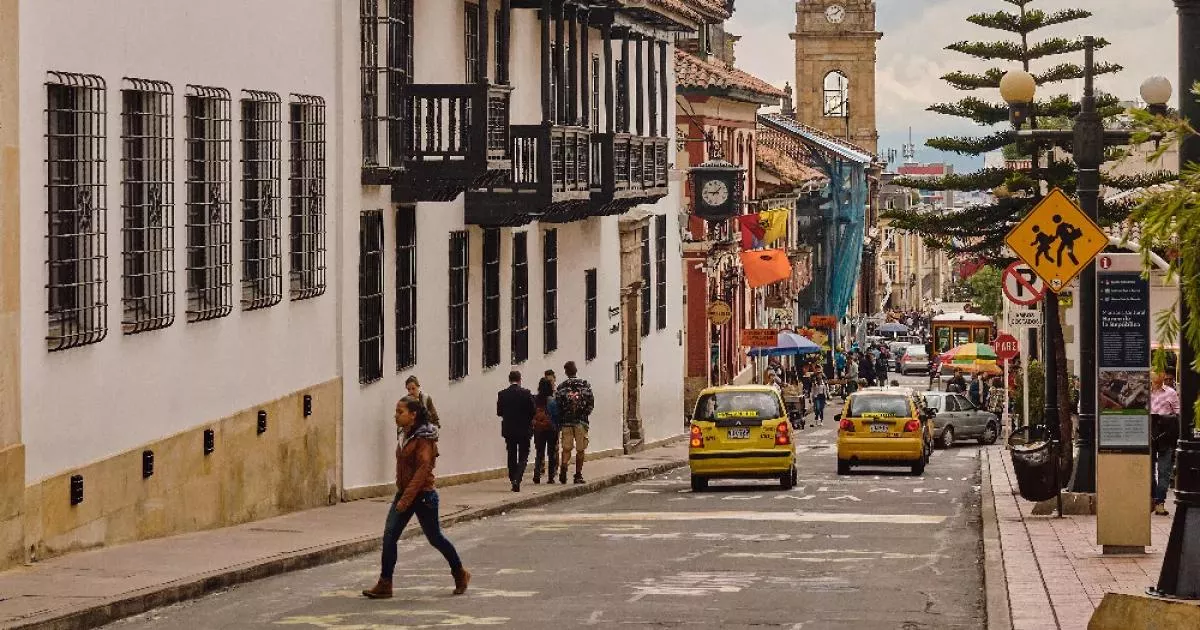
Bogotá, the capital and largest city of Colombia, is officially designated as Bogotá, Distrito Capital. Formerly known as Santa Fe de Bogotá, it functions as the Capital District and is the capital of Cundinamarca, though not politically integrated. Bogotá holds the status of a first-order territorial entity, mirroring the administrative level of Colombian departments. It serves as Colombia's primary hub for political, economic, administrative, industrial, cultural, technological, scientific, medical, educational, and aeronautical activities, extending its influence throughout northern South America.
1900: A new urban landscape of Bogotá
By 1900, the urban landscape of Bogotá had undergone significant changes, influenced by rural migration. The city's expansion efforts, initially proposed in 1847 and encouraged in the 1860s, gained momentum with private sector initiatives to introduce modern infrastructure like sewers, theaters, and electric systems, and new roads.


1904: Re-establishment of the Liberal Party
In 1904, the lawfulness of the liberal party was re-established and President Rafael Reyes endeavored to implement a national government.
1909: National Government Implementation
By 1909, President Rafael Reyes was endeavoring to implement a national government.
1910: Industrial Exposition of the Century
In 1910, the Industrial Exposition of the Century took place at the Park of Independence.
1912: Death of Rafael Pombo
In 1912, Rafael Pombo, an American romanticism poet who left a collection of fables essential part of children imagination and Colombian tradition, died.
1912: Population Growth
In 1912, the city grew to approximately 117,000 people.
1924: Union Struggles Begin
Between 1924 and 1928, hard union struggles began, with oil fields and banana zone workers' strikes, resulting in numerous deaths.
1928: Union Struggles Begin
Between 1924 and 1928, hard union struggles began, with oil fields and banana zone workers' strikes, resulting in numerous deaths.
1928: Banana Massacre
In 1928, the Banana Massacre of fruit pickers occurred, leading to conservative party division.
1930: Enrique Olaya Herrera Takes Office
In 1930, following the Banana Massacre and conservative party division, Enrique Olaya Herrera took office.
1930: End of Republican Architecture Style
In 1930, the "Republican Architecture" style, which prevailed since 1830, came to an end.
1930: End of Conservative Hegemony
The period from 1910 to 1930 is designated as the conservative hegemony.
1932: Coat of Arms Officially Recognized as Symbol of Bogotá
In 1932, the coat of arms granted by emperor Charles V was officially recognized and adopted as the symbol of Bogotá.
1936: Construction of University City and White City Begins
Construction of University City and White City at the National University of Colombia began in 1936, continuing until 1939. The project was developed by German architect Leopold Rother, with participation from architects of rationalist trends in the design of campus buildings.
1938: Bogotá Hosts First Bolivarian Games
In 1938, Bogotá hosted the first Bolivarian Games.
1939: Hailstorms average three times per year
Between 1939 and 2008, 231 hailstorm events were recorded, averaging three times per year in Bogotá.
1948: Bogotazo Riots Damage Tram System
During the Bogotazo riots of 1948, the tram system suffered heavy damage and was forced to close.
1948: Assassination of Jorge Eliécer Gaitán
In 1948, liberal leader Jorge Eliécer Gaitán was assassinated, and subsequent riots known as El Bogotazo virtually destroyed Bogotá's downtown, leading to urban, architectural, and population reorganization, and sparking civil conflict known as La Violencia.
1951: Tram System Replaced by Buses
In 1951, parts of the tram system that had been damaged during the Bogotazo riots were replaced by buses.
October 1952: Patriotic Armband Officially Adopted as Flag of Bogotá
In October 1952, decree 555 of 1952 officially adopted the patriotic armband as the flag of Bogotá.
1955: Construction of El Dorado International Airport
In 1955, the construction of El Dorado International Airport was ordered by Gustavo Rojas Pinilla to replace the Techo Airport.
1967: Urban Buses in Bogota
In 1967, there were 2,679 urban buses in Bogotá transporting an average of 1,630,000 passengers per day. The city had about 1 million inhabitants and 80 km of area.
July 1974: Bogotá's Anthem Officially Declared
In July 1974, the song with lyrics by Pedro Medina Avendaño and melody by Roberto Pineda Duque was officially declared the anthem of Bogotá by decree 1000.
1979: Lowest murder rate
In 2017, Bogotá achieved its lowest murder rate since 1979.
October 1982: Bogotá Joins Union of Ibero-American Capital Cities
In October 1982, Bogotá became part of the Union of Ibero-American Capital Cities.
1988: Administrations of Mayors Andres Pastrana
Between 1988-90, the administrations of mayors Andrés Pastrana formulated proposals to solve the problem of public transport, with limited results.
1990: Slow population growth
A journal mentions that in 1990, the city's life was marked by the lack of cultural activity and public services as well as by the excessive Catholic religiosity in its inhabitants, which almost controlled the whole life of people, as a journalist traveler wrote in 1822 (Biblioteca Luis Angel Arango, 1990,2 ).
1990: City's Urban Shape
According to Bibliotheca Luis Angel Arango in 1990, the city's urban shape remained the same in the 19th century as the 1557 urban landscape as a checkerboard with the Plaza as its core.
1990: Creation of the Bogota Metropolitan area
Since the creation of the Bogota Metropolitan area in 1990 significant efforts to upgrade the city's infrastructure have been undertaken, including the construction of several new avenues and boulevards, as well as the construction of the first two lines of the Bogota Metro.
1991: Bogotá First Awarded Cultural Capital of Ibero-America
In 1991, Bogotá was first awarded the title of Cultural Capital of Ibero-America by the UCCI (Union of Ibero-American Capital Cities).
1991: Santa Fe de Bogotá name period
In 1991, the city was known as Santa Fe de Bogotá, a name it held during the Spanish Imperial period and between 1991 and 2000.
1991: Centralist Republic
In 1991, the country became a centralist republic ruled by the constitution.
1992: Administrations of Mayors Jaime Castro
Between 1992-94, the administrations of mayors Jaime Castro formulated proposals to solve the problem of public transport, with limited results.
1993: Bogotá crime rate
In 1993, Bogotá had a high crime rate with 4,352 murders, equating to 81 murders per 100,000 people.
1995: Administrations of Mayors Antanas Mockus
Between 1995-97, the administrations of mayors Antanas Mockus formulated proposals to solve the problem of public transport, with limited results.
1995: Participatory security policy
In 1995, Bogotá adopted a participatory and integrated security policy named "Comunidad Segura", aimed at reducing the city's high crime rate.
1995: UCI Track Cycling World Championships Held at Luis Carlos Galán Velodrome
In 1995, the Luis Carlos Galán Velodrome in Bogotá hosted the UCI Track Cycling World Championships.
1995: Ciclorruta was started
In 1995, the ciclorruta was started by the Antanas Mockus administration with a few kilometers.
1998: Ciclorruta was started
Between 1995 and 1998, the ciclorruta was started by the Antanas Mockus administration with a few kilometers.
1998: Enrique Peñalosa First Term
In 1998, Enrique Peñalosa's first term as mayor began, including a priority solution to public transport, leading to the construction of specialized bus corridors and bike paths.
1999: Displaced people arrived in Bogotá
In 1999, the accelerated urbanization in Bogotá was due to political and social reasons such as poverty and violence. According to Codhes, in the period 1999–2005 more than 260,000 displaced people arrived in Bogotá, approximately 3.8% of the total population of Bogotá.
2000: End of Peñalosa's First Term
Enrique Peñalosa's first term as mayor ended in 2000.
2000: TransMilenio System Opened
In 2000, the TransMilenio system of articulated buses opened its first phase.
2002: 113 Higher Education Institutions in Bogotá
In 2002, Bogotá had a total of 113 higher education institutions, with several universities accredited by the NAC (National Accreditation Council).
2002: Walnut Tree Declared Emblematic Tree of Bogotá
In 2002, the walnut tree (Juglans neotropica) was declared the emblematic tree of Bogotá by District Agreement No. 069.
February 7, 2003: Car bomb explosion at El Nogal Club
On February 7, 2003, a car bomb exploded in a parking lot at the El Nogal Club in northern Bogotá, resulting in 36 fatalities and over 200 injuries; the FARC guerrilla group claimed responsibility for the attack.
December 29, 2003: Orchid Adopted as Emblematic Flower of Bogotá
On December 29, 2003, the orchid Odontoglossum luteopurpureum (Lindl.) was adopted as the emblematic flower of Bogotá by Agreement No. 109.
2004: Bogotá Wins National Games Championship
In 2004, Bogotá hosted the National Games and won the championship.
2004: Futsal Declared Symbolic Sport of Bogotá
In 2004, futsal was declared the symbolic sport of Bogotá, according to City Council Agreement 133.
2005: Displaced people arrived in Bogotá
In 2005, the accelerated urbanization in Bogotá was due to political and social reasons such as poverty and violence. According to Codhes, in the period 1999–2005 more than 260,000 displaced people arrived in Bogotá, approximately 3.8% of the total population of Bogotá.
April 2006: Routes for Suba Avenue and Southern Highway opened
In April 2006, routes for Suba Avenue and Southern Highway (Autopista Sur), the southern leg of the 30th Avenue, were opened for the TransMilenio system.
2007: Bogotá crime rate
In 2007, Bogotá experienced a reduction in murders to 1,401, a rate of 20 per 100,000 inhabitants, following the adoption of the "Comunidad Segura" security policy in 1995.
2007: Bogotá Named Cultural Capital of Ibero-America by UCCI
In 2007, Bogotá was awarded the title of Cultural Capital of Ibero-America by the UCCI (Union of Ibero-American Capital Cities).
2007: Bogotá Designated Cultural Capital of Iberoamerica
In 2007, Bogotá was designated the Ibero-American cultural Capital of Iberoamerica.
May 2008: Bus services running
Since May 2008, all buses run as corriente services.
2008: Chapinero's English Royal School Existed
A private school, Chapinero's English Royal School (Colegio Inglaterra Real de Chapinero), existed from 2008 until 2021.
2008: Hailstorms average three times per year
Between 1939 and 2008, 231 hailstorm events were recorded, averaging three times per year in Bogotá.
August 12, 2010: Car bomb detonated in front of Caracol Radio
On August 12, 2010, a car bomb detonated in front of a building complex housing Caracol Radio, injuring nine people.
December 2011: New shopping malls planned
As of December 2011, over 160 new shopping malls were planned in Bogotá, in addition to the existing 100 malls, boosting the city's economy.
2011: Gustavo Petro Elected Mayor
After being elected in 2011, Mayor Gustavo Petro clashed with the conservative political establishment after remunicipalization of the city's garbage collection system.
March 2012: Bogotá Joins UNESCO Creative Cities Network
In March 2012, Bogotá became a member of the UNESCO Creative Cities Network in the category of music.
May 15, 2012: Magnetic bomb explosion
On May 15, 2012, a magnetic bomb exploded at the intersection of 74th Street and Caracas Avenue, near the financial district in Bogotá. The attack targeted former Minister of the Interior Fernando Londoño, who was injured, and resulted in the deaths of two people.
October 2012: First Snowfall
On October 30, 2012, the first snowfall in more than 150 years was recorded in the administrative area of Bogotá, specifically in Sumapaz.
2013: Kilometers of Ciclovía
By 2013, Bogotá had established a massive system of bicycle paths and segregated lanes called ciclorrutas spanning 376 km.
2013: Thefts exceeded forecasts
In 2013, a report by the Bogotá Metropolitan Police indicated that thefts exceeded forecasts, reaching around 24,000 cases. Street theft decreased slightly (from 51% to 49%), as did theft on public transportation (from 19% to 17%).
2014: Robberies in commercial establishments doubled
Between 2013 and 2014, robberies in commercial establishments doubled (from 8% to 16%).
2014: Global Cities Index Ranking
In 2014, Bogotá ranked 52nd on the Global Cities Index and was considered a global city type "Alpha-" by GaWC.
2014: Car free week was introduced
In 2014, since the construction of the ciclorruta bicycle use in the city has increased, and a car free week was introduced.
2014: First Kids' Choice Awards Colombia Ceremony
In 2014, the first Kids' Choice Awards Colombia ceremony, given by Nickelodeon, was held in Bogotá, hosted by the singer Maluma.
2015: Inauguration of BD Bacatá
In 2015, BD Bacatá was inaugurated, surpassing the Colpatria Tower to become the tallest building of the city and of Colombia.
April 2016: New Bike Lane Inaugurated on Carrera 11
In April 2016, the carrera 11 was reduced from four to three car lanes and a new bike lane (ciclorruta) was inaugurated.
2016: Enrique Peñalosa Second Term
Enrique Peñalosa served a second term as mayor from 2016-19.
2016: Bogotá has won international events
In 2016, Bogotá had won 50 major international events, with 12 more world-class events in progress.
2016: Bogotá Hosts FIFA Futsal World Cup Matches
In 2016, Bogotá was one of the venue cities hosting the FIFA Futsal World Cup.
2016: Significant Snowfalls
In 2016, there were further significant snowfalls in Bogotá.
February 2017: World Summit of Nobel Peace Laureates took place
From February 2 to February 5, 2017, the 16th World Summit of Nobel Peace Laureates took place in Bogotá, Colombia.
February 2017: Highest Temperature Recorded
In February 2017, Bogotá recorded a temperature of 25.1°C, the highest in the city in sixty years, according to the Institute of Hydrology, Meteorology and Environmental Studies (IDEAM).
February 19, 2017: Explosion in the La Macarena neighborhood
On February 19, 2017, an explosion occurred in Bogotá's La Macarena neighborhood, resulting in the death of one police officer and injuries to 26 people, including 24 members of the Mobile Anti-Riot Squad. The ELN guerrilla group claimed responsibility for the attack.
2017: Bogotá crime rate
In 2017, Bogotá achieved its lowest murder rate since 1979, with 14 murders per 100,000 inhabitants, attributed to the ongoing "Comunidad Segura" participatory security policy.
2017: Significant Snowfalls
In 2017, there were further significant snowfalls in Bogotá.
2018: Bogotá Population
In 2018, Bogotá's population within the city limits was 7,412,566, with approximately 4,310 inhabitants per square kilometer. Rural areas housed 25,166 people, with 47.8% of the population being male and 52.2% female.
January 17, 2019: Car bomb explosion at Police Cadet School
On January 17, 2019, a car bomb exploded at the General Santander Police Cadet School in southern Bogotá, causing at least 21 deaths and 68 injuries.
2019: City's Distribution
As of 2019, the city's distribution is composed of nine main business centers.
2019: Wetlands Disappearance
In 2019, only 727 hectares of wetlands remained in the Bogotá region, compared to nearly 50,000 hectares in the 1960s, representing a disappearance rate of 98%.
2019: Robberies per day
In 2020, Bogotá reported an average of 214 robberies per day, marking a 37% decrease compared to 2019 due to quarantine measures enacted by the national government in response to COVID-19, but robberies increased again after the measure ended.
February 2020: Lowest Temperature Recorded
In February 2020, Bogotá recorded a temperature of −6.3°C, one of the lowest in the city in recent years, according to the IDEAM.
September 2020: Protests Against Police Brutality
In September 2020, protests against police brutality started in Bogotá following the death of Javier Ordóñez while in police custody.
2020: Decrease of robberies per day
In 2020, Bogotá reported an average of 214 robberies per day, marking a 37% decrease compared to 2019 due to quarantine measures enacted by the national government in response to COVID-19, but robberies increased again after the measure ended.
2020: Construction of the Bogotá Metro Begins
In 2020, construction began on the Bogotá Metro after being pushed forward by two successive governments, with the opening planned for 2028.
2020: Significant Snowfalls
In 2020, there were further significant snowfalls in Bogotá.
2021: Chapinero's English Royal School Closed Due to COVID-19
In 2021, Chapinero's English Royal School (Colegio Inglaterra Real de Chapinero) closed due to the COVID-19 pandemic.
2021: Construction on Bogotá Metro Began
In 2021, construction on the Bogotá Metro began.
2021: Pandemic-related mortality increases
In 2021, there were pandemic-related mortality increases.
2022: Births to foreign mothers
In 2022, 13.28% of births in Bogotá were to foreign mothers.
2022: Life expectancy improvements
In 2022, life expectancy in Colombia was reported at 76.51 years, reflecting a notable recovery from mortality increases during the pandemic in 2021 and driven by advances in public health, medical access, and socio-economic conditions.
2022: Significant Snowfalls
In 2022, there were further significant snowfalls in Bogotá.
2023: Bogotá Had Six Mosques
As of 2023, Bogotá had six mosques, including Abou Bakr Al-Siddiq Mosque on Calle 80 and Carrera 30, Estambul mosque in Chapinero, and Centro de Estudios Al-Qurtubi on Calle 60.
2023: Carlos Fernando Galán elected Mayor
In 2023, Carlos Fernando Galán was elected Mayor of Bogotá. His term will run from 2024 to 2027.
2023: Life expectancy improvements
In 2023, life expectancy in Colombia reached 77.73 years, showing an upward trajectory influenced by improvements in public health, access to medical care, and socio-economic advancement.
2024: Life expectancy improvements
In 2024, Colombia's life expectancy was recorded at 78.04 years, marking a continued increase attributed to enhancements in public health, healthcare accessibility, and socio-economic progress.
2024: City Council Approves Megaproject for Bogotá River
In 2024, the City Council approved a megaproject to revitalize the Bogotá River with a focus on transportation. The project, costing 250 billion pesos in its first phase, includes docks and vessels to transport up to 120,000 passengers daily across seven routes.
2024: GDP percentage of the metro
In 2024, the metro contributes to 38% of Colombia's GDP. (150 billion dollars)
2024: Carlos Fernando Galán Mayor term begins
In 2024, the term of the Mayor of Bogotá is starting.
2025: Life expectancy improvements
In 2025, the life expectancy in Colombia rose to 78.21 years, continuing an upward trend from previous years due to improvements in public health, medical access, and socioeconomic development.
2027: Carlos Fernando Galán Mayor term ends
In 2027, the term of the Mayor of Bogotá will end.
2028: Planned Opening of the Bogotá Metro
In 2028, the Bogotá Metro is planned to open, after construction began in 2020.
2030: TransMilenio system to cover the entire city
The TransMilenio system is planned to cover the entire city of Bogotá by 2030.
Mentioned in this timeline
Colombia is a country in South America with insular regions...
A bank is a regulated financial institution licensed to accept...
FIFA or the F d ration Internationale de Football Association...

Music involves arranging sounds to create form harmony melody rhythm...

A car also known as an automobile is a wheeled...
Mexico officially the United Mexican States is a North American...
Trending
3 hours ago Dodgers Star Miguel Rojas Reflects On Retirement Doubts And Achieving US Citizenship
3 hours ago Ha-Seong Kim Returns to Atlanta Braves Lineup for Game 3 Against Dodgers
3 hours ago Semyon Varlamov Returns to Start for Islanders in Rivalry Matchup Against Rangers

3 days ago Dave Portnoy and Barstool Sports Exit Fox's Big Noon Kickoff Show

3 hours ago Freddie Freeman Faces Former Team Braves in High-Stakes NLDS Postseason Matchup

3 hours ago Simu Liu and Allison Hsu Marry in Romantic French Ceremony
Popular

Ken Paxton is an American politician and lawyer serving as...

Elon Musk is a visionary entrepreneur and engineer known for...

Jameis Winston is an American football quarterback currently playing for...

Bernie Sanders is a prominent American politician and the senior...

Shakira Isabel Mebarak Ripoll the Queen of Latin Music is...

Cristiano Ronaldo widely considered one of the greatest footballers captains...