History of Canadian Snowbird Association in Timeline


The Canadian Snowbird Association is a national, non-profit organization that advocates for the rights and benefits of Canadian travelers, particularly those who spend their winters in warmer climates. They work to address issues related to healthcare, insurance, taxation, border security, and other concerns impacting Canadians who travel abroad. The association provides its members with information, resources, and advocacy to protect their interests as they travel internationally.


1992: CSA Evaluates Travel Medical Insurance Plans
Since restrictions on out-of-country emergency medical care were put in place in 1992, the Canadian Snowbird Association made it a mission to evaluate Canadian travel medical insurance plans. Medipac Travel Insurance has since received the CSA's endorsement as the preferred travel medical insurance plan for its members.
1993: CSA Advocacy in New Brunswick
In 1993, the government of New Brunswick proposed reducing the time residents could spend outside the province while maintaining health coverage. The Canadian Snowbird Association's advocacy led the New Brunswick government to shelve the proposal and maintain the existing six-month residency requirement.
1995: CSA Restores Ontario Out-of-Country Emergency Care Rate
In 1995, the Canadian Snowbird Association (CSA) worked with the Ontario government to restore the out-of-country emergency care in-patient rate to $400 per day, after it had been reduced to $100 per day under Premier Bob Rae.
1999: CSA Increases Ontario Residency Allowance
In 1999, the CSA collaborated with the Ontario government to increase the time residents could be outside the province and still retain health coverage under the Ontario Health Insurance Plan (OHIP), from six to seven months. This policy change coincided with another that allowed beneficiaries of the Ontario Drug Benefit Program (ODB) to receive up to a 200-day supply of prescription medication for travel.
2002: CSA Recommends Mail-In Ballots in Ontario
In 2002, the Canadian Snowbird Association recommended to the Ontario government that the Election Act be amended to include an absentee ballot option for temporarily absent residents.
2003: Proposed Rule on Canadian Tourists in the U.S. Rescinded
In 2003, a proposed rule to reduce the allowed stay for Canadian tourists in the U.S. from six months to 30 days was rescinded after the CSA presented before the U.S. House Small Business Committee. Florida Governor Jeb Bush acknowledged the CSA's role in this outcome.
2007: Federal Government Reminds Provinces of Canada Health Act Obligations
In 2007, federal Minister of Health Tony Clement sent letters to all provincial and territorial Ministers of Health to remind them of their obligations under the Canada Health Act, in an effort to enforce the portability section.
2010: Ontario Introduces Mail-In Ballots
In 2010, An Act to Amend the Election Act and the Election Finances Act was passed in the Ontario legislature, allowing Ontario residents to vote by mail-in ballot during a general election. This was a result of the CSA's recommendation since 2002.
2012: CSA Lobbies for "Canadian Retiree Visa"
In 2012 and 2013, the CSA lobbied the U.S. Congress to increase the amount of time that Canadian retirees could spend in the United States from six to eight months. As a result of CSA lobbying efforts, the "Canadian Retiree Visa" or "Snowbird Visa" was included in multiple bills in both the Senate and House of Representatives.
2012: CSA Urges Changes to Saskatchewan Drug Plan
In 2012, the CSA played a key role in convincing the Saskatchewan government to permit residents to obtain up to six months' worth of prescription drugs at once through the Saskatchewan Drug Plan, streamlining the process and reducing costs for traveling residents.
June 27, 2013: JOLT Act Approved by the Senate
On June 27, 2013, the JOLT Act, which contained the "Canadian Retiree Visa", was attached to the comprehensive immigration reform bill which was approved by the Senate with a vote of 68 to 32. The JOLT Act has been referred to the Subcommittee on Immigration and Border Security in the U.S. House of Representatives.
2013: Florida Repeals International Driving Permit Requirement
In 2013, after the CSA's intervention, the Florida Legislature repealed a requirement for foreign drivers to obtain an International Driving Permit. In addition, the CSA also lobbied the U.S. Congress to increase the amount of time that Canadian retirees could spend in the United States from six to eight months in 2012 and 2013.
2013: Canada Introduces 10-Year Passport Validity
In 2013, following the CSA's recommendation, the Canadian government introduced a Canadian passport with a 10-year validity period, making travel easier for its citizens.
2013: CSA Achieves Increased Out-of-Country Time for Residents
In 2013, the Canadian Snowbird Association collaborated with British Columbia to increase the allowed out-of-country time for permanent residents from six to seven months while maintaining health coverage. Later that year, the CSA successfully lobbied Manitoba and Alberta to allow residents to temporarily reside outside of Canada for a maximum of 7 months in a 12-month period.
May 2014: New Brunswick Increases Out-of-Province Medicare Coverage
In May 2014, due to the Canadian Snowbird Association's efforts, the New Brunswick government increased the amount of time that Medicare beneficiaries could temporarily remain outside of the province, from six to seven months, while retaining their eligibility for continued health coverage.
August 1, 2014: Nova Scotia Increases Out-of-Province Health Coverage and Prescription Supply
On August 1, 2014, the government of Nova Scotia increased the time residents could be out of the province while maintaining health coverage. Simultaneously, the Nova Scotia Family and Seniors' Pharmacare Programs was amended to allow for a 270-day prescription medication supply maximum for vacation purposes.
2017: CSA Membership Reaches 110,000
In 2017, the Canadian Snowbird Association (CSA) had approximately 110,000 members across Canada.
Mentioned in this timeline
The United States of America is a federal republic primarily...
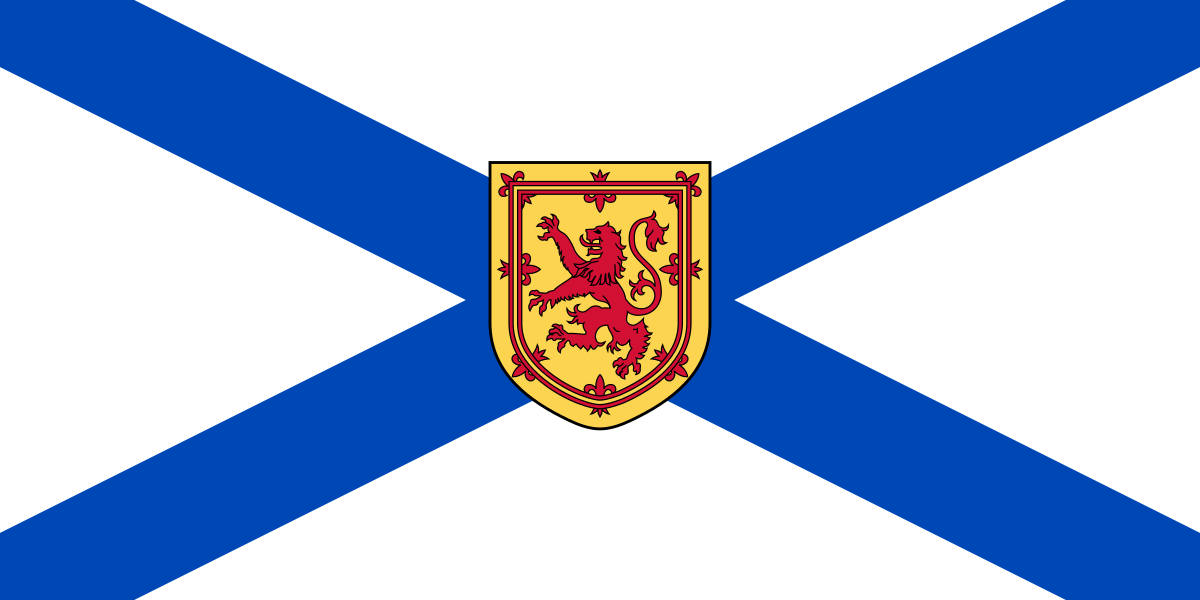
Nova Scotia is a province located in the Maritimes region...
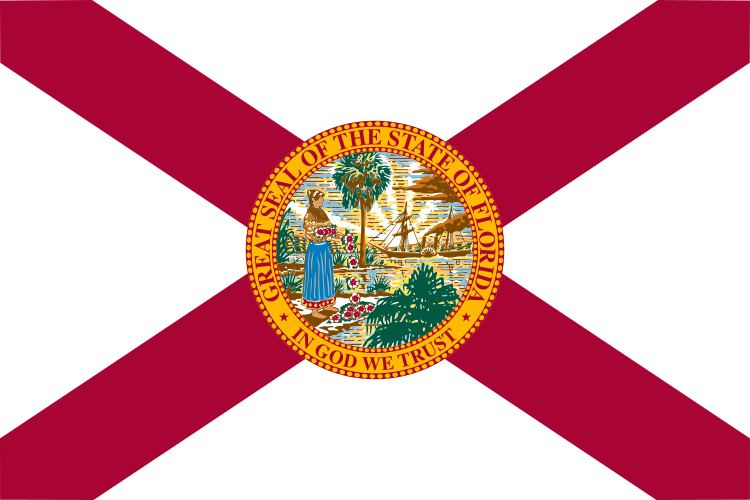
Florida the southernmost state in the contiguous United States is...

Canada is a North American country spanning from the Atlantic...
A passport is a government-issued travel document verifying a person's...

Travel involves the movement of people between geographical locations using...
Trending

4 hours ago Controversy Surrounds Proposed Trump Presidential Library Development in Miami

4 hours ago Cameron Norrie Faces Dalibor Svrcina in ATP Shanghai Masters Second Round Match

4 hours ago ATP Shanghai Masters Tennis Tournament Previews and Predictions

5 hours ago CNBC Reveals Top 100 Financial Advisor Rankings for 2026

5 hours ago Jamaal Williams Visits New England Patriots for NFL Workout

5 hours ago Spurs Experiment With Dynamic Three-Guard Lineup Featuring De'Aaron Fox
Popular

Ken Paxton is an American politician and lawyer serving as...

Shakira Isabel Mebarak Ripoll the Queen of Latin Music is...

Elon Musk is a visionary entrepreneur and engineer known for...

Cristiano Ronaldo widely considered one of the greatest footballers captains...

Jameis Winston is an American football quarterback currently playing for...

Michael Joseph Jackson the King of Pop was a highly...