


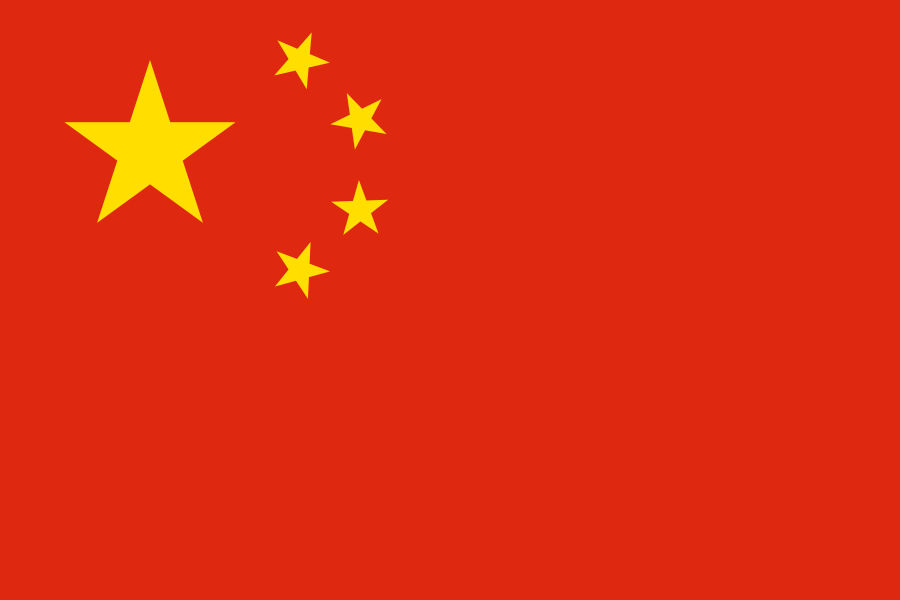
China, officially the People's Republic of China (PRC), is located in East Asia and is the second-most populous country globally with over 1.4 billion residents, constituting 17% of the world's population. It shares land borders with fourteen countries. Spanning 9.6 million square kilometers, it is the third-largest country by area. Administratively, China comprises 33 province-level divisions, including provinces, autonomous regions, municipalities, and special administrative regions. Beijing serves as the capital, while Shanghai is its most populous urban center and a significant financial hub.
6 hours ago : California Woman Accused of Spying for China Stays in Custody Amid Flight Risk Concerns
A California woman faces espionage charges for allegedly spying for China and surveilling the Taiwan president's son. A judge has ordered her to remain in custody due to significant flight risk concerns, despite her offer of $820,000 for bail.


1901: Boxer Rebellion
The ill-fated anti-foreign Boxer Rebellion of 1899–1901 further weakened the Qing dynasty.
1905: First Chinese Film
In 1905, the first Chinese film, Dingjun Mountain, was released.
1911: Xinhai Revolution
In 1911, the Xinhai Revolution ended the Qing dynasty.
January 1912: Establishment of the Republic of China
On January 1912, the Republic of China (ROC) was established, and Sun Yat-sen of the Kuomintang was proclaimed provisional president.
1912: Abdication of Puyi
In 1912, Puyi, the last Emperor of China, abdicated.
1912: End of the Qing Dynasty
The Qing dynasty, the last imperial dynasty of China, lasted from 1644 until 1912.
1915: Yuan Shikai proclaims himself Emperor
In 1915, Yuan Shikai, who was previously a Qing general, proclaimed himself Emperor of China.
1916: Re-establishment of the Republic
After Yuan Shikai's death in 1916, the republic was re-established.
1927: Start of the Chinese Civil War
In 1927, the Chinese Civil War began when Kuomintang forces purged members of the Chinese Communist Party (CCP).
1927: Breakdown of Kuomintang and CCP alliance
In 1927, the Kuomintang alliance with the CCP broke down after Chiang Kai-shek violently suppressed the CCP and other leftists in Shanghai, which marked the beginning of the Chinese Civil War.
1931: Japanese invasion of Manchuria
In 1931, Japan invaded and occupied Manchuria.
1932: Olympic Games Participation
China first participated in the Olympic Games in 1932.
1934: CCP initiates the Long March
In 1934, CCP forces in Jiangxi were defeated by the Nationalist government, leading the CCP to initiate the Long March and relocate to Yan'an in Shaanxi.
1937: Japanese invasion of China
In 1937, Japan invaded other parts of China, precipitating the Second Sino-Japanese War (1937–1945), which was a theater of World War II.
1945: Surrender of Japan
After the surrender of Japan in 1945, China emerged victorious but war-ravaged and financially drained.
1946: Resumption of the Chinese Civil War
In 1946, fighting broke out between CCP and KMT forces, and the country resumed a state of civil war that lasted more than three years.
1947: Establishment of constitutional rule
Constitutional rule was established in China in 1947, but due to the ongoing war, many provisions of the ROC constitution were never implemented in mainland China.
October 1949: Proclamation of the People's Republic of China
On October 1, 1949, CCP Chairman Mao Zedong formally proclaimed the People's Republic of China.
1949: Forest Coverage
According to China's government, the forest coverage of the country grew from 10% of the overall territory in 1949 to 25% in 2024.
1949: Communists Come to Power
After the Communists came to power in 1949, efforts were made to organize science and technology based on the model of the Soviet Union.
1949: Adoption of China Standard Time
In 1949, China adopted a single national time zone, China Standard Time (UTC+8), despite spanning the equivalent of five geographical time zones.
1949: Proclamation of the People's Republic of China
In 1949, the CCP proclaimed the People's Republic of China, which forced the Kuomintang-led government to retreat to Taiwan.
1949: End of major combat in the Chinese Civil War
Major combat in the Chinese Civil War ended in 1949.
1949: Unitary communist state
Since 1949, China has been a unitary communist state with the CCP as its sole ruling party.
1949: Per Capita Income Comparison
When the PRC was founded in 1949, per capita income in China was one-fifth of the world average.
1950: PRC captures Hainan and annexes Tibet
In 1950, the PRC captured Hainan from the ROC and annexed Tibet.
1952: PRC Olympic Participation
China has participated as the PRC since 1952.
1958: Discovery of Erlitou culture sites
In 1958, archaeologists discovered sites belonging to the Erlitou culture, which existed during the early Bronze Age.
1958: Start of Space Program
The Chinese space program started in 1958 with some technology transfers from the Soviet Union.
1959: Start of the Great Leap Forward
In 1959, the Great Leap Forward, a massive industrialization project, began.
1961: End of the Great Leap Forward
The Great Leap Forward, which started in 1959, resulted in an estimated 15 to 55 million deaths between 1959 and 1961, mostly from starvation.
1964: China detonates its first atomic bomb
In 1964, China detonated its first atomic bomb.
1966: Launch of the Cultural Revolution
In 1966, Mao Zedong and his allies launched the Cultural Revolution, sparking a decade of political recrimination and social upheaval.
1970: First Satellite Launch
In 1970, China launched its first satellite, Dong Fang Hong I, becoming the fifth country to do so independently.
1971: UN Recognition
In 1971, most countries switched recognition from the ROC to the PRC after the latter replaced the former in the UN.
1974: Chinese population at 900 million
The Chinese population increased from 550 million in 1950 to 900 million in 1974.
1976: Mao's Death
After Mao's death in 1976, science and technology were promoted as one of the Four Modernizations, and the Soviet-inspired academic system was gradually reformed.
1976: Death of Mao Zedong
The Cultural Revolution, which started in 1966, lasted until Mao Zedong's death in 1976.
1978: Poverty Reduction
Between 1978 and 2018, China reduced extreme poverty by 800 million.
1978: Economic Reforms
In 1978, Deng Xiaoping began instituting economic reforms, leading to improvements in public health due to better nutrition, although free public health services in the countryside declined.
1978: Deng Xiaoping takes power
In 1978, Deng Xiaoping took power and started the reform and opening up, instituting large-scale political and economic reforms to transition away from planned economy.
1978: Reform and opening up
In 1978, reform and opening up began in China, moving the country away from a planned economy towards a market-based economy.
December 1982: Adoption of the current constitution
China adopted its current constitution on December 4, 1982.
1989: Tiananmen Square protests and massacre
In 1989, a movement for political liberalization stalled after the Tiananmen Square protests and massacre.
1989: Tiananmen Square protests
In 1989, there were protests such those in Tiananmen Square, and then throughout the entire nation.
1990: Loss of Primary Forest
Between 1990 and 2000, China lost 19 000 ha of primary forest.
1990: Asian Games in Beijing
China hosted the Asian Games in 1990 in Beijing.
1990: Poverty Reduction
From 1990 to 2018, the proportion of the Chinese population living with an income of less than $1.90 per day (2011 PPP) decreased from 66.3% to 0.3%, the share living with an income of less than $3.20 per day from 90.0% to 2.9%, and the share living with an income of less than $5.50 per day decreased from 98.3% to 17.0%.
1990: Stunting Rates
In 1990, rates of stunting, a condition caused by malnutrition, were at 33.1%.
1997: Return of Hong Kong to China
British Hong Kong returned to China in 1997 as a special administrative region under the principle of one country, two systems.
1999: Return of Macau to China
Portuguese Macau returned to China in 1999 as a special administrative region under the principle of one country, two systems.
2000: Loss of Primary Forest
Between 1990 and 2000, China lost 19 000 ha of primary forest.
2001: WTO Membership
China has been a member of the World Trade Organization since 2001.
2002: Hu Jintao becomes general secretary
In 2002, Hu Jintao succeeded Jiang Zemin as the general secretary.
2003: Citizen satisfaction with government increased
A Harvard University survey published in July 2020 found that citizen satisfaction with the government had increased since 2003, also rating China's government as more effective and capable than ever in the survey's history.
2003: SARS Outbreak
In 2003, China experienced a serious disease outbreak with SARS, although it has since been largely contained.
2003: Education Investment Statistics
In 2003, China's annual education investment was less than US$50 billion.
December 2006: Baiji Confirmed Extinct
On December 12, 2006, the Baiji (a species of freshwater dolphin) was confirmed to be extinct.
June 2008: Laogai Research Foundation estimate
In June 2008, the Laogai Research Foundation estimated that there were nearly 1,422 reform through labor (laogai) facilities.
2008: 2008 Summer Olympics in Beijing
In 2008, China hosted the Summer Olympics in Beijing, receiving 48 gold medals.
2009: Healthcare Initiative
In 2009, the government launched a three-year healthcare provision initiative worth US$124 billion.
2010: Largest Manufacturing Nation
China has been the world's largest manufacturing nation since 2010, after overtaking the U.S.
2010: Asian Games in Guangzhou
China hosted the Asian Games in 2010 in Guangzhou.
2010: National Biodiversity Strategy and Action Plan
In 2010, China's National Biodiversity Strategy and Action Plan was received by the Convention on Biological Diversity.
2010: Economic Complexity Index Ranking
In 2010, Harvard University's Economic Complexity Index ranked complexity of China's exports 24th in the world.
2010: Education Spending Inequality
In 2010, there was a significant disparity in education spending, with Beijing spending ¥20,023 per secondary school student, while Guizhou spent only ¥3,204.
2011: Health Insurance Coverage
By 2011, the healthcare campaign resulted in 95% of China's population having basic health insurance coverage.
2011: Poverty Reduction Metric
From 1990 to 2018, the proportion of the Chinese population living with an income of less than $1.90 per day (2011 PPP) decreased from 66.3% to 0.3%, the share living with an income of less than $3.20 per day from 90.0% to 2.9%, and the share living with an income of less than $5.50 per day decreased from 98.3% to 17.0%.
2011: 2011 Summer Universiade
In 2011, Shenzhen hosted the Summer Universiade.
November 2012: Xi Jinping Takes Office
On November 15, 2012, Xi Jinping took office as the general secretary (party leader) of the CCP.
2012: Cycling Statistics
As of 2012, China had an estimated 470 million bicycles.
2012: 2012 Summer Paralympics
In 2012, China won the most medals at the Summer Paralympics, with 231 overall, including 95 gold.
2012: Nobel Prize in Literature
In 2012, Mo Yan, a xungen literature author, was awarded the Nobel Prize in Literature.
2012: Xi Jinping becomes paramount leader
Xi Jinping succeeded Hu Jintao as paramount leader in 2012.
2013: Largest Trading Nation
China became the world's largest trading nation in 2013 by the sum of imports and exports.
2013: Global Innovation Index Ranking
China was ranked 35th in the Global Innovation Index in 2013.
2013: 2013 East Asian Games
In 2013, China hosted the East Asian Games in Tianjin.
2013: Initiation of the Belt and Road Initiative
In 2013, China initiated the Belt and Road Initiative (BRI), a major global infrastructure building initiative.
2013: Abolishment of re-education through labor
In 2013, the state-imposed re-education through labor (laojiao) system was formally abolished.
2014: 2014 Summer Youth Olympics
In 2014, China hosted the Summer Youth Olympics in Nanjing.
2015: Gain of Primary Forest
Between 2015 and 2025 China gained 100 000 ha of primary forest per year.
2015: World's Largest Middle-Class Population
China has had the world's largest middle-class population since 2015.
2016: Largest Trading Partner
By 2016, China was the largest trading partner of 124 countries.
2016: Largest Publisher of Scientific Papers
China's academic publication apparatus became the world's largest publisher of scientific papers in 2016.
2016: Global Slavery Index
In 2016, the Global Slavery Index estimated that more than 3.8 million people in China were living in "conditions of modern slavery."
2016: Largest Number of Movie Screens
Since 2016, China has had the largest number of movie screens in the world.
2017: Pharmaceutical ingredients production
In 2017, China produced around 40 percent of active pharmaceutical ingredients.
2017: Highest-Grossing Films
In 2017, Wolf Warrior 2 was among the top three highest-grossing films in China.
2017: Crackdown in Xinjiang
In 2017, the Chinese government began a harsh crackdown in Xinjiang, detaining around one million Uyghurs and other ethnic and religious minorities in internment camps. These camps aim to change detainees' political thinking, identities, and religious beliefs, with reports of political indoctrination, torture, abuse, forced sterilization, and forced labor.
2017: Pew Research Center on Religious Restrictions
In 2017, the Pew Research Center ranked the severity of Chinese government restrictions on religion as being among the world's highest.
2018: Patent Applications
According to the World Intellectual Property Indicators, China received more patent applications than the U.S. did in 2018 and 2019.
2018: Most-Visited Country Ranking
In 2018, China was the fourth-most-visited country in the world.
December 2019: COVID-19 Pandemic
In December 2019, the COVID-19 pandemic was first identified in Wuhan.
2019: Patent Applications
According to the World Intellectual Property Indicators, China received more patent applications than the U.S. did in 2018 and 2019.
2019: Nature Reserves in China
As of 2019, China had over 2,750 nature reserves, covering 15% of its total land area.
2019: China Overtakes U.S. in Wealth
In 2019, China overtook the U.S. as the home to the highest number of people who have a net personal wealth of at least $110,000, according to the global wealth report by Credit Suisse.
April 2020: Belt and Road Initiative Expansion
As of April 2020, the Belt and Road Initiative included 138 countries and 30 international organizations.
July 2020: Harvard University survey on citizen satisfaction
A Harvard University survey published in July 2020 found that citizen satisfaction with the Chinese government had increased since 2003, also rating China's government as more effective and capable than ever in the survey's history.
October 2020: Stock Exchanges Market Capitalization
China has three out of the ten largest stock exchanges in the world—Shanghai, Hong Kong and Shenzhen—that together have a market capitalization of over $15.9 trillion, as of October 2020.
2020: Largest Cinema Market
In 2020, China became the largest cinema market.
2020: Education Investment Statistics
In 2020, China's annual education investment reached more than US$817 billion, and the literacy rate reached 97% for the population over age 15.
2020: National Security Law in Hong Kong
In 2020, Chinese authorities cracked down on dissent in Hong Kong, especially after the passage of a national security law.
2020: Carbon Neutrality Aims
In 2020, the Chinese government announced its aims to reach peak emissions before 2030 and achieve carbon neutrality by 2060, aligning with the Paris Agreement.
2020: Pew Research Center on Religious Restrictions
In 2020, the Pew Research Center ranked the severity of Chinese government restrictions on religion as being among the world's highest.
January 2021: Female Billionaires in China
China had 85 female billionaires as of January 2021, two-thirds of the global total.
2021: Global Rankings in Patents
According to the World Intellectual Property Indicators, China ranked first globally in patents, utility models, trademarks, industrial designs, and creative goods exports in 2021.
2021: E-commerce Market Share
China leads the world in e-commerce, accounting for over 37% of the global market share in 2021.
2021: China's Share of Global Agricultural Land
In 2021, China held 12 percent of global permanent meadows and pastures, and 8% of global cropland.
2021: Highest-Grossing Films
In 2021, The Battle at Lake Changjin was among the top three highest-grossing films in China.
2022: World Values Survey on government confidence
According to the World Values Survey (2022), 91% of Chinese respondents have significant confidence in their government.
2022: China's Share of Global Economy
As of 2022, China accounts for around 18% of the global economy by nominal GDP.
2022: Pharmaceutical Production
By 2022, China had established itself as a key producer and exporter of pharmaceuticals.
2022: 2022 Winter Olympics
In 2022, Beijing and Zhangjiakou collaboratively hosted the Winter Olympics, making Beijing the first dual Olympic city.
2022: Zero-COVID Approach
In 2022, China ended its zero-COVID approach following protests.
2022: Investment in Renewable Energy
In 2022, China invested $546 billion in renewable energy and its commercialization. China and India have also been the largest importers of Russian crude oil.
2022: Nature Index Ranking
In 2022, China overtook the US in the Nature Index, which measures the share of published articles in leading scientific journals.
2022: Inward Foreign Direct Investment
In 2022, China was amongst the world's largest recipient of inward foreign direct investment (FDI), attracting $180 billion.
2022: Anti-corruption crackdown
Shortly after his ascension to power, Xi Jinping launched a vast anti-corruption crackdown that prosecuted more than 2 million officials by 2022.
2023: Asian Games in Hangzhou
China hosted the Asian Games in 2023 in Hangzhou.
2023: Outward Foreign Direct Investment
China's total outward FDI was $147.9 billion in 2023.
2023: China's Gini Coefficient
In 2023, China's Gini coefficient was 0.37.
2023: Renminbi Trade Ranking
The renminbi is the world's fourth-most traded currency as of 2023.
March 2024: Foreign Exchange Reserves
China's foreign exchange reserves reached US$3.246 trillion as of March 2024, making its reserves by far the world's largest.
2024: Forest Coverage
According to China's government, the forest coverage of the country grew from 10% of the overall territory in 1949 to 25% in 2024.
2024: China's GDP Growth
According to the World Bank, China's GDP grew from $150 billion in 1978 to $18.74 trillion by 2024.
2024: Diplomatic Networks
As of 2024, China had the largest diplomatic networks of any country in the world.
2024: University Statistics
As of 2024, China has over 3,167 universities with over 47.6 million students enrolled.
2024: Infant Mortality and Stunting Rates
As of 2024, the infant mortality rate is 4 per thousand, and rates of stunting have declined to 4.5%.
2024: Equity and Futures Markets
As of at least 2024, China has the world's second-largest equity markets and futures markets, as well as the third-largest bond market.
2024: Largest Exporter of Cars
China is the world's largest exporter of cars by number as of 2024.
2024: R&D Spending
China officially spent around 2.7% of its GDP on R&D in 2024, totaling to around $496 billion. China accounted for 54% of the world's 2024 total demand, and 43% of global production in industrial robotics.
2024: Military Budget
China's official military budget for 2024 totalled US$246 billion (1.78 trillion Yuan), the second-largest in the world.
2024: Water Quality Assessment
In 2024, the Ministry of Ecology and Environment graded 90.4% of China's national surface water as suitable for human consumption.
March 2025: Forbes on Chinese Billionaires and Millionaires
In March 2025, Forbes estimated China ranked second in the world, after the U.S., in total number of billionaires and total number of millionaires, with 516 Chinese billionaires.
2025: Number of Private Businesses Recorded
Around 57 million private businesses were recorded in China in 2025.
2025: University Ranking
As of 2025, China had the world's highest number of top universities.
2025: Top Grossing Film and Video Game Market
As of 2025, Ne Zha 2 was the highest-grossing film in China, and the video game market was the world's largest by revenue.
2025: Life Expectancy
As of 2025, the life expectancy at birth in China exceeds 79 years.
2025: Gain of Primary Forest
Between 2015 and 2025 China gained 100 000 ha of primary forest per year.
2025: International Visitors
China received 82 million international visitors in 2025, and Chinese tourists made an estimated 6.5 billion travels within the country in 2025.
2025: Global Innovation Index Ranking
China was ranked 10th in the Global Innovation Index in 2025, a considerable improvement from its rank of 35th in 2013.
2025: Energy sources in China
In 2025, 54.4% of China's electricity came from coal, 13.2% from hydroelectric power, 11.1% from solar energy, 10.7% from wind, 4.6% from nuclear energy, 3.2% from natural gas, and 2% from bioenergy; in total, 42% of China's energy came from clean energy sources.
2025: Democracy Index Ranking
In 2025, China was ranked 141st out of 167 countries in the Economist Intelligence Unit's Democracy Index, classifying it as an "authoritarian regime".
2025: Global Forest Resources Assessment 2025
In 2025, the Food and Agriculture Organization of the United Nations (FAO) released the Global Forest Resources Assessment 2025.
2026: Global Financial Centres Index
China has three out of the world's ten most competitive financial centers according to the 2026 Global Financial Centres Index—Shanghai, Hong Kong, and Shenzhen.
2030: Target for Peak Emissions
In 2020, the Chinese government announced its aims to reach peak emissions before 2030 and achieve carbon neutrality by 2060, aligning with the Paris Agreement.
2045: Coal electricity phase out target
According to academics, in order to limit climate change in China to 1.5 °C (2.7 °F) electricity generation from coal in China without carbon capture must be phased out by 2045.
2060: Target for Carbon Neutrality
In 2020, the Chinese government announced its aims to reach peak emissions before 2030 and achieve carbon neutrality by 2060, aligning with the Paris Agreement.
Mentioned in this timeline
Xi Jinping is the paramount leader of China holding the...
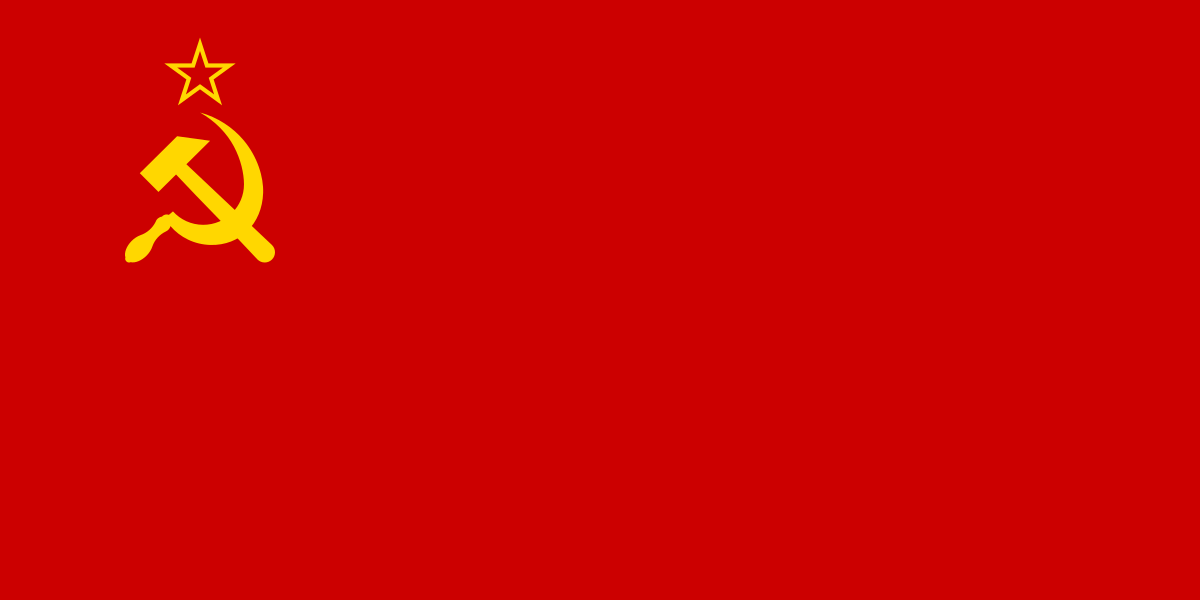
The Union of Soviet Socialist Republics USSR existed from to...
The Second Sino-Japanese War fought between China and Japan from...
Hong Kong is a densely populated special administrative region of...

The Chinese Civil War was a conflict between the Kuomintang...
Japan is an East Asian island country located in the...
Trending
3 days ago Microsoft Pivots AI Strategy to Prioritize Business Solutions Over Consumer Focus

4 hours ago Scott Speedman Discusses R.J. Decker Role and Beau Bridges Reunion

4 hours ago Jennifer Connelly Attends Louis Vuitton Spring 2027 Runway Show at the Louvre

5 hours ago Jennifer Hudson Discusses Her Divine Relationship and Future Marriage Plans With Common

5 hours ago Marvel's VisionQuest Series Details and Release Updates Emerge
5 hours ago Granit Xhaka Receives Probation Over Fake COVID-19 Vaccination Certificate
Popular

Ken Paxton is an American politician and lawyer serving as...

Cristiano Ronaldo widely considered one of the greatest footballers captains...

Elon Musk is a visionary entrepreneur and engineer known for...

Shakira Isabel Mebarak Ripoll the Queen of Latin Music is...

Jameis Winston is an American football quarterback currently playing for...

Michael Joseph Jackson the King of Pop was a highly...