


Erbil, also known as Hawler, is the capital and most populous city of the Kurdistan Region in Iraq and the capital of the Erbil Governorate. It serves as the cultural, economic, industrial, educational, and medical center for the region.
1970: Establishment of the Iraqi Kurdistan parliament in Erbil
In 1970, the parliament of the Iraqi Kurdistan was established in Erbil after negotiations between the Iraqi government and the Kurdistan Democratic Party (KDP) led by Mustafa Barzani.


1975: Amar-Sin sacked Urbilum
Around 1975 BC, the Neo-Sumerian ruler of Ur, Amar-Sin, sacked Urbilum in his second year.
1991: Kurdish uprising at the end of the Gulf War
At the end of the 1991 Gulf War, the Kurdish uprising effectively ended Saddam Hussein's control over the Iraqi Kurdistan parliament in Erbil.
November 1993: Opening of first two Turkmen schools in Iraq
On 17 November 1993, Iraq's first two Turkmen schools were opened, one in Erbil and the other in Kifri.
March 1996: KDP captured Erbil with Iraqi government assistance
In March 1996, the KDP captured Erbil with the assistance of Saddam Hussein's Iraqi government after claiming that PUK asked for Iran's help to fight KDP, leading to the establishment of an alternative Kurdish government in Sulaimaniyah by the PUK.
1997: Reconvening of the Kurdish Parliament
In 1997, the Kurdish Parliament in Erbil reconvened after a peace agreement was signed between the Kurdish parties, but had no real power.
April 2003: Celebrations after the fall of the Ba'ath regime
On April 10, 2003, Erbil was the scene of celebrations after the fall of the Ba'ath regime.
2003: Influx of refugees in Erbil
Since 2003, a large number of refugees had settled in the Erbil metropolitan area. In 2020, it was estimated that 450,000 refugees had settled in the Erbil metropolitan area since 2003.
February 2004: Bomb attacks against Eid celebrations
In February 2004, parallel bomb attacks against Eid celebrations in Erbil killed 117 people; responsibility was claimed by Ansar al-Sunnah.
May 2005: Suicide bombing outside a police recruiting centre
In May 2005, a suicide bombing outside a police recruiting centre in Erbil killed 60 civilians and injured 150 more.
2005: Erbil International Airport opened
In 2005, the Erbil International Airport opened in the city.
2006: Excavation conducted by Karel Novacek
In 2006, a small excavation was conducted by Karel Novacek of the University of West Bohemia, finding pottery shards from various periods.
2006: Relocation of Turkmen from Erbil Citadel
Until 2006, Turkmens were living in the Tophane, Tekke and Saray neighborhoods of the Erbil Citadel. In 2006, the citadel was emptied, and the Turkmen in the citadel were relocated to other neighbourhoods.
2007: Erbil Master Plan Development
Between 2007 and 2009, the General Directorate of Urban Planning (GDUP) in the Ministry of Municipalities and Tourism (MoMT) developed the Erbil Master Plan.
2007: Establishment of the High Commission for Erbil Citadel Revitalization
In 2007, the High Commission for Erbil Citadel Revitalization (HCECR) was established to oversee the restoration of the citadel, and all inhabitants, except one family, were evicted as part of a large restoration project.
2009: Erbil Master Plan Development
Between 2007 and 2009, the General Directorate of Urban Planning (GDUP) in the Ministry of Municipalities and Tourism (MoMT) developed the Erbil Master Plan.
2012: Erbil Plain Archaeological Survey began
In 2012, the Erbil Plain Archaeological Survey began, combining satellite imagery and fieldwork to study the plain's development and archaeology.
September 2013: Quintuple car bombing
In September 2013, a quintuple car bombing in Erbil killed six people.
2013: Ground penetrating radar work on the citadel
In 2013, a team from the Sapienza University of Rome conducted ground penetrating radar work on the center of the citadel.
June 2014: Erbil citadel inscribed on the World Heritage List
On 21 June 2014, Erbil citadel has been inscribed on the World Heritage List.
July 2014: Citadel of Erbil inscribed as a World Heritage Site
In July 2014, the Citadel of Erbil was inscribed as a World Heritage Site.
2014: New bus terminal opened
In 2014, a new bus terminal was opened in Erbil.
2014: Iraqi-led excavation began on a citadel location
Starting in 2014, an Iraqi-led excavation began on a citadel location, prompted by the collapse of a modern building. Historical aerial photographs and ground survey also began on the lower city.
2015: Assyrian Church of the East moved its seat to Erbil
In 2015, the Assyrian Church of the East moved its seat from Chicago to Erbil.
September 2017: Closure of Erbil International Airport to international commercial flights
In September 2017, Erbil International Airport was briefly closed to international commercial flights by the Iraqi government in retaliation for the Kurdish independence vote.
March 2018: Reopening of Erbil International Airport
In March 2018, Erbil International Airport reopened after being closed to international commercial flights in September 2017.
2020: Refugee population estimate
In 2020, it was estimated that 450,000 refugees had settled in the Erbil metropolitan area since 2003.
February 2021: Missile attacks in Erbil
In February 2021, a series of missiles hit Erbil, killing two and injuring eight people.
December 2021: Flash floods in Erbil
On 17 December 2021, a downpour caused flash floods in the Erbil area, resulting in 14 deaths.
March 2022: Further missile attacks in Erbil
In March 2022, further missile attacks took place in Erbil.
October 2024: JICA's final proposal for the updated plan
JICA delivered its final proposal for the updated Erbil Master Plan in October 2024.
October 2025: Inauguration of Erbil Green Belt Project
On 30 October 2025, the Erbil Green Belt Project was officially inaugurated by KRG Prime Minister Masrour Barzani.
2050: Erbil Master Plan Target
The Erbil Green Belt Project is part of the broader Erbil Master Plan, which aims to guide the development and reorganization of Erbil city until 2050 in cooperation with the Japan International Cooperation Agency (JICA).
2050: Planning Horizon
To address rapid urban sprawl and population increase, the GDUP partnered with the Japan International Cooperation Agency (JICA) to develop a new approach with a planning horizon extending to 2050.
Mentioned in this timeline
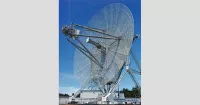
Radar Radio Detection and Ranging is a detection system that...
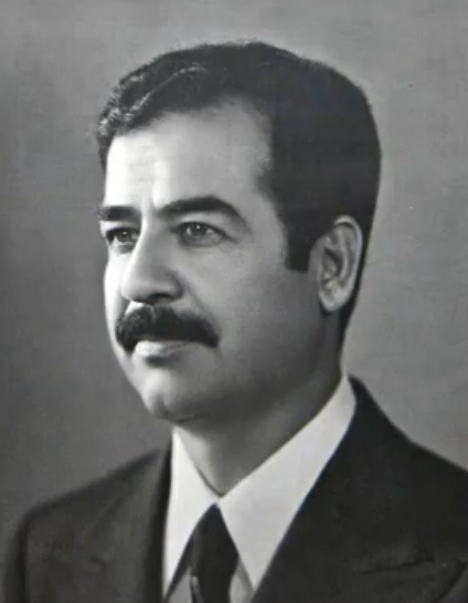
Saddam Hussein was the fifth president of Iraq from to...
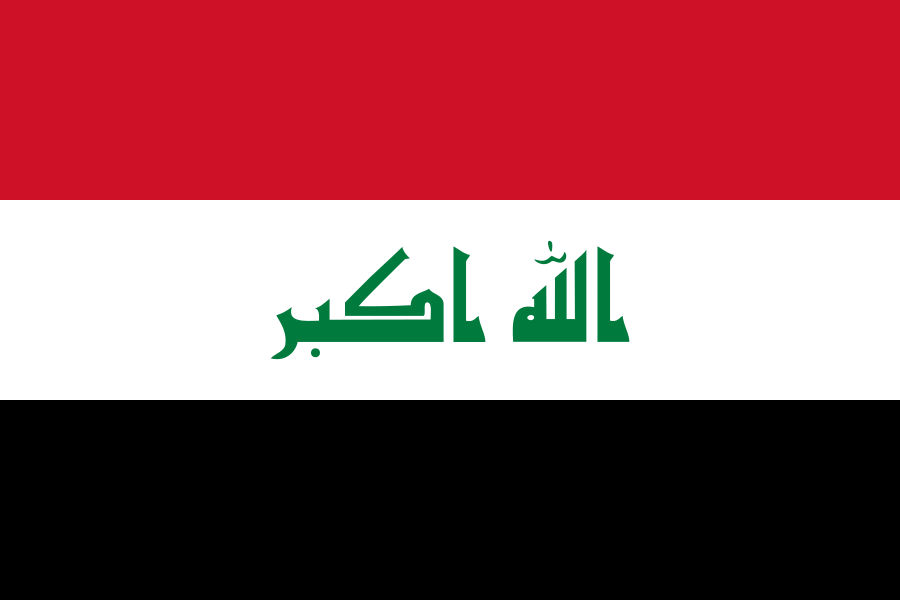
Iraq officially the Republic of Iraq is a country in...
Syria officially the Syrian Arab Republic is a West Asian...
Japan is an East Asian island country located in the...
Iran formerly known as Persia is a sovereign state in...
Trending
3 hours ago Jaylen Waddle Fantasy Football Outlook and Week 6 Trade Value Analysis
3 hours ago Trump Publicly Criticizes Karl Rove and John Cornyn Over Texas Senate Race Support
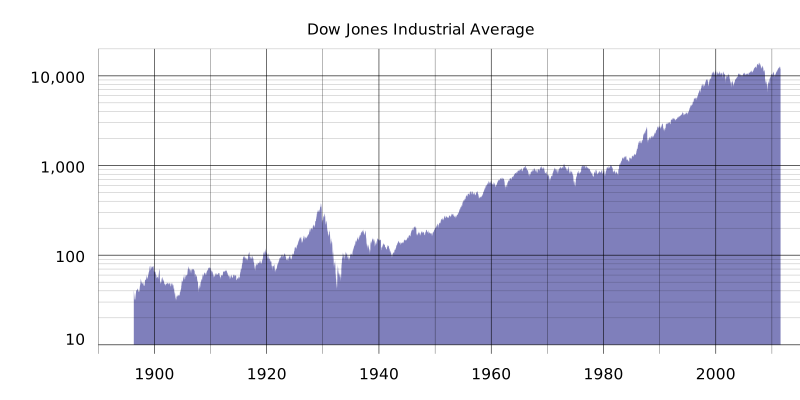
3 hours ago Dow Jones Industrial Average Rises Over 500 Points Amid Changing Investor Strategy

4 hours ago LIV Golf Players Face Backlash Seeking DP World Tour Return Amid Future Uncertainty
4 hours ago Experts Warn Byron Donalds' Energy Plan May Increase Florida Electric Bills

5 hours ago 49ers Open Practice Window for Wide Receiver Christian Kirk
Popular

Ilhan Omar is a prominent American politician currently serving as...

Ken Paxton is an American politician and lawyer serving as...

Jameis Winston is an American football quarterback currently playing for...

Michael Joseph Jackson the King of Pop was a highly...

Elon Musk is a visionary entrepreneur and engineer known for...

Cristiano Ronaldo widely considered one of the greatest footballers captains...